France's Riots: 550,000 Protesters, Competing Agendas
ArtTrak | October 21, 2026
The estimated 550,000 demonstrators who took to France's streets on October 17 did not represent a unified political movement. They included labor unions, students, farmers, environmentalists, political activists and ordinary citizens, many with competing demands. Regardless of your politics it is important to understand not only how complex this problem is but to also appreciate the gravity of the situation. France is in deep trouble. And this intensity may spread to other parts of Europe
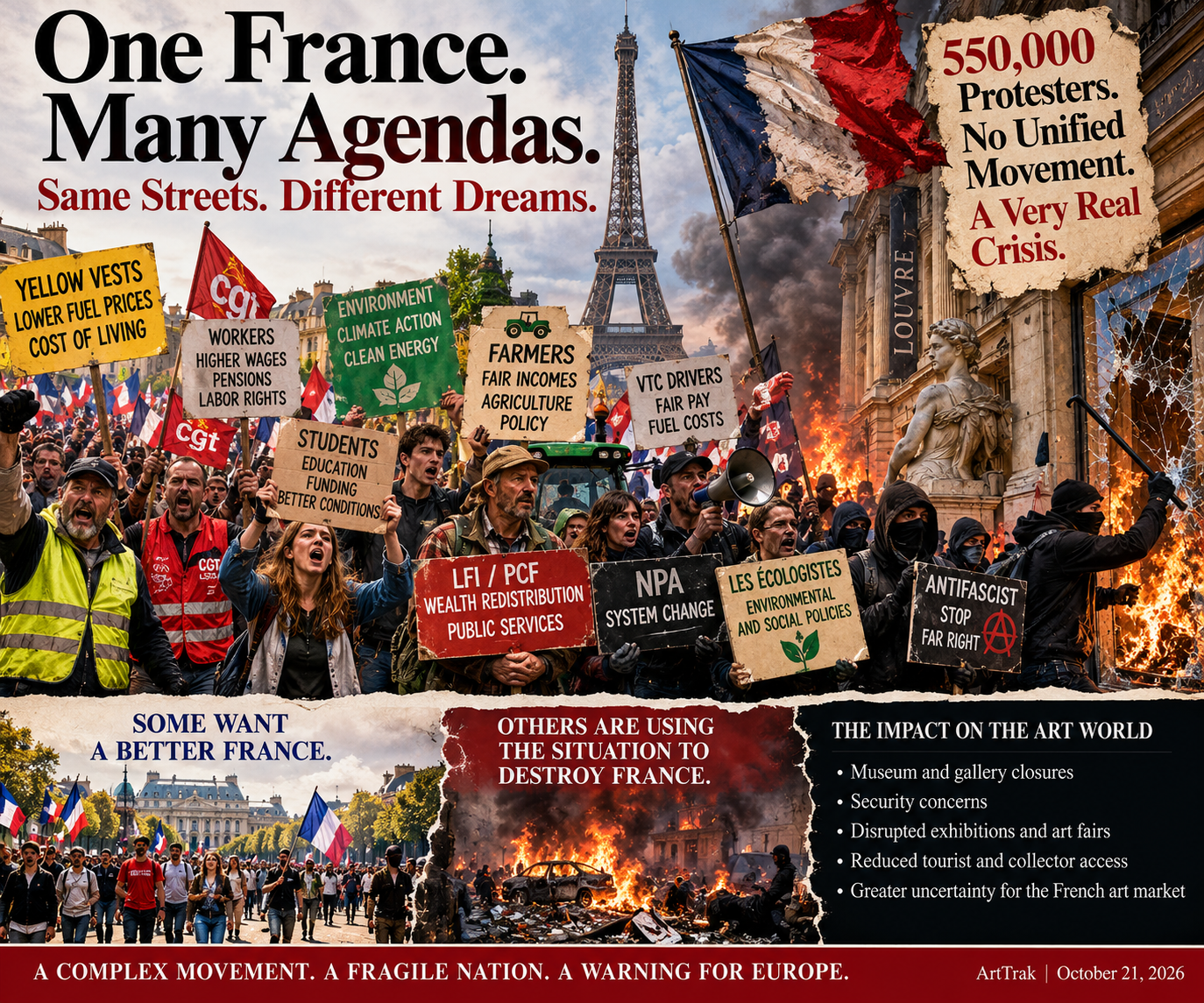
Who Was in the Streets?
Yellow Vests (Gilets jaunes) - Fuel prices, taxation, cost of living
Bloquons tout - Economic grievances, government opposition
CGT and Solidaires unions - Wages, pensions, labor protections
Confédération paysanne - Farm incomes, agricultural policy
VTC driver unions - Earnings, fuel costs, working conditions
Student unions (USL, Union étudiante, FAGE) - Education funding, student living costs
Climate and environmental groups - Climate policy, environmental regulation
La France insoumise (LFI) - Wealth redistribution, public spending
French Communist Party (PCF) - Workers' rights, social services
New Anticapitalist Party (NPA) - Fundamental economic change
Les Écologistes - Environmental and social policies
Antifascist groups - Opposition to far-right politics
These organizations were reported as participants or supporters at varying levels; not all officially endorsed the national demonstrations.
The Problem: Agreement on Protest, Not Solutions
The coalition contains significant contradictions. Farmers demand economic protection while environmentalists advocate additional regulation. Workers want higher wages and public spending while others oppose taxation. Yellow Vest protesters seek cheaper fuel while climate activists support reducing fossil-fuel dependence.
Some participants want government reforms; others want fundamental political and economic change.
Most demonstrators participated peacefully. Violent activists and opportunistic looters were also present, but their actions should not be attributed to the entire movement.
Understand some protestors want a better France while others are simply using the situation to destroy France.
Impact on France's Art Community
For museums and galleries, the immediate consequences include security concerns, interrupted exhibitions, reduced visitor access and uncertainty surrounding international art fairs.
France's cultural sector depends on tourism, public funding and international collectors. Continued unrest threatens all three, regardless of whether museums or galleries are directly attacked.
ArtTrak Assessment
The central contradiction is simple: 550,000 people can agree that something is wrong without agreeing on what should replace it.
France faces overlapping economic, social and political disputes rather than a single protest movement. Without common leadership or achievable shared demands, negotiating a lasting settlement becomes exceptionally difficult.
For the French art market, that uncertainty may prove more damaging than the immediate disruption.
Sources: Le Monde, Euronews and Reuters, October 2026. The participation figure is an estimate, not an organization-by-organization count.