Hawaii At The British Museum
Exhibition shines new light on Hawai'i's history, artistry and enduring relationship with the United Kingdom
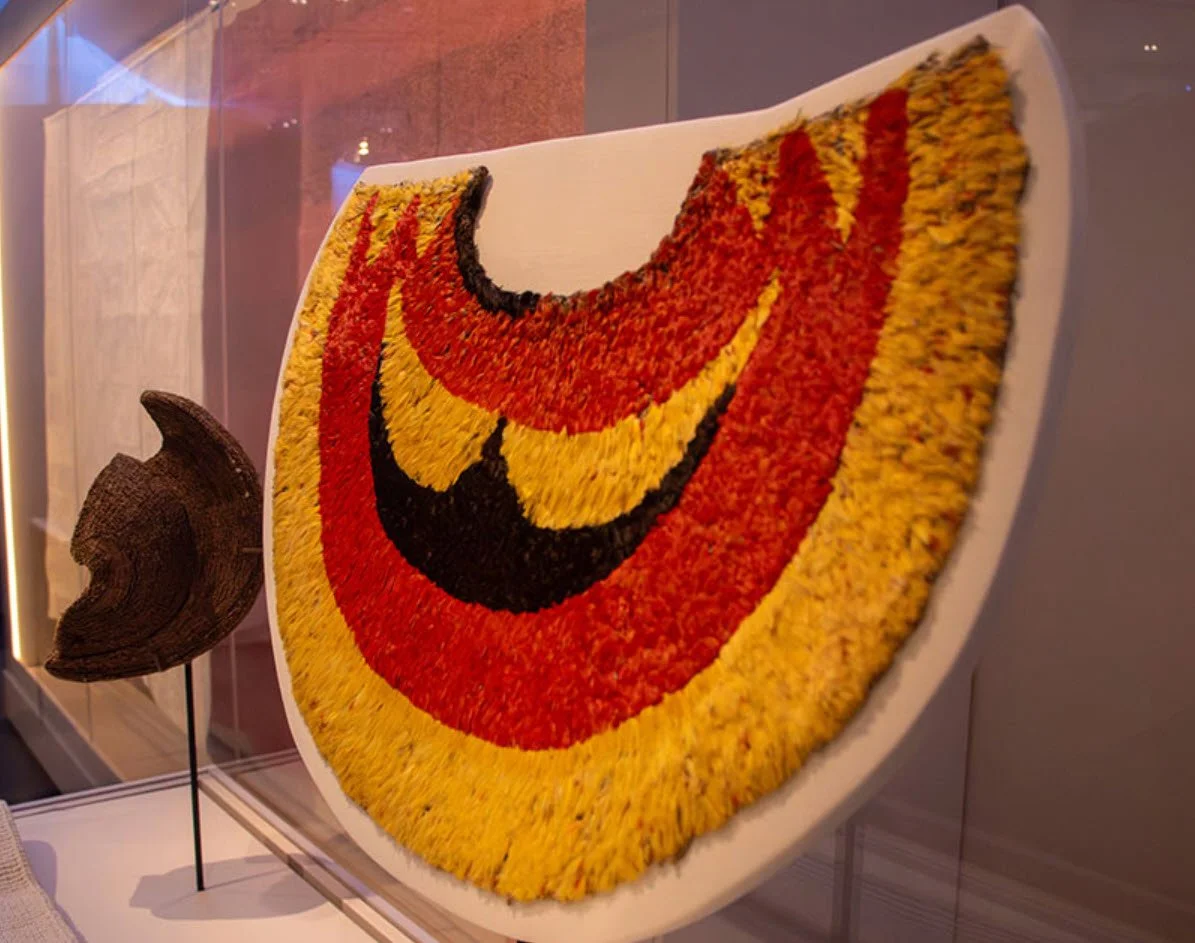
Feathered ‘ahu ‘ula (cape) © The Trustees of the British Museum, Photo by MKH.
LONDON.- A bold new exhibition at the British Museum examines the compelling history of Hawaiʻi and its long-standing ties with the United Kingdom. Hawaiʻi: a kingdom crossing oceans is a dazzling celebration of the rich artistry of Hawaiian makers, past present and future, the global journeys of Hawaiian royals and leaders, and the enduring resonance of their story in today's world.
The exhibition commemorates 200 years since a series of events including the visit of Hawaiian King Liholiho (Kamehameha II) and Queen Kamāmalu to London with a royal delegation to seek alliance and protection from the Crown. This journey to the capital included a visit to the British Museum – the first record of Native Hawaiian aliʻi (chiefs and royals) at the Museum. Building from this moment, which marked a turning point in the shared history of the kingdoms of Hawaiʻi and the United Kingdom, the exhibition tells a compelling story of movement, allyship and cultural exchange.
Settled around AD 1000 by skilled Polynesian seafarers navigating by the stars and following the flight of migratory birds, the Hawaiian archipelago is often remembered in the UK as the place where Captain James Cook lost his life during a voyage of exploration in the islands in 1778–79. Hawaiʻi: a kingdom crossing oceans acknowledges this moment while focusing on movements, stories and voyages initiated from Hawaiʻi itself. Shaped together with Native Hawaiian knowledge-bearers, the exhibition introduces audiences to a remarkable and seldom-seen collection of early Hawaiian treasures combined with striking contemporary works, tracing the journeys that brought these works to London and reflecting on their continued meaning for the people of Hawaiʻi today.
The exhibition will feature around 150 extraordinary objects and artworks including many never seen in the UK. Among the highlights is a magnificent ʻahu ʻula (feathered cloak) sent in 1810 by the first king of unified Hawaiʻi, Kamehameha I, to King George III, the largest known example of its kind. Lent by His Majesty The King from the Royal Collection, the cloak will be on display for the first time in over 100 years, alongside the Hawaiian king's original letter requesting support and protection from the British Crown.
Opening the space and greeting the visitors on the stairs of the Great Court is a powerful, nine-foot kiʻi (image) of the god Kū, the god of warfare and governance, dressed with a contemporary loincloth and standing atop a pole rediscovered inside a historical plinth ahead of the exhibition. A finely carved drum accompanied by an ancient chant recounting early Polynesian migrations to Hawaiʻi pulls the visitors into the gallery. Inside, a stunning bowl with figure, recently returned from loan to Hawaiʻi's Bernice Pauahi Bishop Museum, embodies the continued movements of people and objects between the Pacific and the United Kingdom, while the Anglo-Franco proclamation of 1843, on loan from The National Archives, highlights the UK and France's formal recognition of Hawaiʻi's independence and emphasises diplomatic bonds between these nations.
The making of Hawaiʻi: a kingdom crossing oceans is grounded in a renewed curatorial approach developed with Native Hawaiian knowledge-bearers. A co-stewarded process, the creation of the exhibition involved community partners in a holistic manner, from the shaping of the narrative to the design of the gallery, the meticulous conservation of ancestral treasures and the inclusion of ʻōlelo Hawaiʻi (Hawaiian language) throughout the space.
Building from years of collaborations through the Benioff Oceania Programme (2020-2024), the show highlights a commitment to transforming and humanising museum practice – a dimension that is made palpable through a trail of content that 'breaks the fourth wall' to offer visitors a glimpse into this collective process. As objects, people and voices gather in the space, the gallery becomes a meeting ground, bringing agency and purpose into view and showing how the stories on display were shaped – stories as relevant today as they were two centuries ago.
Quotes
Dr Alice Christophe, Curator and Head of Oceania at the British Museum said: 'This co-stewarded exhibition is a tribute to Native Hawaiian makers, past and present. At its core, it tells the story of the deep and layered relationship between Hawaiʻi and the United Kingdom, reflecting on care, sovereignty and the complexity of allyship. We hope this show will spark conversations and uplift people in the archipelago and beyond.'
################################
13. Beverly Buchanan's vision of belonging https://artdaily.cc/news/189781/New-exhibitions-explore-Beverly-Buchanan-s-vision-of-belonging
ATHENS, GA.- What makes a place feel like home? The Athenaeum and the Georgia Museum of Art, both at the University of Georgia, are exploring this question through joint exhibitions on the work of Beverly Buchanan. “Shacks, Stories and Spirit: Beverly Buchanan’s Art of Home” will be on view at the Georgia Museum January 3 to June 28, 2026. “Beverly’s Athens” will be on view at the Athenaeum, the university’s non-collecting contemporary art venue, affiliated with its Lamar Dodd School of Art, January 16 to March 21, 2026.
Although known nationwide, Buchanan lived in Athens from 1987 to 2010, where she found inspiration in the everyday spaces around her. Using found materials, she built sculptural shacks and photographed humble dwellings across the region. Buchanan also made vibrant drawings that brought these places to life. Through her work, Buchanan argued that these overlooked structures mattered and held stories worth preserving.
“Beverly Buchanan’s art speaks to the South in such an intimate, powerful way,” said Shawnya Harris, Larry D. and Brenda A. Thompson Curator of African American and African Diasporic Art. “She lived here, she knew its landscapes, and she turned everyday materials into narratives of belonging.”
“Beverly’s Athens” is the first major solo exhibition of Buchanan’s work in the city. Guest curated by Mo Costello and Katz Tepper and funded through a grant from Teiger Foundation — a private foundation devoted exclusively to supporting contemporary art curators — it focuses on her the local and lived conditions that shaped her work in Athens. The exhibition emphasizes two intertwined threads from Buchanan’s Athens years: her modes of surviving chronic illness in the absence of an equitable healthcare system, and her multidisciplinary efforts to study and commemorate Black southern geography, traditions and forms.
“Shacks, Stories and Spirit” also focuses on resilience, specifically through the way Buchanan transformed weathered shacks into art.
“Buchanan’s ‘shacks’ hold layers of history and emotion, and the ‘spirit’ speaks to her belief in creativity as a form of survival,” Harris said. “I hope visitors feel that energy from works we have in the collection.”
Together, the exhibitions offer a comprehensive view of an important period in Buchanan’s career. Buchanan’s work is in collections at the Metropolitan Museum of Art, the Whitney Museum of American Art, the High Museum of Art and the Studio Museum in Harlem. She received fellowships from the Guggenheim Foundation and the National Endowment for the Arts and is recognized as a major voice in documenting African American life and Southern culture.