Louvre Theft - Restoration - Paris
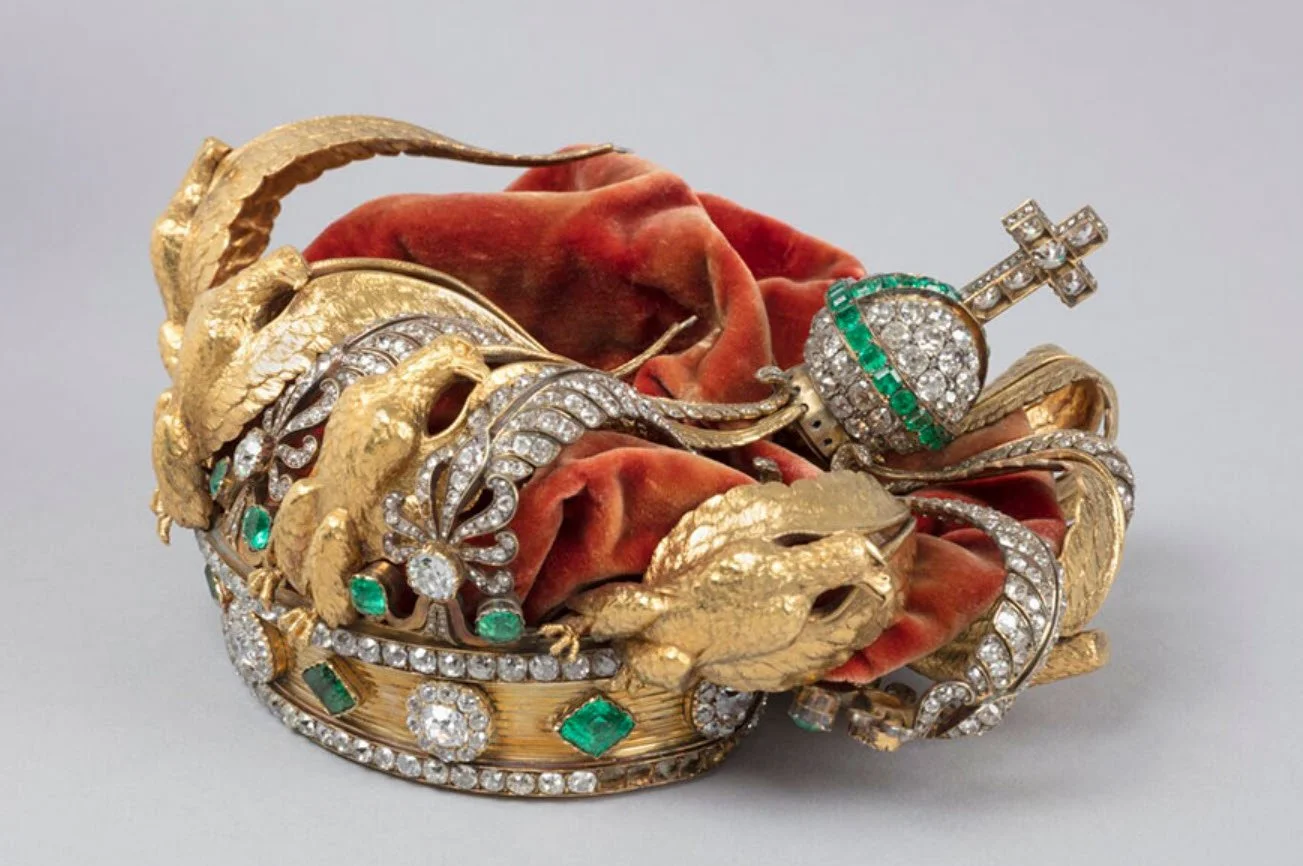
PARIS.- Months after a dramatic theft shook the Louvre, the historic crown of Empress Eugénie is on its way back to its former glory. The jewel, recovered after the October 19, 2025 break-in, survived the incident with most of its precious elements intact, allowing conservators to plan a full restoration rather than a reconstruction.
The crown was found at the foot of the Apollo Gallery, not far from the display case from which it had been forcibly removed. Investigators also recovered a decorative palmette nearby. Although the piece had been crushed and visibly deformed during the theft, experts quickly confirmed that nearly all of its original components remained present.
Damage significant, but restoration possible
PARIS.- After the police released the crown to the Louvre’s Department of Decorative Arts on October 20, 2025, museum officials carried out an initial condition assessment led by department director Olivier Gabet and deputy director Anne Dion.
Their findings revealed that the crown’s lightweight, flexible structure had warped under stress, likely when it was pulled through a narrow opening cut into the display case. This strain caused parts of the crown’s arches to separate, and one element was lost in the gallery. A subsequent impact appears to have crushed the structure further.
Despite this, the losses were surprisingly limited:
The crown originally featured eight diamond-and-emerald palmettes alternating with eight gold eagles; only one eagle is now missing.
All palmettes were recovered, though four had detached and some were bent.
The central diamond-and-emerald globe remains intact and still attached.
All 56 emeralds are still present.
Of the 1,354 diamonds, only about ten very small stones from the base are missing, while nine detached diamonds were recovered.
Because almost every element survives, specialists say the restoration will focus mainly on reshaping the crown’s framework, with no need to recreate missing parts.
Expert committee to guide the process
As with any object in France’s national collections, the restoration will be entrusted to an accredited conservator selected through a competitive process in line with heritage and museum regulations. More detailed technical assessments will follow.
Given the symbolic importance of the crown—and the unusual circumstances of its recovery—the Louvre is also assembling an advisory committee of experts to support the restoration.
The committee, chaired by Louvre President-Director Laurence des Cars, will include museum specialists, a jewelry historian, a Second Empire decorative arts curator from the Musée d’Orsay, a mineralogist from the National Museum of Natural History, and a metals conservation specialist from the C2RMF.
Representatives from five historic French jewelry houses—Mellerio, Chaumet, Cartier, Boucheron, and Van Cleef & Arpels—will also be invited to contribute their expertise. Each house had already expressed its willingness to help restore the emblematic jewel shortly after news of the theft and recovery emerged.
A crown shaped by imperial history
The crown itself dates back to the reign of Napoleon III. It was commissioned for the 1855 Universal Exposition, when the emperor tasked his official jeweler, Alexandre Gabriel Lemonnier, with creating matching crowns for both the emperor and the empress.
The project brought together several notable craftsmen, including sculptor Gilbert, believed to have designed the long-winged eagles forming the crown’s arches, and jeweler Pierre Maheu, who oversaw workshop production. The arrangement of the precious stones was determined by Devin, inspector of the Crown Diamonds.
At the time, observers described Eugénie’s crown as lighter and more elegant than the emperor’s, while still suitably ceremonial.
After the fall of the Second Empire, the crown’s fate took a different path from many other imperial jewels. Returned to Eugénie in 1875 as part of compensation arrangements, it escaped the destruction that befell the emperor’s crown during the 1887 sale of the Crown Diamonds ordered by the Third Republic.
The empress later bequeathed it to Princess Marie-Clotilde Napoléon, Countess of Witt, in 1920. The Louvre acquired the crown in 1988, ensuring its preservation in the national collections.
Although Eugénie was never formally crowned and may never have worn it, the piece holds exceptional historical value. Alongside the crown of Louis XV and the so-called Charlemagne crown made for Napoleon I’s coronation, it remains one of the very few sovereign crowns preserved in France.
A symbol returning to the gallery
For the Louvre, the restoration represents more than technical conservation—it marks the recovery of a powerful symbol of French history and craftsmanship. Once the work is complete, the crown is expected to return to public view, restored not only in form but also in its role as a centerpiece of the Apollo Gallery.