Mystery In Pre-Columbian Peru - Xmas 2025
Thousands of Mysterious Holes Dot the Landscape in Peru. Archaeologists Say They May Finally Know Why
New research suggests the Band of Holes functioned as a barter marketplace before becoming an accounting system for the Inca
Sarah Kuta - Daily Correspondent
November 18, 2025
Researchers used drones to capture high-resolution aerial imagery of the Band of Holes. Jacob Bongers
For decades, archaeologists have been perplexed by thousands of mysterious dimples dotting the landscape in southern Peru. Known as the “Band of Holes,” the depressions are arranged in a long, slender grid pattern and appear to have been dug methodically and deliberately.
Some onlookers have proposed outlandish explanations, theorizing that “ancient astronauts” must have made the holes, according to National Geographic’s Tom Metcalfe. Others have proposed more mundane, human-centric explanations, suggesting they were used for defense, gardening or collecting water.
Now, researchers have come up with another explanation for the perplexing phenomenon, which they outline in a paper published November 10 in the journal Antiquity. Archaeologists suspect the holes were made roughly 1,000 years ago and used by the Chincha people as a central gathering place for exchanging food and goods. Then, when the Inca Empire conquered the Chincha roughly 400 years later, they took over the site and used it to collect tributes from local groups.
The 5,200 holes are between three and six feet wide. Charles Stanish
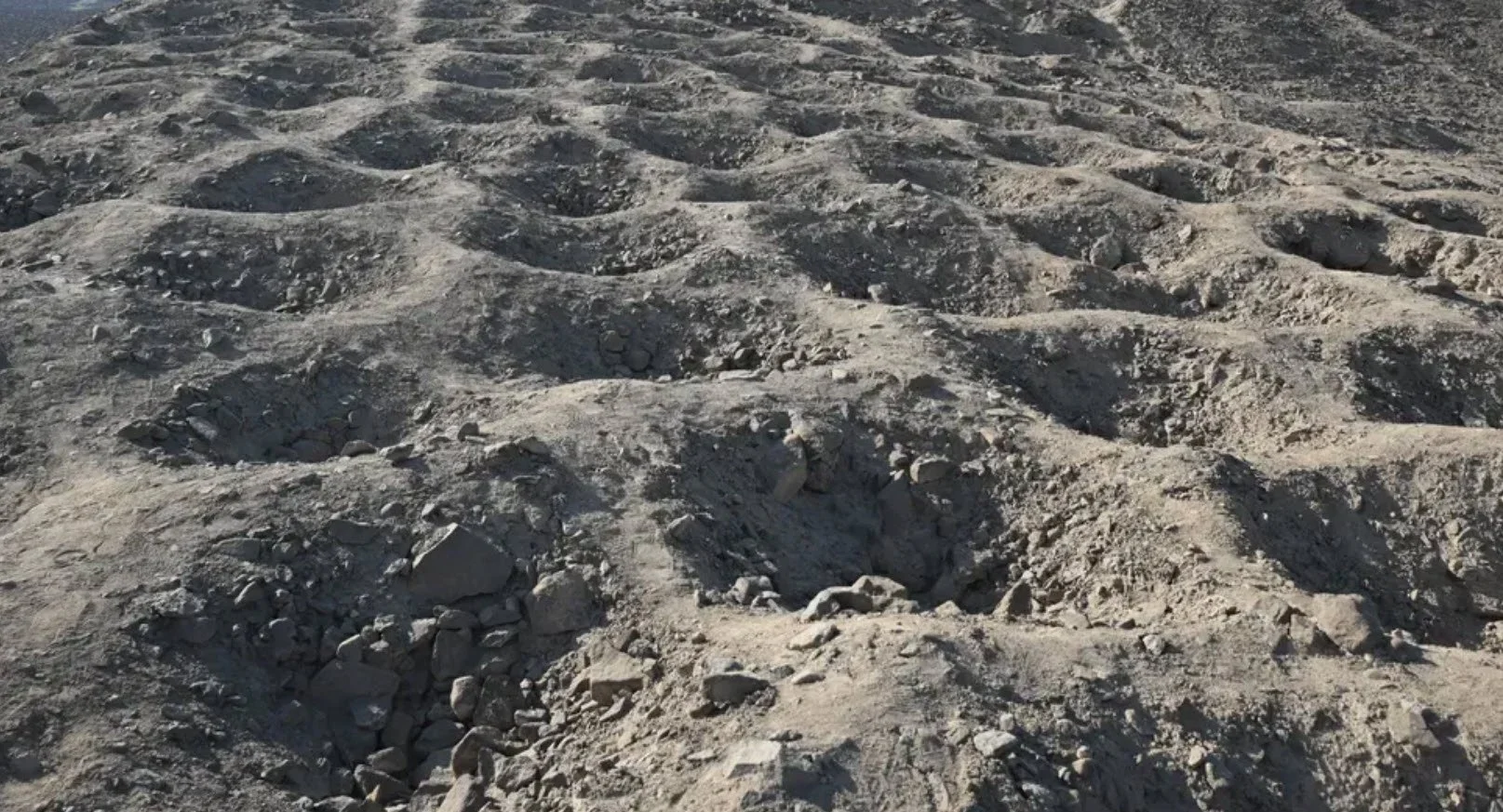
The Band of Holes, also known as Monte Sierpe, is located roughly 20 miles east of the city of Pisco in the foothills of the Andes. The formation, which spans nearly a mile, features around 5,200 holes that are between three and six feet wide and up to three feet deep.
Geologist Robert Shippee and Navy Lieutenant George R. Johnson are credited with discovering the Band of Holes in 1931 during an aerial photography expedition in Peru. Two years later, National Geographic published their photographs of the unusual shapes, raising broader awareness of their existence and sparking curiosity about their origins.
Researchers recently decided to revisit the mystery by gathering sediment samples and taking high-resolution overhead photographs of the site.
When they analyzed the samples, they found pollen from at least 27 different plants, including crops like maize and sweet potato, as well as a wild grass known as bulrush that the Chincha people used to make baskets. It’s unlikely that the pollen was carried to the site by the wind, which suggests that humans may have transported the plants there.
Archaeologists think local groups may have first lined the holes with plant matter before placing various types of goods inside of them. They may have used bulrush baskets to carry the goods to the site, which functioned as a barter marketplace.
In the new study, archaeologists analyzed sediment samples from the site. Jacob Bongers
“Large numbers of people depositing goods in the holes could have been a way of publicly displaying information about the quantity of goods available, as well as the quantity of goods required for a fair exchange,” says lead author Jacob Bongers, an archaeologist at the University of Sydney in Australia, to National Geographic. “For example, a certain number of holes containing maize would have been equivalent to a certain number of holes containing another type of good, such as cotton or coca.”
The overhead imagery, captured by drones, helped researchers investigate the arrangement of the dimples. The imagery revealed that the slender, snake-like structure is made up of more than 60 sections separated by strips of land. The blocks contain varying numbers of rows and holes.
“There are these interesting mathematical patterns,” Bongers tells New Scientist’s Chris Simms. “You have some [sections with] multiple rows of eight holes, and then you have other sections that have alternating counts. Eight holes, then seven, then eight and seven, then eight. It hints that there was some sort of intention behind it.”
The researchers realized the dimples looked like Inca record-keeping devices known as quipus. This led them to theorize the Band of Holes may have later functioned as a large-scale accounting device for keeping track of tributes from different groups.