War Stories from the Road
Appraising Lucy: When $50 Million Wasn’t Enough
In 2007, I was asked to work on an exhibition at the Houston Museum of Natural Science entitled Lucy’s Legacy: The Hidden Treasures of Ethiopia. My original assignment was straightforward enough: appraise the objects in the exhibition for insurance purposes.
Then, in early spring, the Ethiopian government cancelled the loan of nearly 200 objects. The museum suddenly had an exhibition with a very large hole in it. They came back to me with a somewhat different request: Could I not only appraise the exhibition, but find the objects for it?
I agreed.
So, I got in the car. I started at the Harn Museum in Florida and worked my way up the East Coast, eventually ending at the Peabody Essex Museum in Salem, Massachusetts. Between museums, collections, telephone calls, and negotiations, we assembled roughly 200 objects to fill out the exhibition.
I appraised them. The exhibition was coming together. I thought my job was finished.
It wasn’t.
The museum had one final request.
“We need you to appraise Lucy.”
The centerpiece of the exhibition was going to be Lucy, the famous Australopithecus afarensis fossil discovered in Ethiopia in 1974. She needed an insurance value.
Would I appraise her? Of course I said yes. There was only one small problem:
I had never appraised a hominid fossil in my life.
But the International Society of Appraisers had taught me something considerably more useful than knowing the market for every conceivable type of property. It had taught me appraisal methodology.
I didn’t necessarily have to know everything about Lucy. I needed to know how to identify the appropriate market, find qualified specialists, locate meaningful comparables, analyze the differences, and develop a supportable value. And I knew somebody who knew Lucy.
Calling Don Johanson
Years earlier, I had met Don Johanson, Lucy’s discoverer, and had helped raise money in Dallas for his work.
Don was—and remains—a good guy. Somewhere along the way, we even managed to double-date. Don’s date was Morgan Fairchild. Mine has been lost completely to history. I do remember that we went to see a play starring Mel Tillis, a good friend of Fairchild’s.
So, I called Don. He graciously listened to what I was trying to do and then essentially told me:
“No way.”
He wasn’t going anywhere near the valuation of Lucy. He hoped to continue working in East Africa and had no desire to step into what was potentially a political minefield.
In retrospect, Don understood something that I didn’t.
But fortunately, he gave me some leads.
How Do You Value Something That Cannot Be Replaced?
I began calling people around the world—specialists familiar with early human remains, fossils, and important scientific specimens. I spoke with experts in the United States, the United Kingdom, Kenya, and elsewhere.
The fundamental appraisal problem was obvious.
There was no comparable Lucy.
You couldn’t open an auction database and search for recent sales of Australopithecus afarensis skeletons of comparable completeness, scientific importance, and cultural significance. So, I started looking for transactions involving other extraordinarily important fossils.
Eventually, I found the comparable that gave me a framework: Sue, the famous Tyrannosaurus rex discovered in South Dakota and acquired by Chicago’s Field Museum after a highly publicized Sotheby’s auction.
It wasn’t another hominid. It wasn’t Ethiopian. And, scientifically, it wasn’t directly comparable to Lucy.
But from an appraisal standpoint, it offered something extremely useful: an actual market transaction involving an exceptionally famous, scientifically important, and essentially irreplaceable fossil specimen. That gave me a starting point.
I analyzed Lucy’s scientific significance, rarity, completeness, international recognition, and extraordinary cultural importance. And I arrived at an insurance value:
$50 million.
I felt good about it. More importantly, I felt I could support it.
Then Came Opening Night
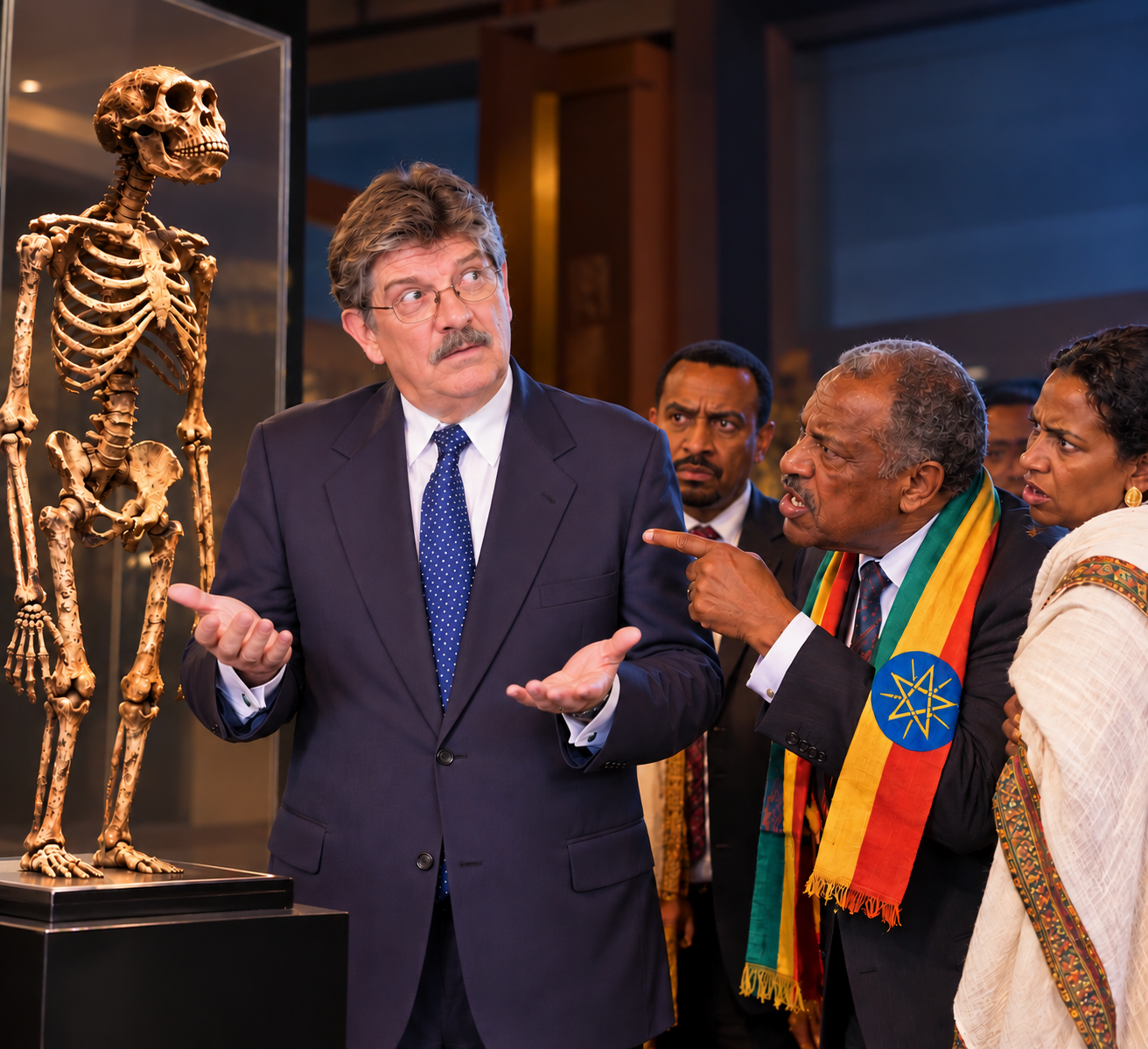
At the museum opening, someone quietly took me aside. There were Ethiopian government officials in attendance, and I was asked if I could please discreetly avoid them.
Why?
They had learned about my $50 million valuation.
And they were apoplectic.
I had spent all that time worrying about appraisal methodology, comparable transactions, scientific significance, rarity, and defensibility. The Ethiopians apparently had another comparable in mind:
Ethiopia.
From their perspective, Lucy wasn’t simply a fossil. She was a national treasure, an international symbol of Ethiopia, and one of the most famous physical links to humanity’s distant past. As far as they were concerned, $50 million wasn’t remotely enough.
The figure they apparently considered appropriate was closer to:
$500 million.
Ten times my appraisal.
And that was when I discovered an appraisal variable that I had somehow managed to overlook:
National pride.
There wasn’t a box for that on my appraisal worksheet.
The Lesson
Looking back, I still think the $50 million valuation was defensible within the methodology and market evidence I was using. But the experience taught me something more interesting than how to appraise a fossil.
Appraisers spend their careers trying to separate value from emotion. We look for markets, comparables, provenance, condition, rarity, and demonstrable demand. We try to replace enthusiasm with evidence. Usually, that works.
But occasionally, an object stops being merely an object.
It becomes history.
And once that happens, the question, “What is it worth?” may have several perfectly different answers, depending upon who is being asked.
I thought I had successfully appraised Lucy. The Ethiopians thought I had insulted her. Don Johanson, meanwhile, had wisely stayed out of the whole thing. Perhaps he was the best appraiser of us all.
Moral of the story: Happiness is fleeting when you know you’re right.
— War Stories From the Road