Museum Economics — The Basics
Catering to supporters with very different generational interests is challenging. But the reasons museums are struggling are, in part, surprisingly basic: the cost of maintaining the traditional museum has risen faster than its ability to attract audiences, generate revenue, and build the next generation of supporters. Museums must preserve the expectations of longtime patrons while competing for younger audiences whose choices, habits, and definitions of cultural experience have fundamentally changed. Brick-and-mortar museums are still struggling in 2026 because the economics of running a physical museum have deteriorated faster than attendance and earned income have recovered. This is especially difficult for institutions dependent on admissions, memberships, retail, restaurants, events, and private philanthropy.
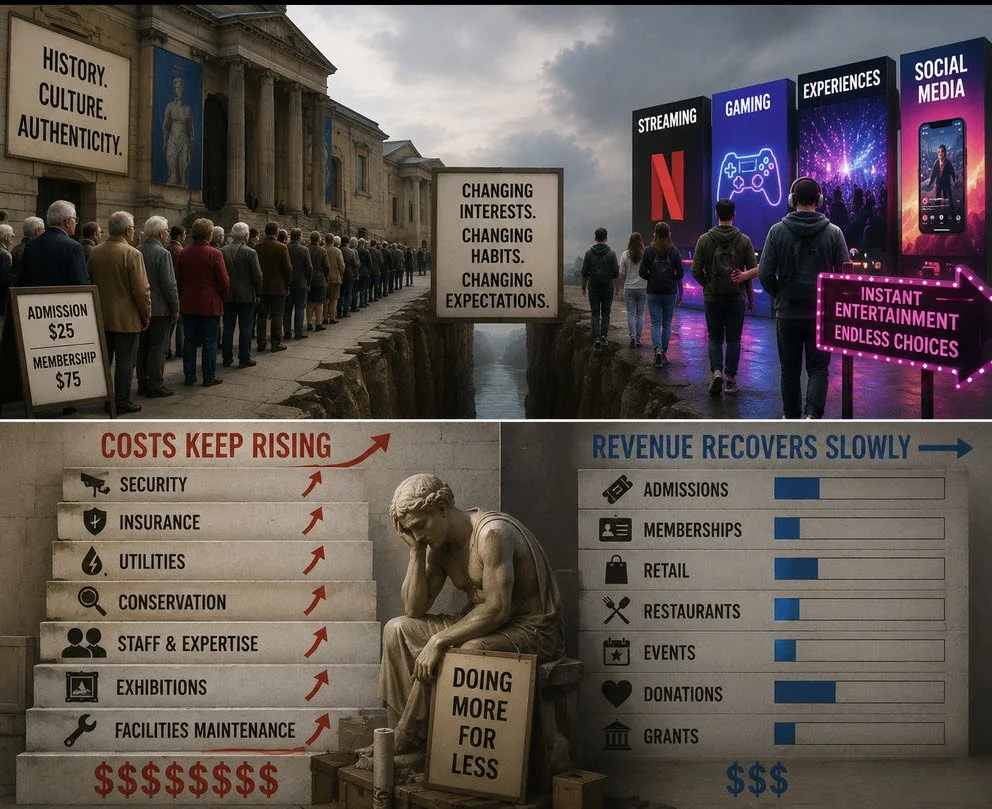
A useful way to think about it is that museums are caught between 20th-century infrastructure and 21st-century audiences.
The biggest pressures are:
Operating costs have risen sharply. Security, insurance, climate control, utilities, conservation, transportation, construction, and skilled labor are all expensive. Museums cannot simply cut temperature control or security the way another business might cut overhead.
Attendance has changed, not merely declined. Tourism has recovered in many major cities, but repeat local visitation and some older membership patterns have weakened. At the same time, blockbuster exhibitions have become extremely expensive to mount.
Younger audiences have enormous competition for their attention. A museum isn't just competing with another museum. It's competing with streaming, gaming, restaurants, concerts, travel, immersive entertainment, social media, and virtually unlimited cultural content available instantly on a phone.
The traditional membership model is aging. Boomers remain important donors and visitors, while museums face the challenge of turning Gen X, Millennials and Gen Z into equally committed members, patrons and eventually major donors.
Collections are expensive even when nobody is looking at them. A museum may display only a small fraction of its holdings while paying indefinitely for storage, cataloguing, conservation, insurance and research.
Government and philanthropic money is under pressure. Endowments help major institutions, but many small and mid-sized museums have little financial cushion. Donors also increasingly want measurable impact rather than simply underwriting institutional overhead.
Museums have accumulated additional missions. Education, community programming, digital access, accessibility, provenance research, repatriation work and public programming are worthwhile, but each adds personnel and expense without necessarily producing corresponding revenue.
Digital access creates a paradox. Museums need digital content to remain culturally relevant, yet excellent digital access can reduce the urgency of physically visiting. The challenge is making the physical object and museum experience something that cannot be replicated online.
The deeper problem
The old museum proposition was essentially:
“We possess extraordinary things. Come see them.”
That alone is becoming less powerful.
The emerging proposition has to be closer to:
“We possess extraordinary things—and we can give you an experience, knowledge and access that you cannot get anywhere else.”
That doesn't necessarily mean turning museums into amusement parks. In fact, their competitive advantage may be the opposite: authenticity. In a world saturated with AI-generated imagery, reproductions and instantaneous digital information, museums possess something increasingly unusual—the actual object.
That creates an interesting generational challenge for the meme you were developing:
BOOMER:The Object
GEN X:The Story
MILLENNIAL:The Experience
GEN Z:Why should I come?
The successful museum of the late 2020s probably has to answer all four questions simultaneously rather than choosing one generation over another.