Brass or Bronze?
The Material Reality and Evolution of West African Court Metalwork
The popular term "Benin Bronzes" is a historical misnomer. Metallurgical and scientific analyses have revealed that the vast majority of these objects are not actually made of bronze (an alloy of copper and tin), but rather brass (an alloy of copper and zinc) and leaded brass.
The Terminology: Bronze vs. Brass
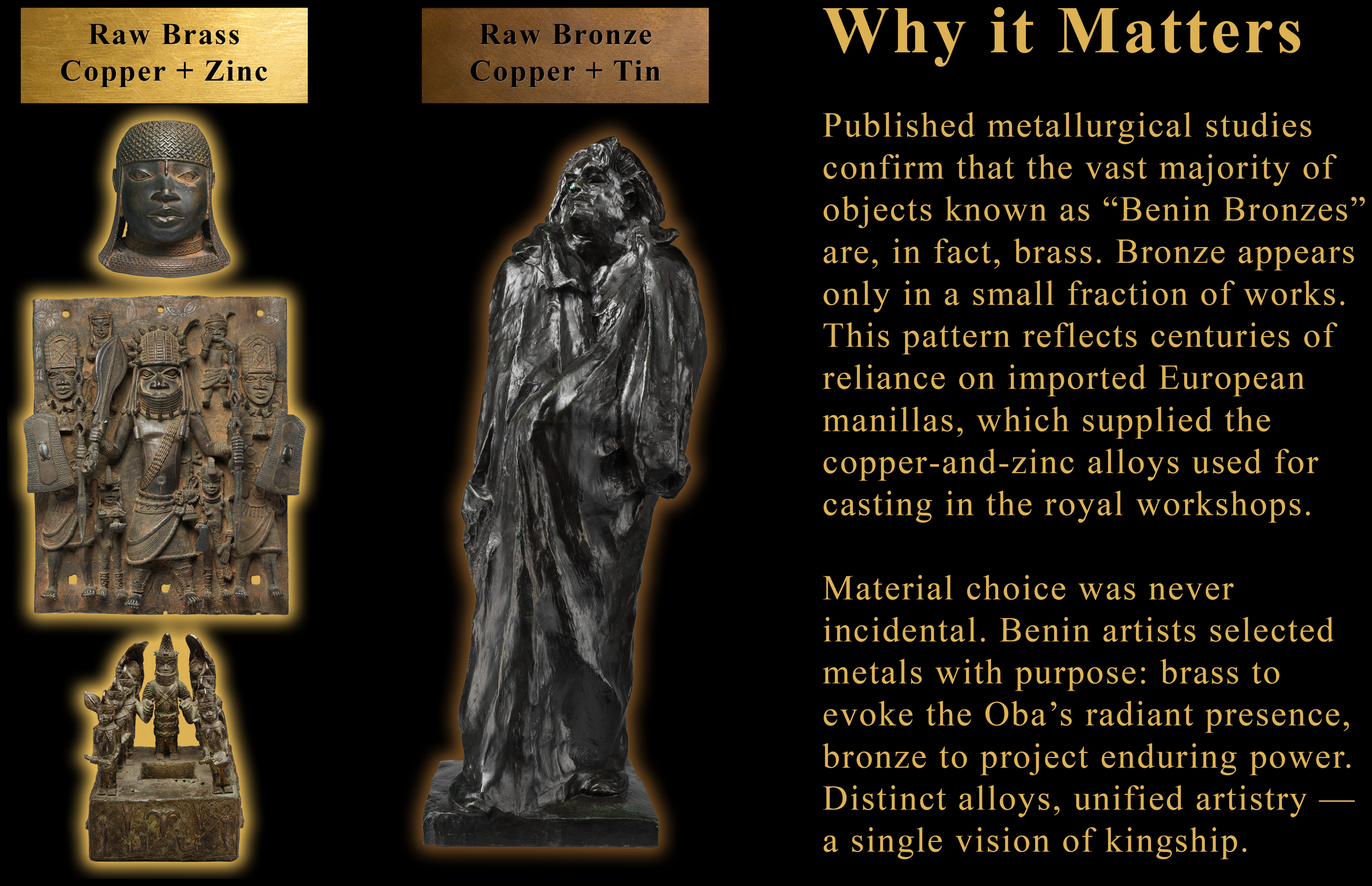
Why they are called "Bronzes": 19th-century European colonizers and early art historians broadly categorized all dark, heavy West African metal sculptures as "bronzes" out of a Eurocentric assumption that indigenous African cultures lacked the sophisticated metallurgy required to manufacture complex brass alloys.
What they actually are: Scientifically, the royal plaques, commemorative heads, and altarpieces commissioned by the Oba are primarily composed of brass, alloyed with zinc and often containing lead and tin.
The Evolution of the Metal Supply (15th Century Onward)
The composition of the metals changed over the centuries, driven heavily by international trade dynamics between the Kingdom of Benin and European merchants:
The Early Period (Late 15th to 16th Century)
The Portuguese Trade and "Manillas": Following the arrival of Portuguese traders in the late 1400s, a booming trade network was established. Europe exported vast quantities of manillas—horseshoe-shaped metal currency rings—to West Africa.
The German Connection: Advanced geochemical and lead-isotope tracking has shown that much of the brass used in early Benin masterpieces was originally smelted from calamine ores mined in Western Europe, specifically the Rhineland in Germany. These German manillas were melted down by the royal brass-casters guild (Igun-Eronmwon) in Benin City to create the first wave of exquisite court art.
The Middle Period (17th to 18th Century)
Recycling and Alloy Mixing: As master casters refined their techniques during peak artistic eras (such as the reigns of Esigie and Eresoyen), they rarely relied on raw imported metal alone. Instead, they practiced sophisticated recycling—combining incoming European trade brass with older scrap metals, copper, and intentional additions of lead and tin to achieve specific melting points and color patinas.
Shifting European Trade Partners: As Dutch, French, and British merchants successively dominated maritime trade routes into the Bight of Benin, the geographic origin of the imported metal bars and manillas diversified, slightly shifting the trace-element signatures embedded in the alloy recipes.
The Late Period (19th Century up to 1897)
Industrial British Influence: By the 19th century, British industrial manufacturing took total control of the export market, flooding West Africa with standardized brass rods and lower-grade metal goods.
Alloy Degradation: Metallurgical studies indicate that some late-period items show greater variance in purity compared to the tightly controlled, high-zinc brass compositions of the 16th-century "Golden Age" plaques.
The Earlier Precedent: The Metallurgical Legacy of Ife
Long before European trade routes flooded the Bight of Benin with industrial metals, the neighboring Yoruba kingdom of Ife (flourishing from the 12th to the 15th centuries) had already mastered hyper-realistic, highly sophisticated metal casting.
The Compositional Foundation: Early scientific evaluations of Ife’s naturalistic brass and copper heads reveal that Ife smiths utilized distinct mixed zinc and lead ores. Some Ife masterpieces were cast from nearly pure copper, while others utilized complex brass formulas that predated regular Atlantic maritime contact.
The Technological Bridge: As Benin's casting tradition matured, local artisans built upon earlier West African metallurgical knowledge. Geochemical data indicates that later Benin workshops occasionally remelted older regional scrap objects alongside incoming European trade brass, blending historical West African brass traditions with imported European materials.
Note: While the historical shift in West Africa from earlier regional practices to the massive output of the Kingdom of Benin was primarily driven by trade access (the sudden, abundant influx of European brass manillas), the physical properties of brass made it exceptionally well-suited for the hyper-detailed, thin-walled masterpieces produced by the royal guild (Igun-Eronmwon).
The technical advantages of brass over bronze include:
Lower Melting Point: Brass generally melts at a lower temperature (roughly 900°C to 930°C) compared to bronze (which often requires 950°C to 1,050°C+ depending on the tin content). This lower thermal threshold made it easier for traditional charcoal-fired furnaces to achieve and maintain the necessary fluidity using natural draft or bellows.
Superior Fluidity and Malleability: Brass is significantly more malleable and ductile than bronze. When molten, high-zinc brass flows more smoothly into complex molds. This fluidity was critical for achieving the extraordinary "uniformity of thinness" (often casting relief plaques down to just an eighth of an inch thick) without trapping air bubbles or causing premature freezing in intricate wax-carved details.
In short, while the artists did not abandon bronze because of a chemical aversion, the chemical reality of imported European trade brass offered superior fluidity, workability, and melting characteristics that allowed them to push the limits of sculptural finesse far beyond what raw local copper or stiff tin-bronze would easily allow.