Repatriation 2026
The repatriation landscape across U.S. museums and federal collections continues to accelerate, driven by tightened regulatory frameworks, aggressive federal oversight, and ongoing voluntary institutional audits
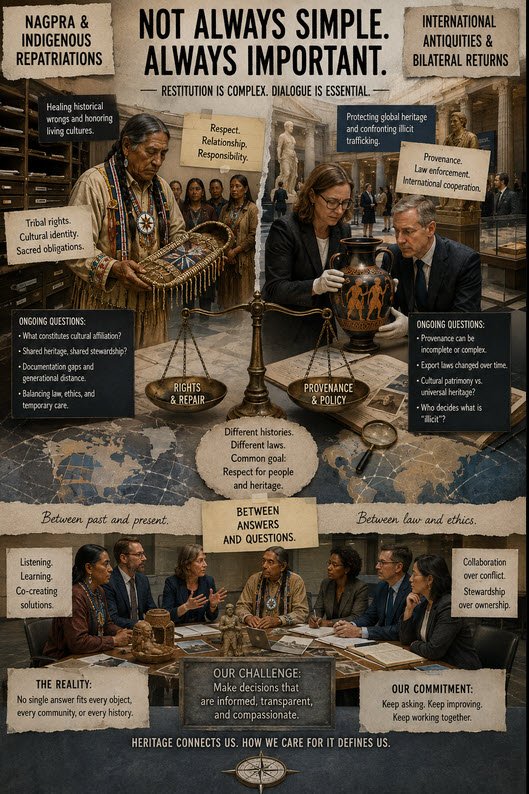
NAGPRA and Indigenous Repatriations
Compliance with the Native American Graves Protection and Repatriation Act (NAGPRA) remains a primary pressure point for U.S. institutions following the 2024 regulatory overhauls that strengthened tribal authority and mandated stricter inventory updates.
Recent Museum Actions: Institutions continue processing returns under these stricter timelines. For example, the Speed Art Museum in Louisville executed its first-ever NAGPRA repatriation, returning 24 culturally significant objects—including a Cheyenne cradle board, a Sundance rattle, beaded pipe cases, and a turtle amulet—to the Cheyenne and Arapaho Tribes of Oklahoma, concluding decades of holding items donated in 1930. Similar federal notices involve intended repatriations by major entities like the American Museum of Natural History and regional institutions such as the Santa Barbara Museum of Natural History.
Congressional Pressure: The oversight push remains intense. Senate leadership (including the Senate Committee on Indian Affairs) has stepped up direct inquiries targeting 15 major universities and public museums—such as Harvard, UC Berkeley, the University of Kentucky, and the Ohio History Connection—demanding explanations for continued delays and accountability in transferring remaining ancestral remains and sacred patrimony.
International Antiquities and Bilateral Returns
International restitution cycles are seeing continuous collaboration between major U.S. repositories, foreign governments, and domestic law enforcement task forces (such as the Manhattan District Attorney’s Antiquities Trafficking Unit):
The Metropolitan Museum of Art: Maintained an active restitution cadence, most recently formalizing the return of multiple antiquities to the Republic of Italy following joint provenance reviews and ongoing law enforcement discoveries.
Broader Restitutions: Coordinated efforts between Homeland Security Investigations and foreign cultural ministries have consistently targeted illicit trafficking networks, facilitating the return of smuggled antiquities to source countries across the Mediterranean, Southeast Asia, and Latin America.
Major U.S. cultural institutions, universities, and regional repositories are currently managing intense waves of active negotiations, formal inquiries, and statutory compliance pressures regarding repatriation. The focus spans three distinct legal and ethical vectors:
Indigenous Repatriation: The Senate Oversight Push
Rather than isolated bilateral talks, Native American repatriation negotiations are currently defined by direct, coercive federal oversight. The Senate Committee on Indian Affairs—led by Senator Brian Schatz—has placed 15 major institutions under formal review, demanding expedited compliance with the tighter Department of the Interior regulations governing the Native American Graves Protection and Repatriation Act (NAGPRA).
Institutions Under Negotiation / Review: Prominent entities facing active federal pressure to clear their inventories and settle pending repatriation claims with tribal nations include Harvard University, UC Berkeley, Indiana University, the University of Kentucky, the Ohio History Connection, the University of Tennessee, and the Milwaukee Public Museum.
Focus of Claims: Thousands of unreturned ancestral human remains, sacred ceremonial objects, and unassociated funerary items that have languished in university basements and historical societies for decades.
Holocaust-Era Claims: Post-HEAR Act Expansion
Following the legislative extension and expansion of the HEAR (Holocaust Expropriated Art Recovery) Act, museums are facing renewed, legally unhindered claims from heirs of families persecuted during World War II.
Institutional Posture: Major bodies like the Metropolitan Museum of Art and various regional institutions have found themselves bracing for or actively negotiating restitution claims. Because the updated statute strips away traditional defense mechanisms that museums previously used to dismiss old lawsuits (such as arguing that too much time has elapsed or that the claim is time-barred), heirs and estate legal teams are forcing renewed reviews of murky mid-20th-century provenance records.
Focus of Claims: European paintings, drawings, and ceremonial objects sold under duress or confiscated between 1933 and 1945 that currently sit in permanent collections without clean chains of title.
International Antiquities: Law Enforcement-Driven Returns
While voluntary museum-to-government negotiations continue quietly behind closed doors, many active international repatriations are being brokered or accelerated via the Manhattan District Attorney’s Antiquities Trafficking Unit and Homeland Security Investigations.
Institutions Involved: Major encyclopedic museums holding unprovenanced Mediterranean, Southeast Asian, and Latin American antiquities are quietly coordinating deaccessions to avoid formal seizure warrants.
Focus of Claims: Illicitly trafficked terracottas, temple sculptures, and ancient bronzes linked to historical smuggling rings (such as those tied to the networks of the late Douglas Latchford or Giacomo Medici) with destination countries like Italy, Greece, Cambodia, and Egypt.
The Senate Committee on Indian Affairs—led by Vice Chair Senator Brian Schatz—has maintained an ongoing oversight push, targeting prominent universities, public museums, and historical societies that hold the largest inventories of unreturned Native American ancestral remains and cultural patrimony. The institutional inquiries and public disclosure files highlight several key entities and the specific types of items under review:
Key Institutions Under Scrutiny
The 15 institutions explicitly targeted by the Senate committee's oversight letters include:
Harvard University (and its Peabody Museum and Warren Anatomical Museum); University of California, Berkeley; University of Kentucky; Ohio History Connection; Indiana University; University of Tennessee, Knoxville; Illinois State Museum; University of Alabama, University of Arizona, University of Florida, University of Missouri, University of Oklahoma, Center for American Archeology, University of Texas at Austin, and Milwaukee Public Museum
Categories of Items and Remains Involved
The ongoing negotiations and audit responses center on categories that institutions historically lagged in clearing under older, looser interpretations of federal rules:
Ancestral Human Remains: Thousands of Native American skeletal remains that were excavated or acquired over the 19th and 20th centuries for anatomical study or archaeological archiving, many of which spent decades categorized as "culturally unidentifiable" to bypass return mandates.
Sacred Funerary Objects & Ceremonial Patrimony: Associated and unassociated funerary items, sacred objects, and items of cultural patrimony tied directly to tribal lineages across the Midwest, Southwest, and Plains regions.
Sensitive Personal Archives: High-profile items such as historical hair clippings—including collections housed at institutions like Harvard's Peabody Museum taken from Indigenous children at U.S. boarding schools—which prompted specialized negotiations regarding spiritual and cultural repatriation.
Under the updated Department of the Interior regulations, these institutions face heightened pressure to eliminate past classification loopholes, shift the burden of proof away from tribes, and finalize compliance.
The updated Department of the Interior regulations governing NAGPRA completely restructured the legal leverage between museums and Native nations. For over three decades, the original 1990 framework was hampered by procedural loopholes and vague timelines, leaving nearly half of all reported ancestral remains languishing in institutional basements. The revised rules fundamentally overhauled four critical areas to accelerate repatriation:
Elimination of the "Culturally Unidentifiable" Loophole
The Old Rule: Museums routinely classified thousands of ancestral remains as "culturally unidentifiable" if there was no immediate, airtight paper trail linking them to a modern tribe. This classification allowed institutions to indefinitely halt returns and retain custody.
The Update: The category was entirely eliminated. Museums are now mandated to establish cultural affiliation based on a reasonable connection (geographical, historical, or anthropological) and must actively consult with tribes to disposition those remains.
Shift in the Burden of Proof and Evidentiary Rules
The Old Rule: Tribes bore a heavy, often impossible burden of proof, forced to produce exhaustive, Western-academic documentation and multi-variate evidence to demonstrate direct lineage or connection to an object or ancestor.
The Update: The burden of proof has shifted away from tribes. Under the new guidelines, a single line of evidence—including traditional Indigenous knowledge, oral histories, and geographical continuity—is legally sufficient to establish cultural affiliation, and institutions must give formal deference to tribal expertise.
Strict Timelines and the Five-Year Inventory Mandate
The Old Rule: There were no hard deadlines for completing inventories or responding to claims, leading to decades of administrative stalling.
The Update: Institutions face a strict five-year deadline (centering on a 2029 full compliance target) to complete or update inventories of all holdings and consult with tribes. Furthermore, institutions must acknowledge repatriation requests within 90 days and initiate active consultations swiftly.
Mandatory Prior Consent for Display and Research
The Old Rule: Museums could freely exhibit, study, or grant academic access to human remains and sacred funerary objects without consulting or notifying descendant communities.
The Update: A strict Duty of Care provision now requires museums to obtain free, prior, and informed consent from lineal descendants and tribes before allowing any exhibition, public access, or scientific research on Native American human remains or sacred cultural items. This single clause forced major museums across the country to rapidly shutter entire exhibition wings or pull sensitive artifacts from public view.