Dallas, Texas November 2026. An examination of his career, institutional philosophy, and what his leadership may mean for Dallas.
Brian Ferriso assumed leadership of the Dallas Museum of Art in December 2025, following nearly two decades directing the Portland Art Museum. His appointment brings to Dallas an experienced museum administrator with a substantial record in fundraising, capital development, curatorial expansion, and public engagement.
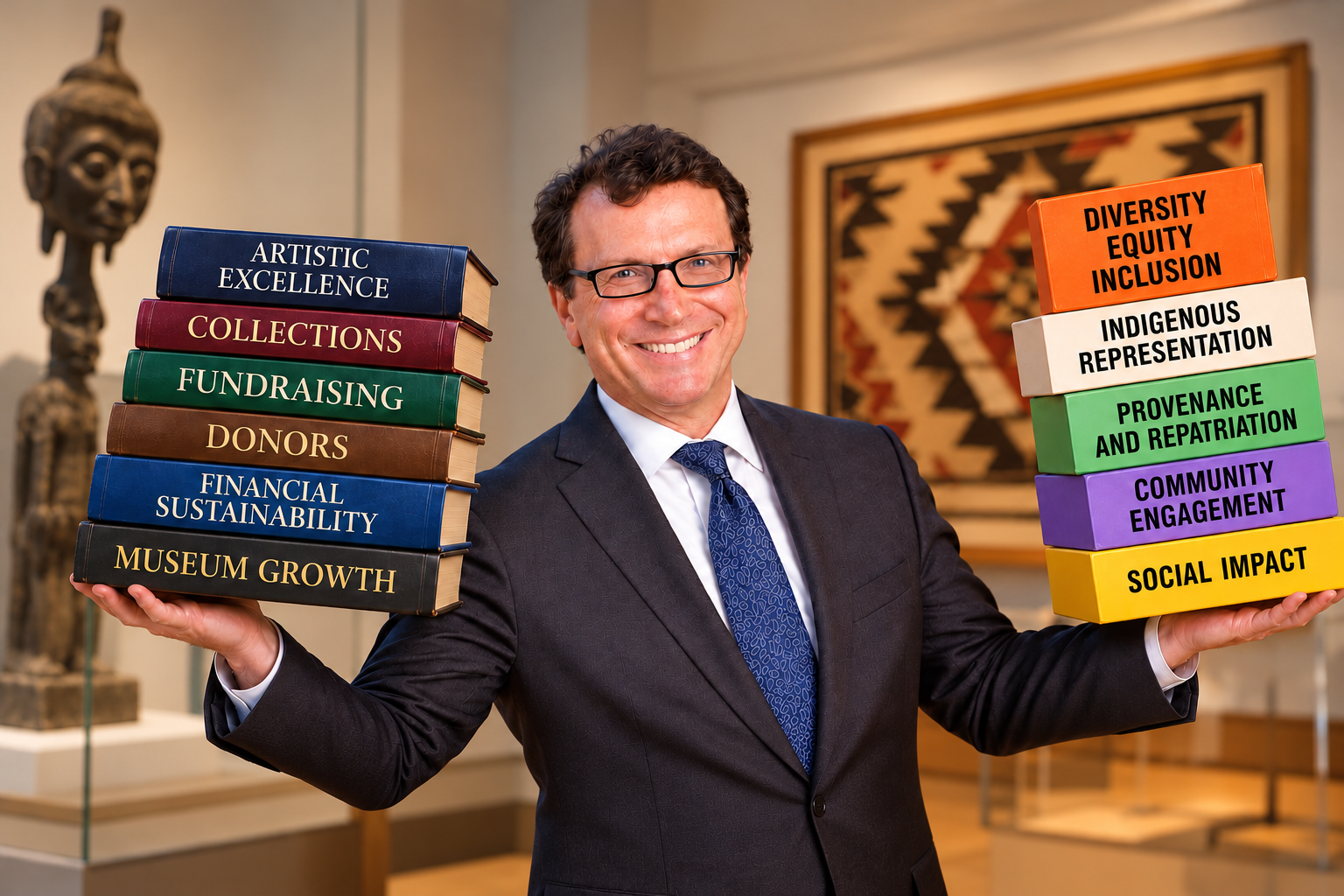
His professional philosophy combines a traditional commitment to artistic excellence and scholarship with an emphasis on diversity, institutional equity, Indigenous representation, and greater public accessibility. These priorities are documented in his published statements and administrative record.
The question for Dallas is how he will balance these objectives with financial sustainability, donor expectations, collection development, and the museum's responsibility to serve a broad public.
Professional accomplishments
Ferriso directed the Portland Art Museum from 2006 to 2025, having previously led the Philbrook Museum of Art in Tulsa. He also held senior positions at the Milwaukee Art Museum and the Smart Museum of Art in Chicago.
His Portland record includes more than $140 million raised for renovation and endowment initiatives, approximately $40 million in endowment growth, elimination of $7 million in unfunded debt, and significant expansion of curatorial staffing. He also oversaw a major campus redevelopment project.
These are substantial institutional achievements, particularly in an environment where many American museums have struggled with attendance, operating costs, and fundraising.
His philosophy: Artistic excellence and social responsibility
Ferriso's published statements reveal two important dimensions of his approach.
In a 2006 Willamette Week interview, he criticized the tendency to judge museums primarily by attendance figures and emphasized artistic quality over commercially attractive exhibitions. His argument was that strong programming should drive attendance, rather than allowing attendance targets to determine artistic programming.
His later statements reflect a broader view of museums as institutions with social responsibilities beyond preserving and exhibiting art.
At Portland, he supported equity initiatives, greater representation of historically underrepresented communities, Indigenous participation in museum governance, and closer examination of provenance and historical collecting practices.
These policies align with progressive trends in American museum administration, particularly concerning diversity, equity, inclusion, and the reassessment of colonial-era collecting. That alignment describes his documented institutional policies, not his personal political beliefs.
Importantly, his record does not suggest that these priorities displaced traditional museum responsibilities. Portland continued developing collections, supporting curatorial scholarship, raising substantial private funding, and investing in its physical infrastructure.
Progressive institutional policies
Ferriso's record at Portland includes several policies commonly associated with progressive museum management. These included prioritizing acquisitions by women, Black and Native American artists; establishing a Native American Advisory Committee; adding Indigenous representation to the board; and supporting formal equity and inclusion initiatives.
A 2020 Portland Art Museum publication identifies Ferriso as a member of the museum's Equity Team, which addressed racial equity, organizational culture, staffing, and visitor engagement. This establishes his direct participation in the initiative, rather than merely his approval of a general institutional policy.
Portland Art Museum
Such policies can broaden participation, strengthen relationships with communities represented in museum collections, and introduce overlooked artists to the public. They can also raise legitimate questions about how institutions balance representational goals with aesthetic quality, historical significance, scholarly independence, and the interests of established audiences.
Ferriso's record includes important counterexamples to the idea that his programming was exclusively focused on contemporary social issues. Portland presented major works by Raphael, Titian, and Thomas Moran alongside exhibitions featuring historically underrepresented artists.
DMA Content Management System
What might change in Dallas?
Ferriso's record suggests several plausible directions, although none should be treated as a predetermined policy.
Collections and exhibitions. The DMA may place additional emphasis on Indigenous American art, contemporary artists from underrepresented communities, and exhibitions addressing historical interpretation. His expressed admiration for the DMA's Indigenous American and Latin American collections reinforces this possibility.
Benjamin Lima
Provenance and repatriation. Greater attention to provenance research and consultation with source communities would be consistent with his Portland experience. However, his record does not establish that he favors indiscriminate repatriation or restrictions on the legitimate private art market.
Public access. Expanded educational programming, community partnerships, and reduced barriers to attendance appear likely priorities, given his Portland initiatives and public statements.
Financial management. His strongest immediate contribution may be guiding the DMA's proposed architectural transformation, estimated in 2025 at approximately $150 million. Fundraising, construction costs, attendance, and long-term operating expenses will test his administrative skills.
The larger question
Ferriso has summarized his management philosophy around three principles: art, access, and accountability. These are particularly useful standards against which to judge his Dallas tenure.
His record demonstrates that progressive institutional policies and traditional curatorial scholarship can coexist. What remains uncertain is how he will resolve conflicts between them, particularly when acquisition resources, exhibition priorities, or donor expectations compete.
Dallas will ultimately judge his directorship not by policy statements but by measurable results: the quality of exhibitions and acquisitions, growth in attendance and financial support, responsible stewardship of collections, and the museum's ability to attract audiences beyond its established constituency.
Ferriso arrives with a substantial record of institutional accomplishment. Whether he can translate Portland's combination of artistic ambition, social engagement, and financial development into lasting success at the Dallas Museum of Art remains the central question.
Principal sources: Dallas Museum of Art appointment announcement (August 2025); Portland Art Museum equity publications; FRAME museum leadership profile (2016); KERA and The Art Newspaper reporting (2025); and Ferriso's 2026 interview in Patron magazine.