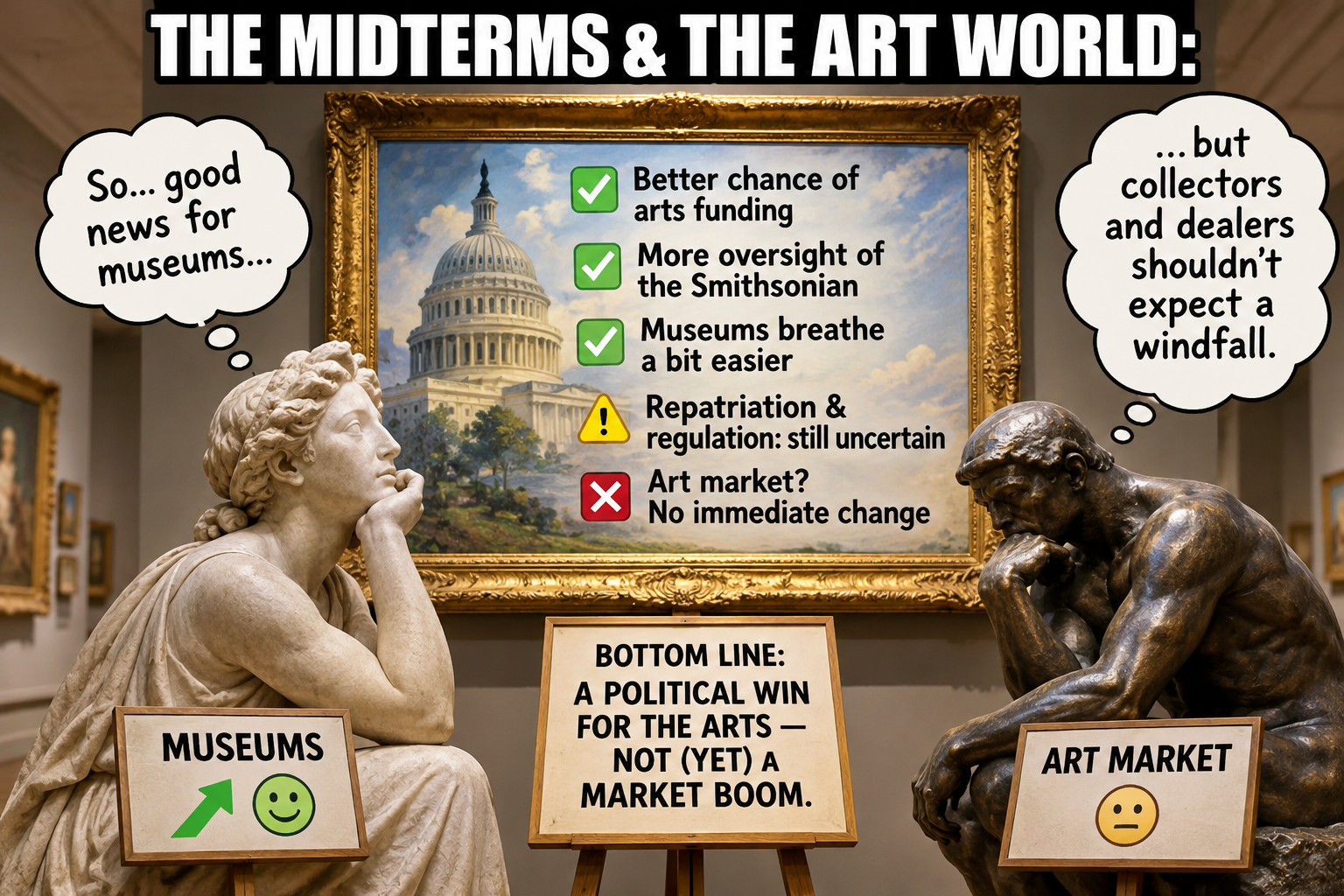
The November 3, 2026 midterm elections could have significant consequences for American museums, galleries, collectors, dealers, and appraisers. But the most important effects are likely to be political and institutional rather than immediate changes in art sales.
The central question is whether the election altered Washington's ability to influence cultural policy, particularly federal museum funding, Smithsonian oversight, repatriation policy, charitable giving, and the regulation of cultural property.
For the traditional Indigenous and tribal art market, three issues deserve particular attention: museum accountability, repatriation enforcement, and the regulatory environment for private collecting.
What the election actually changed
Democrats won control of both the House and Senate, with the new Congress taking office January 3, 2027. This gives them considerably greater influence over federal cultural spending and oversight, although President Trump retains veto authority.
Federal arts funding — High impact
The National Endowment for the Arts currently receives $207 million annually. A House proposal would reduce that to $135 million, a cut of approximately 35%. The election improves the prospects of protecting this funding, although the December 11 budget deadline comes before the new Congress convenes.
Smithsonian and museum governance — High impact
Democratic congressional leadership could challenge administration efforts to influence exhibitions, historical interpretation, and institutional leadership. Congressional oversight may increase, but that does not necessarily resolve the underlying question of who should hold federally supported museums accountable.
Museum financial stability — Moderate to high impact
The American Alliance of Museums is already pressing the new Congress to increase funding for the Institute of Museum and Library Services, NEA, and NEH, and to eliminate restrictions on congressional earmarks for museums. These are advocacy objectives, not enacted changes.
American Alliance of Museums
Repatriation and cultural property — Uncertain impact
There is no demonstrated immediate change in NAGPRA enforcement, cultural property import restrictions, or restitution policy attributable to the midterms. Congressional oversight and future agency appointments could affect enforcement priorities, but existing laws and agreements remain in place.
Private art market — Limited immediate impact
There is not yet persuasive evidence that the election has materially changed auction prices, gallery sales, collector confidence, or appraisal values. Future tax policy, capital gains treatment, charitable deductions, and economic conditions could matter far more than the election itself.
GiWhat matters specifically for tribal art
For dealers and appraisers specializing in African, Oceanic, Pre-Columbian, and Native American material, I would watch whether the new Congress takes up the relationship between museum acquisitions, provenance standards, repatriation policy, and the rights of private collectors. One important distinction is that a Democratic majority does not automatically translate into stricter cultural property regulation. Much of that policy is implemented through executive agencies, existing statutes, international agreements, and law enforcement. The market's greater concern may be the cumulative effects of regulatory uncertainty and increasingly demanding provenance standards, rather than any immediate electoral result.
My assessment
The midterms were potentially a major victory for federally supported cultural institutions, but not necessarily for the commercial art market.
Museum administrators have reason to welcome the prospect of greater federal funding. Dealers and collectors, however, have little reason to assume that the election will improve their operating environment. There is also an unresolved contradiction: Congress may defend museums against political interference while failing to examine whether those same institutions are sufficiently transparent, financially responsible, and accountable to the public.
That is an issue worth raising regardless of which political party controls Congress.
For further reading, the most useful immediate sources are the American Alliance of Museums election statement and the National Assembly of State Arts Agencies funding analysis.
Bottom line: As of November 9, the election has changed the political prospects for the American art world much more than its commercial realities. The decisive test will be what Congress actually funds, investigates, or legislates in 2027.