Democratizing the Art Museum
Why We Need Physical Galleries, How the Politics Work, and a Blueprint to Flatten the Ivory Tower
A long-standing and uncomfortable truth shadows the modern art museum: for far too long, these institutions have felt like fortresses built for the wealthy and highly educated. By sticking to a narrow, traditional Western standard of what qualifies as "real art," museums have accidentally created an exclusionary, elitist atmosphere.

The average person often walks into a gallery and immediately feels intellectually inadequate. The unspoken message is that their personal taste isn't refined enough and that the creative expressions of their own communities don't belong inside institutional walls.
To survive in a fast-moving, digital world, art museums face an existential choice. They are currently forced to make a massive philosophical pivot: transforming from object-worshipping mausoleums into people-first community spaces. To see if this change can actually last, we need to look honestly at why we still need physical museums, understand the political and funding battles behind them, and map out a practical playbook to break down the walls of the ivory tower for good.
Why We Still Need Physical Museums
In a world dominated by screens—where high-resolution scans and digital renderings can put any image on a smartphone instantly—the high cost of running a brick-and-mortar museum needs a strong justification. The case for keeping physical spaces alive rests on three main ideas.
The Real Thing Has a Unique "Aura"
Decades ago, cultural theorist Walter Benjamin used the word "aura" to describe the unique presence of a real piece of art in a specific time and place. A digital image cannot capture the material reality of the actual object. Looking at a compressed photo on a phone is a purely mental, flat experience.
Standing in front of a massive canvas is a physical experience. You see the depth of layered glazes, the texture of the brushstrokes, and the sheer scale of the artist's physical effort. This face-to-face encounter forces us to slow down and reflect in a way that digital screens inherently disrupt.
Museums as "Secular Temples"
Modern city life is fast, overwhelming, and highly commercialized. Almost every public space requires you to buy something just to sit down. Art museums are one of the few non-commercial public spaces designed specifically for quiet, internal reflection. They act as secular sanctuaries where people can process personal grief, find un-commodified inspiration, or simply experience stillness away from the noise of everyday life.
The Mirror and the Window
Museums shape community identity and empathy by acting as both a mirror and a window. As a mirror, they preserve and honor the history, struggles, and triumphs of local communities. As a window, they open up views into different eras, distant geographies, and unfamiliar cultures. This encounter with the unfamiliar expands our capacity for empathy, challenging our worldview within a shared, democratic space.
The Political and Funding Divide
The relationship between politics and art museums is complicated, and it is often oversimplified by noisy culture-war narratives. To understand what is really happening, we have to look past the visitors and staff and look at how these institutions are funded.
Data from major national surveys shows that people who identify as liberal or progressive visit art museums, engage with them, and trust them at significantly higher rates than conservatives. However, the real political friction isn't over whether art has value—it is over curatorial intent, how art is valued, and where the money comes from.
The Progressive View
Progressives lean toward seeing the museum as a tool for social change, critical questioning, and breaking down old hierarchies. Because they view museums as an essential public good, they strongly favor government funding and tax-supported grants. In their view, public money ensures that museums stay free and open to everyone, regardless of background or income.
The Conservative View
Conservatives and traditionalists more often view the museum as a sanctuary meant to preserve aesthetic beauty, technical skill, and historical heritage. They generally prefer a free-market, private donation model. Their argument is that public tax dollars should not be used to fund non-essential infrastructure or artistic statements that alienate or divide local taxpayers.
The Internal Disconnect
This divide is made tougher by an internal cultural disconnect. A museum's local audience and donor base often include plenty of conservatives, but the professional pipeline—the curators, collections managers, and directors—skews overwhelmingly progressive. When contemporary exhibitions focus heavily on sharp political critique, it can alienate traditional audiences who come looking for aesthetic escape. This has caused a measurable drop in institutional trust over the past ten years, as more people perceive public museums as politically co-opted.
The Civic Interdependence: Education, Economics, and Media
Art museums do not exist in a vacuum. They are kept alive by a connected network of schools, city budgets, and modern media.
Breaking the Cycle of Elitism
Data shows that a person's education level is the single strongest predictor of whether they visit museums. Historically, this created a self-reinforcing loop of elitism: museums catered primarily to those who already had the background to decode complex fine art.
To break this loop, the mandate has flipped. Museums can no longer just wait for an educated visitor to walk in; they have to become active educational engines themselves. Subsidized school field trips are a vital equalizer. They bypass a family's financial limitations, ensuring that every child gets introduced to their cultural heritage. When children experience art early on, the museum stops looking like an intimidating fortress and starts looking like a familiar public resource.
The "Bilbao Effect" and City Budgets
Local governments frequently support museums with tax money, city bonds, or rent-free public land. They do this because of the "Bilbao Effect"—the proven reality that a striking cultural institution can anchor and revitalize a struggling city economy.
Museums drive tourism, fill hotel rooms, boost restaurant sales, and make cities highly attractive to companies looking for a good quality of life for their employees. Data from the American Alliance of Museums shows that for every single dollar invested in a museum, more than $4.60 flows back into the local economy through travel, dining, lodging, and retail. Cultural spaces are high-performing financial assets, not just luxury expenses.
Changing how Museums Speak
To reach a wider public, old-school marketing—like stiff public service announcements announcing a new masterpiece—is dead. That old approach just reinforced the elitist idea that you needed prior knowledge to enjoy the show.
Modern museums use digital, short-form video and behind-the-scenes content to take away the intimidation factor. By showing diverse groups of people talking, laughing, and creating inside the galleries, they shatter the myth that a museum is a silent, intimidating tomb.
A Practical Blueprint for Better Museums
To truly dismantle institutional gatekeeping, museums need to fix how they operate in three core areas.
1. Kill "Artspeak" and Redesign Curation
For generations, museum labels and essays have been written in a dense, academic jargon designed to show off scholarly credentials to other academics. This leaves everyday visitors feeling confused and alienated. Museums need to enforce clear, plain-language standards for labels. Text should simply explain what the object is, why the artist made it, and why it matters to human life today.
Furthermore, museums should embrace co-curation. This means actively inviting neighborhood groups, local workers, youth councils, and indigenous communities to help design exhibitions and write the commentary, rather than letting the museum be the sole judge of cultural value.
2. Expand What Counts as "Valid Art"
When a museum only shows centuries-old European oil paintings, it sends a clear signal to the local community that their own lives and creativity do not matter. Progressive institutions are changing this by displaying creative mediums that the traditional art world used to dismiss. Streetwear design, sneaker culture, comic book art, tattoo design, independent video games, and grassroots folk crafts are now being shown with the exact same care, lighting, and respect as a Renaissance masterpiece. This closes the artificial gap between everyday life and elite culture.
3. Build a "Third Place" Culture
The internal culture of a museum needs to feel less like a high-end boutique and more like a public park or library—a true social "third place." This means retraining security staff to focus on warm hospitality rather than aggressive policing. It means building interactive spaces where visitors can make their own art right after viewing an exhibit. It also means hosting late-night community events with local bands and food trucks, and explicitly loosening the strict rules against talking at a normal volume or moving freely through the galleries.
The Financial Bottom Line
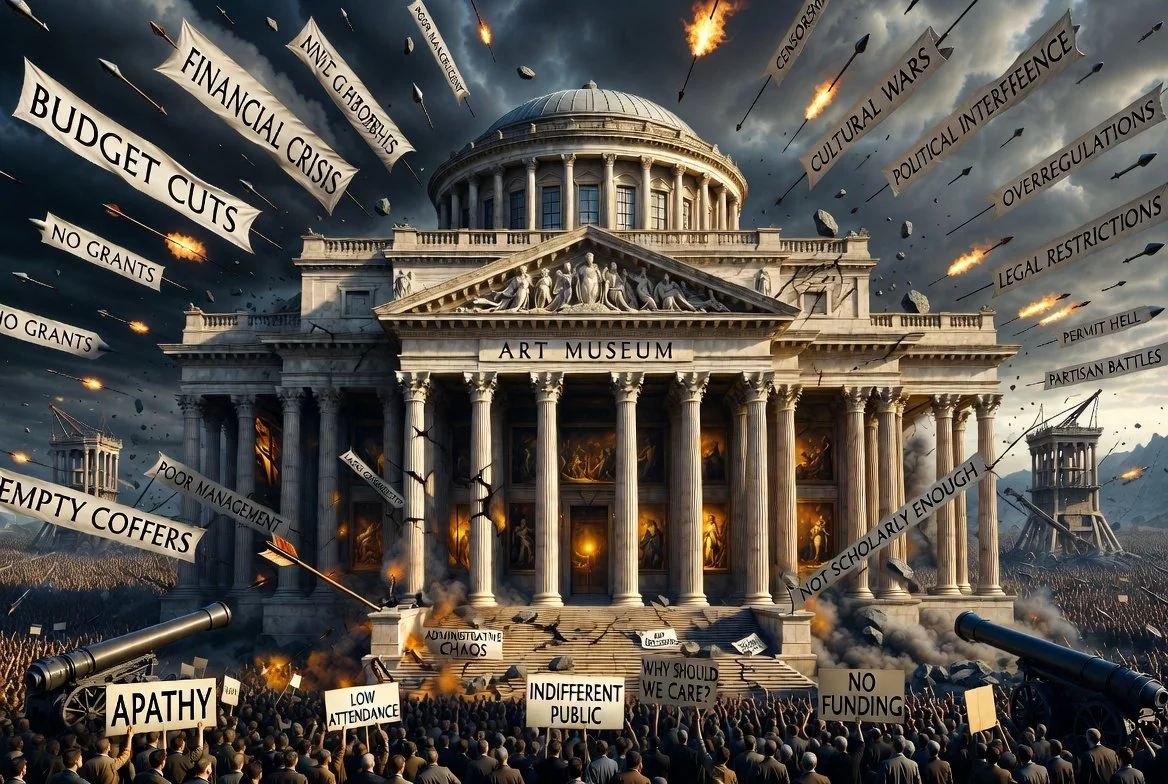
When you look at the economics of culture, one conclusion stands out: without steady public and government funding, the democratic mission of an art museum is impossible to maintain. When a museum gets zero public support, it is left entirely at the mercy of commercial markets and ultra-wealthy donors, creating a damaging feedback loop.
The Dictatorship of the Blockbuster
To survive solely on ticket sales, a museum can no longer take creative risks. It is forced to program safe, repetitive, highly commercial exhibitions—like endless rotations of French Impressionism or immersive digital light shows—because they guarantee mass-market ticket sales. Meanwhile, underrepresented local artists, avant-garde installations, and specialized historical research get completely defunded because they do not sell out the box office. This leads to a bland homogenization of culture.
The Trustee Playground
A museum funded entirely by ultra-wealthy private donors inevitably creates an environment that reflects the tastes, financial interests, and social values of its board members. It becomes an exclusive playground rather than a public utility.
Government support—even when it only makes up 15% to 25% of the annual budget—acts as a vital shield for financial independence. Public funding provides the safety net that allows museums to offer free admission days, fund rural school outreach, protect delicate local history, and support marginalized artists who lack big commercial backing. Ultimately, public funding keeps the art museum accountable to the public, ensuring it remains an essential piece of community infrastructure belonging equally to everyone.
Core Frameworks and Sources
National Endowment for the Arts (NEA):Survey of Public Participation in the Arts — Long-term tracking of how education, background, and worldview impact cultural attendance.
American Alliance of Museums (AAM):Economic Impact Study — Analysis of the 4.6x financial multiplier that museums bring to local city economies.
Walter Benjamin (1935):The Work of Art in the Age of Mechanical Reproduction — The classic theoretical text on the unique physical presence, or "aura," of an original artwork.
General Social Survey (GSS): Sociological tracking of public trust, political identity, and cultural habits across American demographics.