Is AI Just a Search Engine?
Instant Gratification and Always the Right Answer - Forget About It
One of the most common misconceptions about artificial intelligence is that it functions like an advanced search engine. It does not. A search engine retrieves existing information; an AI system analyzes language, synthesizes evidence, identifies relationships, and generates reasoned responses based upon the information available and the manner in which the inquiry is framed. As a result, the quality of an AI-generated answer depends not only upon the quality of the underlying information but also upon the quality, precision, and progression of the questions being asked.
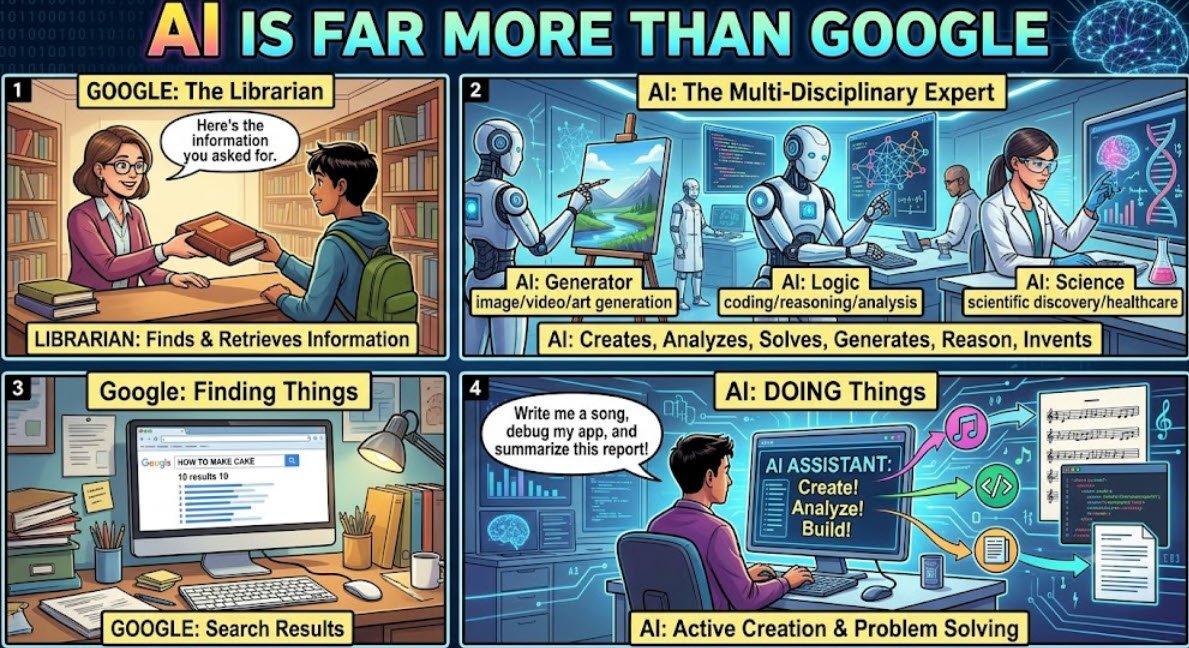
This explains why an AI's responses may evolve over the course of a research project. Such evolution should not automatically be interpreted as inconsistency, deception, or error. Rather, it often reflects the normal progression of scholarly inquiry. Every refined prompt narrows the field of investigation, introduces new evidence, removes unsupported assumptions, or shifts the analytical framework. As the questions become more sophisticated, so too does the resulting analysis.
Experienced researchers have long understood that important discoveries rarely emerge from a single question. Historical research, legal analysis, scientific investigation, and art attribution are iterative disciplines. Each answer generates additional questions. A seemingly insignificant detail may expose an overlooked contradiction, reveal an alternative explanation, or identify entirely new avenues of investigation. AI simply accelerates this process by allowing researchers to test multiple hypotheses, compare competing explanations, and synthesize large bodies of information in a fraction of the time previously required.
The effectiveness of AI therefore depends less upon the technology itself than upon the expertise of the individual directing the inquiry. An experienced historian recognizes the difference between primary and secondary sources. A museum curator understands the distinction between stylistic attribution and documented provenance. A lawyer distinguishes between evidence that is admissible and evidence that is merely suggestive. A scientist knows that correlation is not causation. These forms of professional judgment cannot be replaced by artificial intelligence; they determine whether AI is being used responsibly or merely producing plausible narratives.
AI excels at identifying patterns, organizing information, comparing competing viewpoints, and exposing relationships that may not be immediately apparent to a human researcher. It can rapidly assemble museum records, auction histories, scholarly literature, archival references, conservation reports, and legal frameworks into a coherent analytical framework. What it cannot do is independently determine which pieces of evidence deserve the greatest weight. That remains the responsibility of the researcher.
This distinction is particularly important because AI is capable of constructing explanations that appear persuasive even when the underlying evidence is incomplete. A well-written narrative is not necessarily a well-supported conclusion. The responsibility of the researcher is to distinguish between established facts, reasonable inferences, informed hypotheses, and speculation. The most valuable use of AI is not to accept its first answer, but to challenge it continuously, refine the inquiry, test competing interpretations, and seek independent corroboration.
The most successful users of artificial intelligence are therefore not those who simply know how to write prompts. They are those who understand the research process itself. They recognize gaps in evidence, identify unsupported assumptions, formulate increasingly precise questions, and know when additional documentation is required before reaching a conclusion. In this sense, AI rewards intellectual discipline rather than technical proficiency.
Artificial intelligence should be viewed not as an oracle that provides definitive answers, but as a powerful research instrument that amplifies human expertise. It accelerates discovery, expands the scope of inquiry, and enables researchers to explore questions at a depth that would have required months or years using traditional methods alone. Yet its conclusions remain only as reliable as the evidence upon which they are based and the judgment of the person interpreting them.
For this reason, using AI without an understanding of evidence, source criticism, analytical reasoning, and the iterative nature of research can produce unwarranted confidence in conclusions that have not been adequately tested. Conversely, when directed by an experienced researcher who understands nuance, methodology, and the importance of verification, AI becomes one of the most powerful research tools ever developed, capable of uncovering relationships, testing hypotheses, and advancing scholarship in ways that were previously unimaginable.