The Laxtunich Maya Lintel
Trophy Convictions, Bureaucratic Theater, and the Distortion of Cultural Property Justice
The return of the Laxtunich Maya lintel by the Manhattan District Attorney's Office to Mexico illustrates a recurring and troubling pattern in cultural property enforcement: government agencies often pursue highly publicized victories long before the underlying facts have been fully established. In these cases, bureaucratic incentives frequently reward political symbolism over scholarly rigor, creating an environment where uncertainty is treated as an inconvenience rather than the central issue.
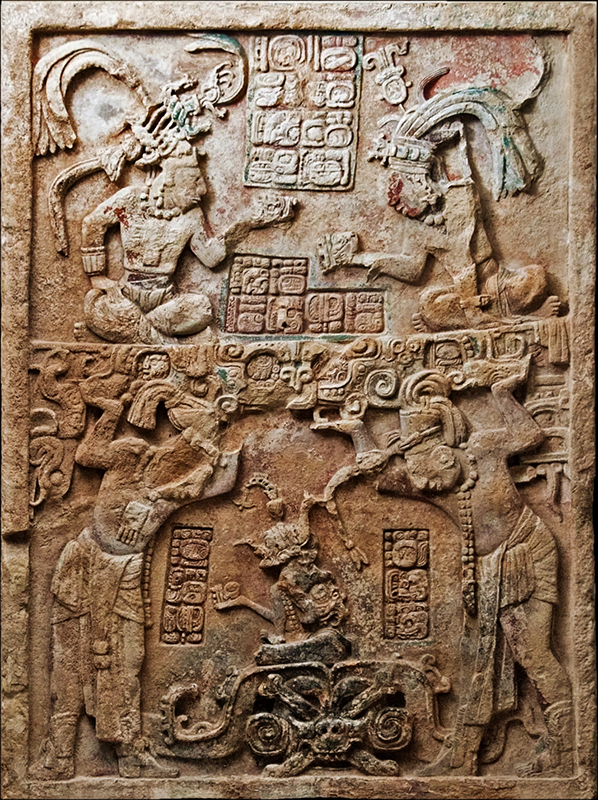
The Laxtunich Maya Lintel
The result is a form of administrative justice in which press conferences substitute for proof, moral certainty substitutes for evidence, and prosecutors claim the ethical high ground even when the legal and historical foundations remain deeply contested.
The Laxtunich case, the Ben Johnson litigation, and the McClain prosecutions reveal the same underlying tension. Ancient civilizations did not organize themselves according to modern national borders, yet contemporary governments routinely behave as if present-day political boundaries can be projected backward through centuries or millennia of history. When legal systems prioritize symbolic outcomes over archaeological complexity, the search for truth becomes secondary to the search for a headline.
The Laxtunich Lintel: Repatriation by Press Conference
In 2026, the Manhattan District Attorney's Antiquities Trafficking Unit returned the Laxtunich Maya lintel to Mexico. The decision relied heavily on decades of art-market assumptions identifying the monument as originating in Chiapas, Mexico.
Yet modern scholarship has increasingly challenged that conclusion. Through detailed analysis of the 1950 expeditions of Dana and Ginger Lamb, scholars including Stephen Houston, Charles Golden, Andrew Scherer, and James Doyle reconstructed the likely location of Laxtunich and concluded that the site almost certainly lay within what is now Guatemala's Petén region rather than Mexico. This distinction is not a minor technicality. It goes directly to the legitimacy of the repatriation itself.
The ancient Maya world was a network of interconnected polities whose political influence crossed modern borders with ease. A court subordinate to Yaxchilan could have existed within modern Guatemala just as easily as within modern Mexico. The archaeological evidence therefore raises serious questions about whether Mexico was the proper recipient of the lintel at all.
Yet rather than commissioning an independent scholarly review before acting, authorities moved directly toward a public restitution ceremony. The result was not the careful administration of justice but what can fairly be described as repatriation by press conference—a process in which political optics outran factual certainty.
If the lintel originated in Guatemala, then the celebrated act of restitution may have amounted to nothing more than a highly publicized transfer of cultural property to the wrong sovereign state.

The Ben Johnson Case: When Courts Demanded Actual Proof
The civil case of Government of Peru v. Johnson demonstrated a far more disciplined approach to cultural property disputes. Peru sought the return of numerous Moche artifacts allegedly removed from its territory. Peru's claim rested on a reasonable belief that the objects originated within Peru and were subject to Peruvian patrimony laws. Reasonable belief, however, was not enough.
The court recognized that the ancient Moche culture occupied territories that extend beyond modern Peru. Because Peru could not establish where the specific artifacts had been excavated, it could not prove that they had been removed from Peruvian territory after the enactment of Peru's ownership laws.
The court refused to transform probability into proof. The decision represented an important legal principle: cultural affiliation does not establish legal ownership. National pride does not establish provenance. Political desire does not substitute for evidence. Unlike many modern repatriation campaigns, the Johnson court insisted that a sovereign nation satisfy the same evidentiary standards expected of any other claimant.
McClain: The Birth of a Doctrine and a Warning About Prosecutorial Overreach
The McClain prosecutions remain among the most influential and controversial cultural property cases in American legal history. Federal prosecutors sought to convict dealers under the National Stolen Property Act by arguing that artifacts exported from Mexico were stolen because Mexican patrimony laws vested ownership in the Mexican government. The government's theory was ambitious. It also rested on remarkably uncertain foundations.
No theft victim was identified.
No chain of title was established.
The government presented no evidence showing when many of the artifacts left Mexico. Some objects were believed to have originated outside Mexico altogether, including areas of modern Guatemala and Honduras. The government's case therefore depended largely upon persuading an American court to recognize Mexican ownership claims rather than proving a conventional theft.
The Fifth Circuit ultimately reversed the convictions because the trial court had incorrectly instructed the jury that Mexico had owned all pre-Columbian artifacts since 1897. In reality, Mexico's ownership laws evolved over decades and did not reach their broadest form until 1972.
The court recognized a fundamental problem: illegal exportation alone does not automatically create stolen property. The desire to secure a landmark conviction had outrun the legal foundation necessary to support it.
McClain ultimately produced the doctrine that bears its name, but the case also stands as a cautionary tale. It demonstrates how quickly prosecutors can become invested in achieving a symbolic victory even when the factual record remains incomplete.
Three Persistent Failures
1. Ancient Civilizations Are Not Modern Nation-States
Cultural property enforcement routinely assumes that modern political borders define ancient cultural ownership.
They do not.
Maya kingdoms ignored the boundaries separating Mexico, Guatemala, Belize, and Honduras. Moche influence extended across regions that today belong to multiple countries. Countless ancient societies occupied territories that bear little resemblance to modern states.
Yet governments regularly present cultural affiliation as if it automatically establishes national ownership. The assumption is convenient. It is also historically simplistic.
2. Bureaucratic Incentives Reward Certainty Where None Exists
The modern repatriation apparatus often encourages officials to present disputed questions as settled facts. Ambiguity becomes politically inconvenient. Doubt becomes a threat to the narrative.
The result is a system in which agencies gain public credit for announcing returns but face little accountability when later scholarship undermines the factual basis for those decisions.
3. Political Justice Can Produce New Injustices
Perhaps the greatest irony is that repatriation conducted without adequate proof can simply create a second wrongful transfer. An object removed from one owner and transferred to an incorrect sovereign state has not been restored to its rightful home. It has merely changed hands again.
The rhetoric of justice does not guarantee the reality of justice. Without independent review, rigorous provenance analysis, and a willingness to acknowledge uncertainty, cultural property enforcement risks becoming less about protecting heritage and more about demonstrating governmental virtue.
Conclusion
The Laxtunich lintel, the Johnson litigation, and the McClain prosecutions all expose the same uncomfortable truth. The moral and legal high ground in cultural property disputes is often far murkier than government press releases suggest.
Ancient objects exist in a world of incomplete records, overlapping cultures, uncertain provenances, and shifting legal doctrines. Honest scholarship recognizes those complications. Bureaucracies often do not.
The danger arises when prosecutors, politicians, and cultural ministries become more interested in obtaining trophy convictions, headline-generating seizures, or symbolic repatriations than in resolving the underlying historical questions.
Justice requires evidence.
Public relations requires certainty.
Too often, cultural property enforcement chooses the latter.