Five Crazy Moments in the Art World
Sometimes you need crazy to be certain that you are alive. We picked five crazy momemnts that may set the stage for the last half of the years. The art world in 2026 has been anything but quiet. Between institutional meltdowns, eye-watering trophy-hunting at auction, and legal battles finally coming to a head, the year has delivered plenty of high-stakes drama.
Here are five of the craziest, most talked-about events shaping the art market and cultural landscape this year:
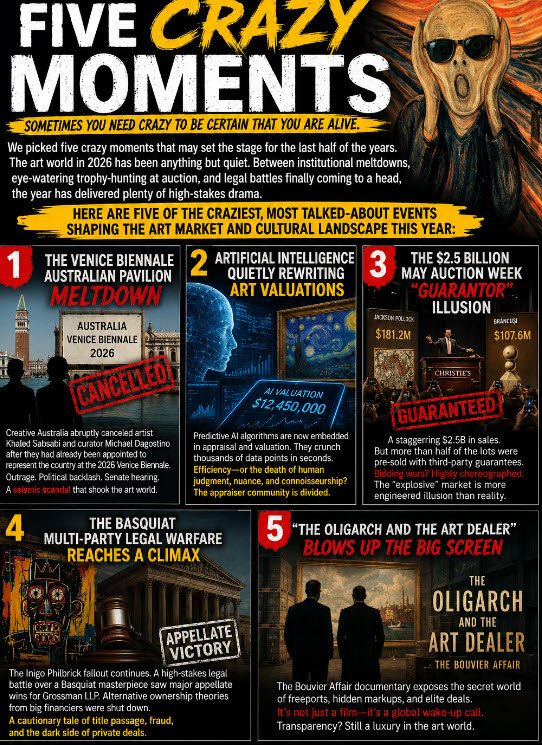
1. The Venice Biennale Australian Pavilion Meltdown
In one of the most shocking institutional disruptions of the year, Creative Australia abruptly canceled artist Khaled Sabsabi and curator Michael Dagostino after they had already been officially appointed to represent the country at the 2026 Venice Biennale. The sudden, opaque decision sparked immediate outrage over artistic freedom, triggered an intense political backlash, and even led to a formal Senate hearing. The scandal has deeply fractured the Australian arts community and cast a major shadow over national pavilion selections globally.
2. Artificial Intelligence Quietly Rewriting Art Valuations
While public attention often fixes on AI-generated imagery, the real structural shockwave hit the backrooms of the market this year. Predictive AI algorithms have aggressively moved into standard art appraisal and valuation workflows. By instantly analyzing thousands of opaque data points—historical provenance, regional macroeconomic shifts, gallery price lists, and global auction sell-through rates—synthetic data tools are starting to out-calculate traditional valuation methods. It has sparked a massive debate among veteran appraisers over whether algorithmic efficiency is stripping the necessary human nuance, connoisseurship, and expert due diligence out of the market.
3. The $2.5 Billion May Auction Week "Guarantor" Illusion
The top end of the market saw an staggering resurgence during New York's May auction week, generating a massive $2.5 billion. Rooms erupted as a Jackson Pollock masterpiece hammered at $181.2 million and a Constantin Brâncuși sculpture shattered records at $107.6 million. However, the "crazy" part was behind the curtain: more than half of the evening sales were locked down by third-party financial guarantees before the auctions even started. Insiders revealed that some "dramatic" bidding wars were highly choreographed, with backers paying numbers vastly lower than the public headline figures due to complex financing fees, pulling back the veil on how the illusion of an explosive market is engineered.
4. The Basquiat Multi-Party Legal Warfare Reaches a Climax
The fallout from convicted fraudster Inigo Philbrick’s schemes continued to haunt the blue-chip market into 2026. A long-running, bitter multi-party legal battle over a single Jean-Michel Basquiat masterpiece saw dramatic shifts in the federal courts this spring. High-stakes litigation handled by Grossman LLP resulted in major appellate wins for their client, completely shutting down alternative ownership theories from powerful art market financiers like Athena Art Finance. The complex case exposed the treacherous legal pitfalls of Title Passage (when ownership legally transfers) and the terrifying vulnerabilities that still plague multi-million-dollar private transactions.
5. "The Oligarch and the Art Dealer" Blows Up the Big Screen
The legendary, decade-long Bouvier Affair—the multi-billion-dollar legal war between Russian billionaire Dmitry Rybolovlev and Swiss art transport magnate Yves Bouvier—took over public consciousness this summer with the premiere of the explosive documentary The Oligarch and the Art Dealer. The film laid bare the ultra-opaque mechanics of freeports, hidden markups, and private sales. By forcing details of high-level, clandestine elite dealings into the open, it re-ignited the global conversation regarding transparency, unregulated secondary markets, and just how easily the world's most expensive masterpieces can be used as pure financial chips.