The Art Dealer Gatekeeper
The Illusions of Expertise: A Critical Deconstruction of High-End Art Gatekeeping
When an art dealer asserts that collectors are buying judgment, they are executing a deliberate rhetorical shift. They are moving away from the baseline, objective service of a merchant—verifying material facts and facilitating a fair transaction—and demanding intellectual submission.
An honest market relies on transparent data and fair pricing. The self-promotional newsletter analyzed below demonstrates how high-end content marketing actively undermines that transparency, replacing verifiable information with romanticized paternalism.
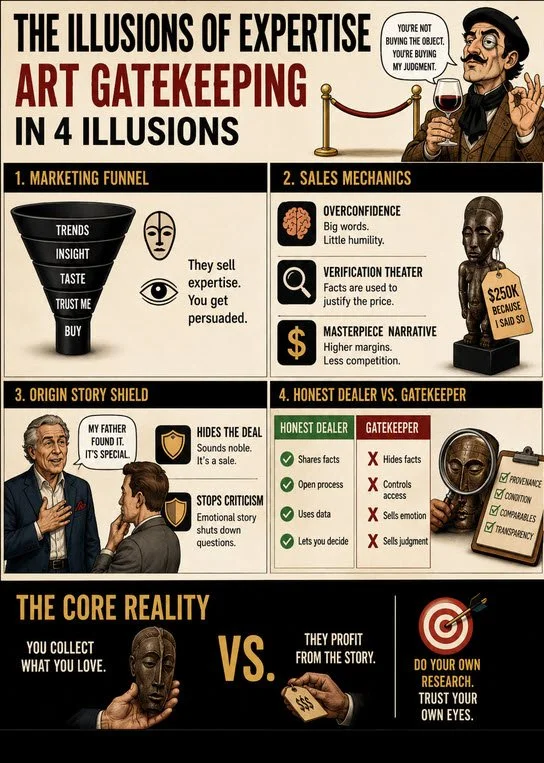
1. The Marketing Funnel: Education as a Velvet Rope
When a newsletter begins by diagnosing a real macroeconomic phenomenon—the bifurcation of the art market—but shifts immediately into a mechanism for establishing unchallenged authority.
The Weaponization of Taste: The author draws a distinction between an object being authentic and being great. While it is true that material culture varies in aesthetic complexity, the dealer can reframe a competent village carving as basically inferior. In doing so, he projects Western, modernist criteria (balance, rhythm, tension) onto ethnographic objects that may have been carved to be intentionally asymmetric or unpolished for ritualistic purposes.
The "Eye" as an Unverifiable Moat: By arguing that a market split means you just need a better eye, the dealer can establishe an invisible gate. If expertise cannot be quantified or written down, the collector becomes entirely dependent on the dealer to tell them what to like.
2. The Sales Mechanics: How "Fluff" Simulates Authority
Beneath the posture of a disinterested educator lies a highly engineered sales framework designed to maximize dealer profit margins.
The Overconfidence Moat
In fields like cognitive psychology, true expertise requires immediate, objective feedback (like a surgeon or a structural engineer). The high-value art market, however, is a low-feedback environment. A dealer can pass around subjective aesthetic assertions for 30 years without ever having their "eye" objectively tested. Making a profit on a piece does not prove aesthetic supremacy; it only proves they found a buyer who believed their narrative.
The Limit of Objective Verification
This scenario highlights a profound logical pivot in how we value objects. While objective data points—such as age, material authenticity, and verifiable provenance—can be structurally confirmed by peer-reviewed authorities, they only tell part of the story.
The core tension lies where physical evidence meets subjective appraisal. An item can be indisputably authentic and verified by every measurable metric, yet still be deemed lacking by an expert using entirely unquantifiable criteria, such as "less convincing proportions" or a "less powerful expression."
The Takeaway: Technical validation proves what an object is, but subjective connoisseurship determines its ultimate aesthetic or cultural worth.
This isn't material expertise; it is an economic tactic. By minimizing an object he did not source, the dealer devalues the client's independent assets while positioning his own unverified "judgment" above written scholarship.
The Economics of the "Masterpiece" Narrative
This perspective exposes a fundamental flaw in the traditional hierarchy of connoisseurship: it entirely ignores the collector's underlying motivation. By dictating how a collector should acquire objects—specifically through the common refrain to "buy fewer, but better"—dealers cloak a highly profitable business strategy in the language of anti-consumerism and aesthetic purity.
In practice, steering a buyer toward a single, high-margin, opaque "masterpiece" rather than multiple lower-cost, highly transparent items is a structurally superior business model for a boutique operation. This strategy yields significant economic advantages for the dealer:
Capital Consolidation: It locks up buyer capital into single, high-value inventory items where pricing is driven entirely by narrative, subjective prestige, and artificial scarcity.
Asymmetric Information: Unlike lower-cost items that rely on clear market comparables ("comps") and transparent data, a "masterpiece" exists in a pricing vacuum, allowing the dealer to maximize profit margins without objective pushback.
The Takeaway: The elite advice to prioritize "quality over quantity" is less about elevating the collector's taste and more about a calculated dealer strategy to replace transparent, high-volume markets with high-margin, narrative-driven monopolies.
3. The Origin-Story Shield: Trading Logic for Emotion
This tactic shows how a seller can use a personal, emotional story to disarm a buyer's financial defenses. By shifting the conversation away from a cold, commercial business and into a romantic story of family legacy or artistic upbringing, the seller changes the rules of the game.
This framing acts as a shield against hard questions in two ways:
It Hides the Transaction: It turns a standard retail sale into a deep, shared passion, making it feel less like a business deal and more like a mentorship.
It Stops Criticism: It lifts the seller above the regular market. The buyer is no longer arguing over price tags or profit margins; they are questioning someone’s lifelong, almost sacred talent.
The Takeaway: When a salesperson brings up a deeply personal origin story, they are trying to replace economic facts with emotional trust. It forces you to debate their integrity rather than their price.
4. What an Honest Dealer Provides a Knowledgeable Buyer
A healthy relationship between a collector and a dealer should be strictly transactional, grounded in empirical evidence rather than epistemic paternalism. Information should be an open invitation, not a velvet rope.
The Gatekeeper's Model (Subjective)
The lines lack structural authority.
The expression lacks presence.
You must use my eye
You are buying my judgment.
vs.
The Honest Dealer's Model (Objective)
Material Analysis: Identification of wood species, adze vs. steel tool marks, natural pigments (kaolin) vs. trade paints.
Traces of Use: Internal patination from actual ritual wear, structural stress points, native fiber repairs, or sacrificial residue.
Verifiable Provenance: Documented collection dates, auction histories, colonial estate inventories, and field photography.
Market Transparency: Open disclosure of historical auction comps for items of identical age, rarity, and physical condition.
The Core Reality
A collection built entirely on "borrowed passion" is not a collection—it is an outsourced portfolio. If a knowledgeable buyer selects an authentic object because they connect with its raw form, its history, or its cultural context, that is a successful interaction with art.
When a gatekeeper demands that you reject your own emotional and intellectual assessment because an object lacks an elusive, unprovable power, they are asking you to replace your authentic experience with their commercial inventory.