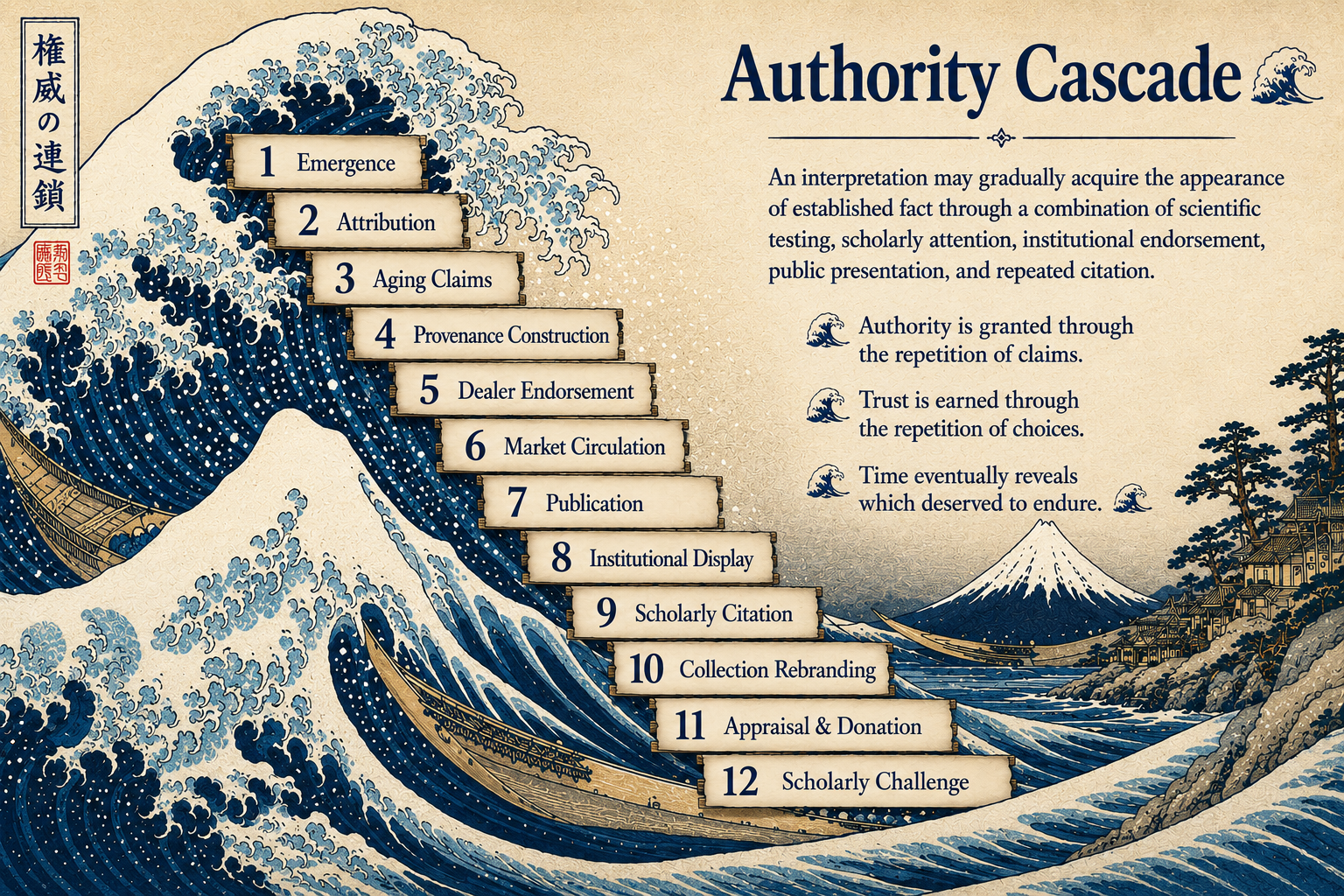
The Authority Cascade — When Authority Begins to Outpace Evidence🌊

This Authority Cascade illustrates a pathway by which interpretation, repetition, institutional attention, and market activity may accumulate into perceived authority before ultimately being re-examined.

How does an interpretation become accepted as fact?

Sometimes through rigorous investigation and independent verification. But sometimes confidence grows through a different process—repetition. A description is repeated in a catalogue. A catalogue is cited by a later author. An object is exhibited, published, acquired, appraised, and eventually accepted with increasing confidence. Over time, the accumulated authority surrounding the object may become far greater than the evidentiary foundation on which it originally rested.

This article introduces the Authority Cascade, a conceptual framework that illustrates how interpretations can gain credibility through publication, institutional attention, market circulation, and repeated citation. It is not a criticism of scholarship or expertise. Rather, it is a reminder that authority and evidence are related, but they are not the same thing. As an object's scholarly, cultural, legal, or financial importance increases, the expectation for independent verification should increase as well.

Whether you are a collector, museum professional, appraiser, attorney, researcher, or student of cultural heritage, this article offers a practical way to think about how confidence develops—and why returning to the original evidence remains essential.

View the complete article and explore this Authority Cascade.

Mark Rasmussen

Mark Rasmussen is a recognized specialist in the scientific analysis of artwork and archaeological material with over twenty four years of hands-on experience. His approach integrates materials science, forensic methodology, and advanced analytical technologies—reflecting a technical perspective shaped by decades of experience as an engineer and technology‑industry leader. Rasmussen is an early adopter and pioneer in applying advanced tools such as CT scanning, multispectral imaging, artificial intelligence, and technical automation to art, provenance research, and cultural‑materials investigations.

As the founder of Rare Collections, he has supported technical investigations for major museums—including The Metropolitan Museum of Art, The Brooklyn Museum, and the Art Institute of Chicago—as well as leading auction houses and private collectors. Rasmussen is also a published author in the field of scientific authentication, contributing peer‑reviewed work on terracotta analysis and due‑diligence standards.

He is a frequent lecturer on authenticity, scientific due‑diligence, and risk assessment, having presented to organizations such as the International Society of Appraisers, the Internal Revenue Service, Harvard University, the University of Minnesota, Arizona State University, the Smithsonian Institution, and other academic and museum institutions. His collaboration with John Buxton has contributed to the scientific evaluation and appraisal due‑diligence of hundreds of objects across African, Native American, Oceanic, and Pre‑Columbian collections.

Rasmussen has additionally provided expert support in authenticity disputes for prominent law firms, including cases involving millions of dollars in contested artworks.

https://www.rare-collections.com/
Previous
Previous

Manufactured Certainty — How Misinformation Enters the Tribal Art Record

Next
Next

Professional Framework — Toward a Standard for the Characterization of the Physical Condition of Tribal and Indigenous Artwork