European Tribal Art Fairs — Shrinking?
Is the European Tribal Art Market Shrinking—or Simply Changing?
The European tribal-art market in 2026 presents an interesting contradiction: there are fewer specialist dealers and arguably fewer traditional collectors, yet exceptional material can still command extraordinary prices.
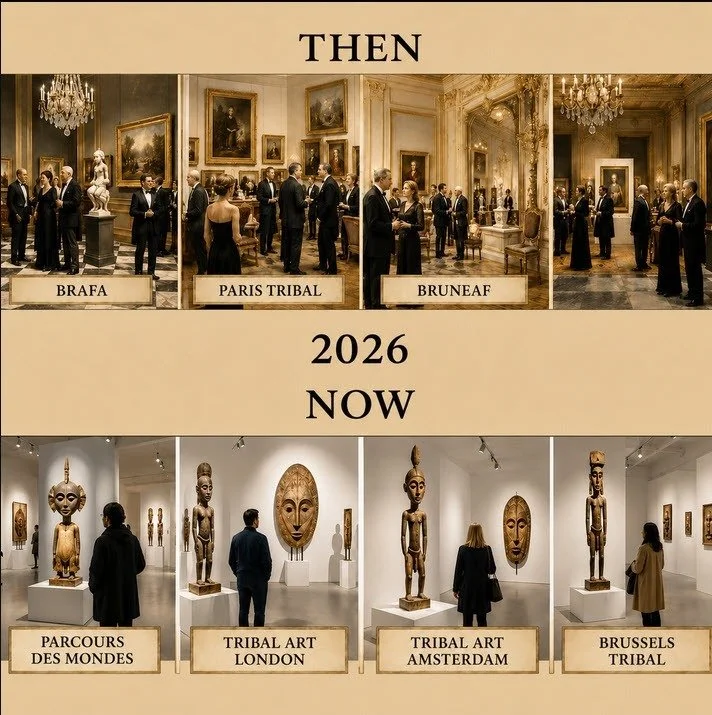
The market isn't disappearing. It appears to be concentrating and changing.
Paris: Parcours des Mondes — September 8–13, 2026
Parcours des Mondes remains the most important European gathering for African, Oceanic and other non-European art.
The numbers, however, tell an interesting story. In 2019, Parcours included roughly 64–65 galleries. The 25th-anniversary edition in 2026 expects about 50. That represents a meaningful contraction, although hardly a collapse.
Many of the important dealers remain, including Bernard Dulon, Bernard de Grunne, Entwistle, Philippe Ratton, Lucas Ratton, Yann Ferrandin, Galerie Flak, Adrian Schlag and Kevin Conru.
More importantly, serious money hasn't disappeared. Christie's 2024 sale of the Barbier-Mueller collection realized approximately €73 million, including €14.8 million for a Fang reliquary head.
The message seems clear:
The top isn't dead. The middle is the problem.
Brussels: BRAFA — January 25–February 1, 2026
Although BRAFA is not exclusively a tribal-art fair, Brussels remains one of Europe's strongest centers for African art.
At BRAFA 2026, dealers reported significant activity in non-European art. Galerie Flak sold works at approximately €4,000–€35,000, while Claes Gallery reportedly sold a Dan Mano mask for nearly €150,000. Serge Schoffel reported selling around 40 objects across multiple price levels.
Perhaps more important was evidence of younger European buyers entering the field.
The long-term issue facing tribal art isn't simply price. It is generational replacement. Brussels provides some encouraging evidence that younger collectors may be appearing.
Brussels: BRUNEAF — June 10–14, 2026
BRUNEAF — Brussels Non-European Art Fair remains important because Belgium possesses an unusually concentrated community of African and Oceanic art dealers, collectors and specialists.
The Brussels model is less dependent upon a single conventional fair than upon its network of galleries, dealers and collectors. That makes the city particularly useful for judging the health of the specialist trade.
Amsterdam: Tribal Art Fair — October 29–November 1, 2026
The Tribal Art Fair Amsterdam represents the more traditional specialist-fair model.
The 2026 edition brings together approximately 20 dealers from seven countries offering around 3,000 objects, ranging across Africa, Oceania, Asia and the Americas.
Amsterdam's smaller scale may actually be an advantage. It provides an accessible market where collectors can still find interesting objects without competing exclusively for museum-quality masterpieces.
This middle and entry level is important. Today's €3,000 collector can become tomorrow's €30,000 or €100,000 collector.
London: Tribal Art London — September 29–October 4, 2026
London is adapting.
Tribal Art London now operates alongside The Decorative Fair at Evolution London in Battersea Park, exposing ethnographic material to buyers interested in furniture, design and decorative arts rather than exclusively to established tribal-art collectors.
That may be an important glimpse of the future.
A younger collector might place an African sculpture beside contemporary art, photography and modern design without ever describing himself as a "tribal-art collector."
Paris Tribal — May 12–17, 2026
Paris Tribal provides another important Paris event, emphasizing the city's extraordinary concentration of specialist galleries.
Together with Parcours des Mondes, it demonstrates why Paris remains the European center of gravity for the serious African and Oceanic art market.
The Market Is Becoming More Selective
What appears to be disappearing is not necessarily demand for tribal art. It is demand for ordinary material at extraordinary prices.
Today's buyer increasingly wants provenance, publication history, exhibition history, convincing attribution and documentation.
The questions have changed:
Where was it collected? When did it leave Africa? Who owned it? Has it been published? Is the attribution convincing? Are there title or repatriation concerns?
And finally:
Why should I buy this particular example?
That is a harder question for dealers than it was thirty years ago.
Fewer Dealers, Stronger Survivors
The decline from approximately 65 Parcours exhibitors in 2019 to around 50 in 2026 shouldn't be ignored.
But fewer dealers don't necessarily mean the market is collapsing.
The survivors increasingly tend to possess what the internet cannot easily provide: expertise, reputation, scholarship, provenance research and access to old collections.
Ironically, the enormous amount of questionable material now circulating online may make trusted expertise more valuable rather than less.
So Is Tribal Art Expanding or Contracting?
The traditional tribal-art market is probably contracting.
Older collectors are leaving the field. Provenance requirements are becoming tougher. Repatriation concerns are increasing. The middle market faces enormous competition from material circulating online.
But another market appears to be emerging.
Exceptional objects remain capable of bringing exceptional prices. Younger collectors may be approaching African and Oceanic art differently—mixing it with contemporary art, antiquities and design rather than building traditional encyclopedic "tribal art" collections.
The 2026 European fair calendar illustrates the transition:
Paris — Parcours des Mondes: September 8–13
London — Tribal Art London: September 29–October 4
Amsterdam — Tribal Art Fair: October 29–November 1
Brussels — BRUNEAF: June 10–14
Paris — Paris Tribal: May 12–17
Brussels — BRAFA: January 25–February 1
Paris remains the center of the high-end specialist market. Brussels retains an extraordinary dealer network. Amsterdam preserves the intimate specialist-fair model. London is integrating tribal art into the broader decorative-arts market.
Perhaps the mistake is expecting the tribal-art market of 2035 to look anything like the market of 1995.
It won't.
The question isn't whether tribal art survives. It is who the next collectors will be—and what they will choose to call it.