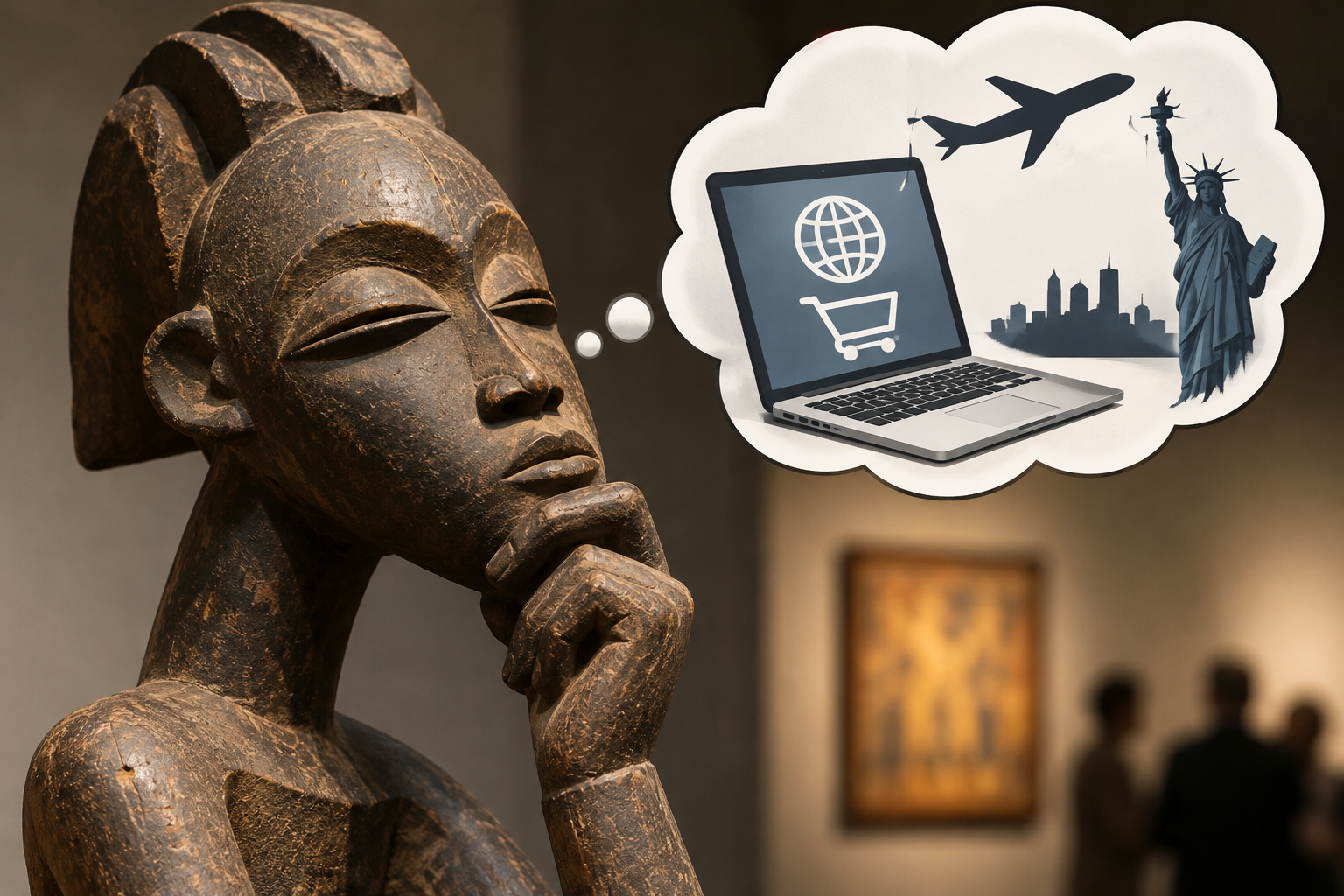
Economic Instability, Gallery Consolidation, Digital Commerce, and the Potential Shift Toward America
ArtTrak Market Analysis | November 10, 2026 | Forecast: 2027–2031
Europe's fine art and traditional tribal art markets face a convergence of economic, political, and technological pressures that could significantly alter international art commerce over the next five years.
France, Belgium, the Netherlands, and the United Kingdom face differing combinations of fiscal pressure, operating costs, regulatory complexity, and periodic social unrest. At the same time, auction houses and private galleries are increasingly able to reach international collectors through websites, email, video presentations, online bidding, and artificial intelligence.
The central forecast is a restructuring of European art commerce rather than its collapse. Traditional gallery premises may become less essential as dealers increasingly rely on private appointments, international fairs, and digital communications. The United States could benefit from this transition through additional consignments, collector relationships, and high-value transactions.
European Economic and Political Pressures
France: French galleries face particularly well-documented financial challenges. October 2026 reporting, citing French gallery-sector research, indicated that 86% of surveyed galleries were pessimistic about their future, approximately one-third reported zero or negative margins, and employment declined 19%. These figures describe the surveyed gallery sector, not specifically the tribal art trade.
Fiscal uncertainty, operating costs, and occasional disruptions to cultural events may encourage further consolidation, private dealing, and reduced dependence on conventional storefronts.
Belgium: Brussels remains an important center for traditional African art, supported by established specialists, collectors, and international exhibitions. Fiscal pressures and periodic transportation disruptions could increase business costs. However, Brussels may also benefit from dealers seeking commercial alternatives to Paris.
The Netherlands: Amsterdam and Maastricht remain significant within European art commerce. Regulatory complexity, operating expenses, and occasional public disturbances represent potential challenges, but the Netherlands retains substantial institutional and fair infrastructure. TEFAF Maastricht's continued international participation demonstrates the resilience of this market.
United Kingdom: London remains Europe's largest national art market center, supported by major auction houses, galleries, financial institutions, and international collectors. Brexit-related trading arrangements, taxation, high operating expenses, and occasional public disruptions may affect its competitiveness. Nevertheless, London remains a formidable alternative to New York.
These conditions differ considerably among countries. Periodic demonstrations or strikes do not, by themselves, establish sustained commercial instability.
Digital Commerce Is Changing the Business Model
The increasing use of digital marketing may prove as consequential as Europe's economic difficulties.
Auction houses and private galleries now routinely employ illustrated websites, email campaigns, online catalogs, video presentations, livestreamed auctions, and remote communications to reach international buyers.
Artificial intelligence offers additional possibilities in catalog preparation, translation, market research, inventory management, and customer communications.
The commercial evidence requires an important distinction. According to the 2026 Art Basel–UBS Art Market Report, online-only sales declined in 2025 as higher-value transactions returned to in-person channels. Nevertheless, digital selling remains substantially more important than before the pandemic.
The 2026 Art Basel–UBS collector survey also found that many collectors who preferred dealing with galleries favored communicating or transacting through websites, telephone, email, or social media rather than visiting gallery premises.
These findings suggest that digital technology is becoming integral to collector relationships, even when the final transaction involves personal inspection or conventional sales channels.
For smaller specialist galleries, digital marketing may reduce certain promotional and premises-related expenses, although photography, staffing, shipping, insurance, and technology costs remain.
The dealer's expertise and collector relationships remain important; the physical location of the gallery may become less so.
European Art Fairs: Resilience and Vulnerability
Europe's major fairs remain commercially and culturally significant.
TEFAF Maastricht reported more than 50,000 visitors and representation from over 450 museums in 2026. BRAFA Brussels reported approximately 72,000 visitors and 147 participating galleries. Frieze London and Frieze Masters reported 95,000 visitors combined.
Art Basel Paris and Parcours des Mondes continue to provide important international platforms, particularly for established fine art and traditional tribal art specialists.
These attendance figures demonstrate continued participation, but they do not independently establish exhibitor profitability.
Fairs face rising transportation, insurance, accommodation, and exhibition expenses. Political demonstrations, strikes, or security restrictions may occasionally complicate operations, although their long-term commercial impact remains uncertain.
A possible development is more selective fair participation, with dealers combining a smaller number of major exhibitions with direct digital marketing and private sales.
For traditional tribal art, fairs may remain especially important because collectors frequently value direct examination of condition, craftsmanship, restoration, and provenance documentation.
Five-Year Probability Assessment, 2027–2031
The following estimates represent subjective, probability-weighted scenario judgments. They are not statistically calibrated forecasts. Each percentage describes the estimated likelihood of a defined development occurring within five years, not the percentage of businesses affected.
Potential development
Estimated probability
Continued expansion of digital marketing and remote collector communications
95%
Increased adoption of AI-assisted gallery and auction operations
90%
Further European gallery consolidation and private dealing
85%
Greater reliance on flexible, lower-overhead gallery models
85%
Increased use of digital channels in international transactions
85%
US share of global art sales exceeds its 2025 level of 44%
75%
More European inventory is marketed directly to American collectors
75%
At least one major European fair experiences significant operational disruption
70%
Further consolidation among specialized European tribal art fair exhibitors
65%
At least 20% of existing Paris tribal art storefronts disappear
50%
Paris loses its position as a leading international traditional tribal art center
35%
At least 20% of Paris tribal art businesses relocate their principal operations abroad
20%
These estimates are conditional on current economic and commercial trends. The outcomes overlap and should not be added together.
The forecast would become more unfavorable for European galleries if fiscal conditions deteriorate, disruptions become frequent, fair participation declines, or operating costs continue rising faster than sales.
Conversely, improved economic stability, sustained international attendance, and profitable adoption of flexible business models could strengthen Europe's competitive position.
Implications for Fine Art
The international fine art market may experience additional concentration among major auction houses, established galleries, and private intermediaries with substantial international collector networks.
The United States already accounts for approximately 44% of global art sales, with New York playing a particularly important role in high-value auctions.
Continued concentration of private wealth and international consignments could increase American market activity. However, this outcome is not guaranteed. London, Paris, Switzerland, and other international centers remain significant competitors.
The location of an artwork, its buyer, its seller, and the jurisdiction in which a transaction is recorded may differ. Consequently, increased American purchasing of European inventory does not necessarily establish a corresponding increase in the US share of reported global sales.
6. Implications for Traditional Tribal Art
The traditional African, Oceanic, and Indigenous art markets may experience particularly significant changes at the specialist dealer level.
Paris and Brussels retain important concentrations of dealers, scholarship, collections, and institutional expertise. These relationships are unlikely to disappear simply because conventional gallery premises become more expensive.
However, a relatively small international collector base makes private dealing and targeted digital communications especially relevant.
Dealers may increasingly maintain modest offices or appointment-only galleries while marketing important objects through international networks. American collectors could become more accessible without requiring European dealers to relocate.
At the same time, provenance, authenticity, condition, restoration, cultural-property restrictions, and repatriation considerations remain essential. Digital images and AI-assisted research cannot independently establish authenticity, ownership, or lawful transfer.
Applicable legal requirements must be evaluated individually, particularly for Indigenous cultural material and objects subject to import, export, or repatriation restrictions.
The Potential American Advantage
The United States may benefit from three related developments: international collector wealth, established auction and private-sale infrastructure, and the ability of digital marketing to connect American buyers with European inventory.
New York is particularly well positioned in high-value transactions. Other American markets, including Dallas and Miami, may offer additional opportunities for private dealers serving established regional collectors.
Nevertheless, American tariffs, tax policy, economic conditions, and cultural-property regulations could limit the expected benefits.
A relocation of European galleries is not necessary for American collectors or intermediaries to gain commercial influence. Transactions and relationships can shift internationally while dealers retain their European businesses.
Conclusion
The next five years may produce a substantial restructuring of European art commerce, driven by operating costs, economic uncertainty, evolving collector behavior, and technological change.
France presents particularly visible gallery-level financial pressures. Belgium and the Netherlands retain important specialist and fair infrastructure, while London remains a major international competitor despite its own commercial challenges.
Digital communications, online platforms, video, and AI-assisted operations are likely to encourage greater flexibility in how dealers conduct business. Their impact may be more pronounced in reducing dependence on physical premises than in replacing personal expertise or major art fairs.
Our central subjective estimates are an 85% probability of further European gallery consolidation and a 75% probability that the United States increases its global art market share by 2031.
The most consequential change may not be where galleries close or relocate, but where inventory is marketed, where collectors purchase, and which businesses control the resulting commercial relationships.
For traditional tribal art, Paris and Brussels may retain much of their historical expertise and scholarly importance even as some international transactions increasingly involve American buyers and intermediaries.
The future market may be less geographically concentrated without becoming any less dependent on professional knowledge, trusted relationships, and careful examination of individual objects.
Sources and Methodological Limitations
Principal sources include the Art Basel and UBS Global Art Market Report 2026, the Art Basel and UBS Survey of Global Collecting 2026, the French Comité Professionnel des Galeries d'Art 2026 barometer, and official 2026 reporting from TEFAF, BRAFA, and Frieze.
The probability estimates are independent analytical judgments, not statistically validated forecasts. The article is general market commentary, not an appraisal, investment recommendation, legal opinion, or assessment of any identified dealer's financial condition. No conclusion concerning an individual object's authenticity, title, provenance, or legal status is intended.
The analysis relies on publicly reported information and does not disclose private client transactions or confidential advisory material. Forecasts are subject to revision as additional market evidence becomes available.
Publication notes
The revised report corrects one important factual weakness in the earlier version: digital marketing is expanding in importance, but online-only art sales did not increase in 2025. Art Basel reported that dealer online sales declined to 16% of turnover, while art-fair sales rose to 35%. This makes the argument for a hybrid future considerably stronger than a prediction that internet sales will replace galleries and fairs.
The evidence for AI adoption is also more specific: the 2026 collector survey found that 22% of surveyed high-net-worth collectors used apps or AI tools for advice, compared with 4% in 2024.
Art Basel
For publication, I recommend linking the underlying French gallery barometer and Art Basel–UBS market report. The remaining numerical probabilities should be explicitly presented as ArtTrak analytical estimates, not independently verified market statistics.
Final editorial risk: Low for language concerning identified parties; Moderate for the forecast and its evidentiary limitations. The report is substantially more defensible as independent market commentary, subject to final source and rights verification.