Kate Fitz Gibbon's July 28, 2026 article, The Trump Administration's Smithsonian Report: A Blueprint for Governmental Censorship, argues that the administration's attempt to reform the Smithsonian represents political interference, ideological censorship, and a threat to scholarly independence. Se: https://culturalpropertynews.org/the-trump-administrations-smithsonian-report-a-blueprint-for-governmental-censorship/
Her central concern is that government officials are attempting to dictate how American history should be presented.
The strongest counterargument is that the Smithsonian may already have been influenced by political and ideological preferences, and that correcting institutional bias is not necessarily censorship.
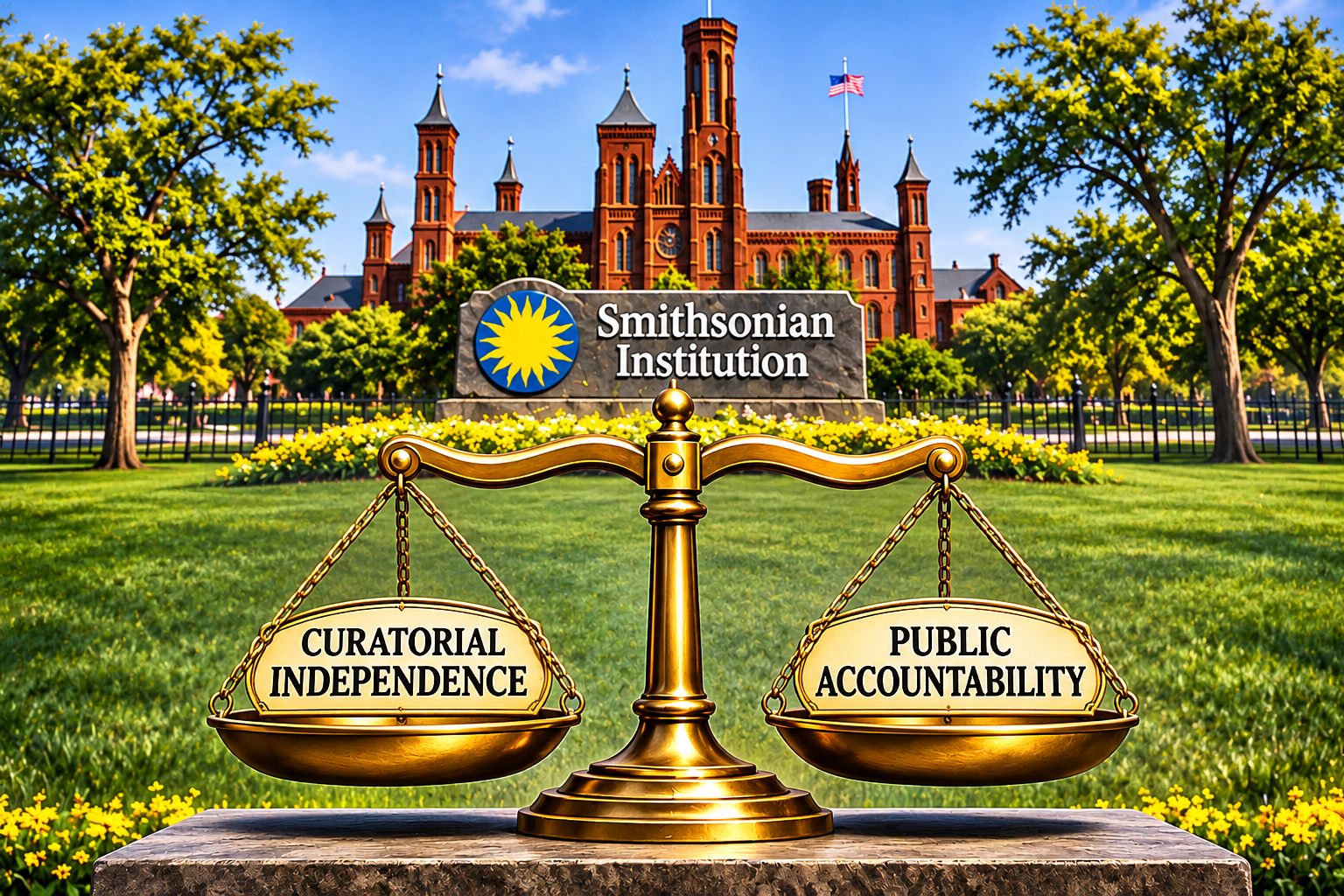
There is an important distinction between protecting curatorial independence and allowing a publicly funded institution to operate without meaningful accountability.
Seven arguments Kate's analysis does not adequately address
Curatorial independence is not immunity from accountability.
The Smithsonian receives substantial federal funding. Congress, the administration, and ultimately taxpayers have legitimate interests in whether the institution fulfills its educational mission.
Museum professionals should control scholarly judgments, but they should also be accountable for accuracy, balance, transparency, and responsible use of public money.
The question is not whether the government should supervise the Smithsonian. It is how far that supervision can legitimately extend.
Ideological bias can exist inside museums as well as outside them.
Kate assumes that political interference originates primarily with the Trump administration.
But museum leadership, curators, academics, and exhibition designers are not necessarily politically neutral.
The adoption of interpretive frameworks emphasizing systemic racism, colonialism, gender identity, and social justice can reflect legitimate scholarship. It can also introduce ideological preferences when alternative interpretations are excluded or inadequately represented.
The appropriate question is whether those frameworks are supported by evidence and presented fairly.
The public has a legitimate interest in how American history is presented.
A national museum has responsibilities beyond those of a university department or privately financed cultural institution.
It serves an extraordinarily diverse public, including visitors who may disagree with the political assumptions of its curators.
A museum that presents America's history predominantly through oppression, exclusion, and injustice risks producing a distorted account just as surely as one that presents nothing but national achievement.
Historical accuracy requires both.
Patriotism is not inherently incompatible with scholarship.
Kate treats the administration's emphasis on national pride and unity as evidence of an attempt to manufacture historical conformity.
But celebrating the Constitution, Declaration of Independence, abolition, scientific achievement, and democratic institutions does not require concealing slavery, Native American dispossession, segregation, or other historical injustices.
A museum can acknowledge profound national failures while recognizing the country's extraordinary accomplishments.
Patriotism becomes propaganda when it requires suppressing contrary evidence. Criticism becomes ideological advocacy when it systematically minimizes accomplishments or excludes competing interpretations.
The Smithsonian's leadership should be subject to performance review.
Kate strongly objects to the administration's criticism of Smithsonian leadership.
Yet leadership accountability is a normal feature of institutions receiving public support.
Legitimate questions include whether exhibition policies are transparent, whether interpretive disagreements receive professional consideration, whether curatorial appointments encourage intellectual diversity, and whether the institution maintains public confidence.
Such reviews should use independently verifiable standards rather than political loyalty tests.
Kate's comparison with Nazi and Soviet propaganda weakens her argument.
Her references to the Nazi Degenerate Art exhibition and Soviet ideological conformity introduce extreme historical comparisons without establishing that the Smithsonian controversy involves equivalent practices.
There is a substantial difference between government criticism of a publicly supported museum and the systematic suppression, confiscation, and persecution associated with totalitarian regimes.
That does not mean government censorship is impossible. It means the analogy requires considerably stronger evidence.
Academic freedom must operate in both directions.
Kate argues that government pressure could discourage curators from presenting controversial historical interpretations.
That is a legitimate concern.
But intellectual freedom should also protect scholars who challenge fashionable academic theories, question decolonization frameworks, or offer more favorable interpretations of American institutions.
If a museum protects one category of interpretation while marginalizing another for ideological reasons, its claim to scholarly independence becomes less persuasive.
Where the counterargument is strongest—and weakest
The strongest case against Kate's position is that she gives insufficient attention to the possibility that the Smithsonian itself may require reform. Her article concentrates on the dangers of political intervention without adequately examining whether the underlying criticisms of museum practices have merit.
However, the reverse argument also has limitations. Public funding does not authorize the president to rewrite exhibition labels, dismiss Smithsonian officials outside established legal procedures, or require historians to reach predetermined patriotic conclusions. Those are genuine governance and constitutional concerns.
Furthermore, Kate's article alone does not establish that the Smithsonian has engaged in systematic ideological discrimination. That proposition requires a separate, evidence-based review of actual exhibitions, staffing policies, interpretive decisions, and competing scholarly assessments.
The fundamental question Kate leaves unanswered
Who determines when legitimate scholarly interpretation becomes institutional political advocacy?
Kate appears to place considerable confidence in museum professionals to make that distinction. The administration's position places greater emphasis on public accountability and correcting perceived ideological bias.
Neither approach is sufficient by itself.
The Smithsonian should be free from partisan direction, but it should not be free from independent scrutiny. Its exhibitions should withstand the same rigorous examination of evidence, interpretation, omissions, and professional judgment that museums routinely apply to the objects in their collections.
The strongest rebuttal to Kate is therefore not that the Trump administration should control the Smithsonian. It is that curatorial independence cannot become a justification for ideological insulation, institutional self-protection, or freedom from accountability.
There is a further irony worth exploring: Kate demands a rigorous, transparent methodology from the White House report, but her own article does not undertake a systematic examination of whether the Smithsonian's exhibitions actually exhibit the ideological bias the administration alleges.
That omission does not invalidate her warnings about government overreach. It does, however, leave the other half of the controversy largely unexamined.
The real standard should be straightforward: Neither the White House nor the Smithsonian should have the authority to substitute political preference for historical evidence.