One of the great pleasures of Antiques Roadshow was never knowing what would come through the door—or whether you would survive telling its owner what he had brought.
When we filmed in convention halls, ninety to a hundred appraisers sat behind six-foot tables arranged in a giant circle, with three taping areas in the center. It was a remarkably efficient operation, particularly considering the number of egos involved.
Whenever something extraordinary entered the hall, word spread instantly. Heads turned, producers appeared, and appraisers abandoned whatever they were doing to get a look.
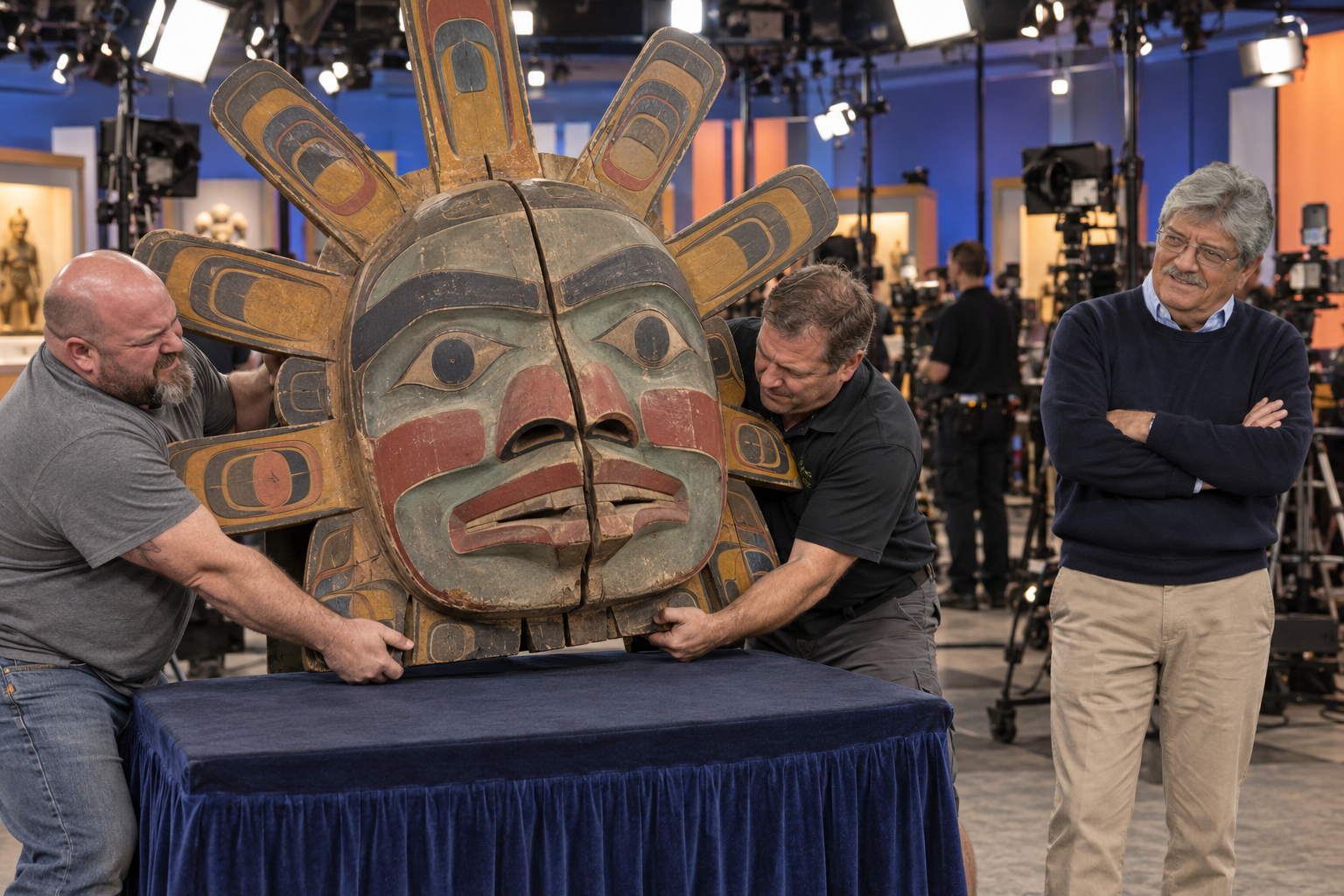
In Baltimore, something extraordinary was headed straight for me: an enormous Kwakiutl-style transformation mask, four or five feet tall, accompanied by a short, stocky fellow who looked as though he could tear the doors off a Buick without breaking a sweat.
The mask was intimidating. Its owner was worse.
He had the build of a human wrecking ball and the expression of a man who hadn't come to Baltimore to make friends.
We shook hands, looked each other in the eye, and began discussing his treasure. He was quiet, polite enough, but wound tighter than a cheap watch.
He had purchased the mask from a Maryland dealer about nine years earlier. According to the dealer, it had come from the estate of a missionary in Pennsylvania's Lehigh Valley. An earlier appraisal identified it as a Kwakiutl transformation mask from Vancouver Island, dating to around 1900–1910, with an auction value of $8,000.
There was only one problem. It was a fake. I knew it immediately.
Now, a sensible appraiser might have thanked the gentleman, explained the problem privately, and sent him on his way. But I had been doing Roadshow long enough to recognize television gold when it walked through the door. The mask was enormous, theatrical, and spectacularly wrong. The producers would love it.
And I, apparently having misplaced whatever instinct for self-preservation the Navy had once taught me, pitched it for television. Naturally, the producers jumped at it. Whether the guest might dismantle the appraiser on camera was apparently a secondary consideration. Good television was good television.
I'm reasonably certain some of my fellow tribal art appraisers would have exercised better judgment. I have never been accused of that particular failing.
During the taping, I asked the owner whether he had ever seen a traditional transformation mask this large.
"I'd never seen anything this big," he admitted.
Neither had I, and for good reason.
It had taken two people to hoist the damned thing onto the table. A Kwakwaka'wakw dancer wearing this monster would have needed the shoulders of a linebacker and probably a chiropractor standing by. Actually dancing in it, while opening and closing its articulated sections, would have been somewhere between improbable and suicidal.
The problems didn't end with its size. The broad nose, full lips, crude construction, hinges, excessive weight, and general stylistic confusion all pointed away from a historic Northwest Coast ceremonial mask.
My conclusion was that it had probably been manufactured in Indonesia for the Western decorative market.
In other words, instead of an important Indigenous ceremonial object, he owned an oversized piece of imported wall decoration.
He had paid somewhere between $3,000 and $4,000 for it. I estimated its actual market value at $1,500 to $2,500 on the decorative market not the fine art market.
Not exactly the news he had traveled to Baltimore hoping to hear.
He took it quietly. Perhaps a little too quietly.
After the taping, my good friend Sean, the head of security, approached me looking distinctly relieved.
"I'm glad that's over," he said.
"Why?"
"The guy told us he was going to charge you if you embarrassed him on camera, so I had plain clothes security surrounding the set."
I stared at Sean.
"Thank you very much for not telling me that BEFORE the segment."
Apparently, the security department had decided that ignorance was the best protection for an appraiser. Or perhaps they just wanted to see how it played out.
Either way, I survived.
The guest went home with a fake Kwakiutl mask, a considerably smaller valuation, and, I suspect, a powerful dislike for me.
I went home with another Roadshow story and a renewed appreciation for the fact that the show's security staff had been paying attention—even if they had neglected to share some fairly important information.
And somewhere in Maryland, there may still be a very large mask and a very unhappy man who remembers exactly who told him it was fake.