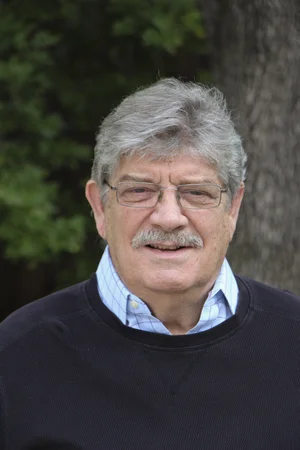
In Memorium
Bob Pickering
October 11, 1950 – July 1, 2026
Bob Pickering was an anthropologist, archaeologist, forensic anthropologist, museum curator and educator whose career ranged from identifying the remains of American servicemen to investigating the authenticity of ancient West Mexican ceramics.
I first knew Bob when he was at the Children’s Museum of Indianapolis and I was visiting the city. Looking back over his career, what strikes me is how consistently he approached objects as evidence. Art was something to look at, certainly, but it was also something to question, investigate and use to understand the people who made it.
A Career in Anthropology and Museums
Pickering trained in physical anthropology and received his Ph.D. from Northwestern University in 1984. In 1975–76, he worked at the U.S. Army identification laboratory in Thailand, helping identify the remains of American servicemen from the Vietnam War. He later worked in education at Chicago’s Field Museum.
From 1988 to 1991, Pickering served as an educator and curator of anthropology at the Children’s Museum of Indianapolis. His interest in teaching through objects was already apparent. A 1988 professional presentation was titled “Cultural Awareness in Tomorrow’s Adults: The Collection Strategy at the Children’s Museum of Indianapolis.”
In 1991 he joined the Denver Museum of Natural History as curator and chair of anthropology. His work increasingly combined archaeology, physical anthropology and museum collections, with particular attention to the shaft-tomb cultures of ancient West Mexico.
Pickering subsequently served at the Buffalo Bill Historical Center in Cody, Wyoming, before moving to Tulsa, where his career became closely associated with the University of Tulsa and Gilcrease Museum. At the university, he was a professor of anthropology and founding director of the graduate program in Museum Science and Management. At Gilcrease, he continued his research and curatorial work.
Looking Inside the Object
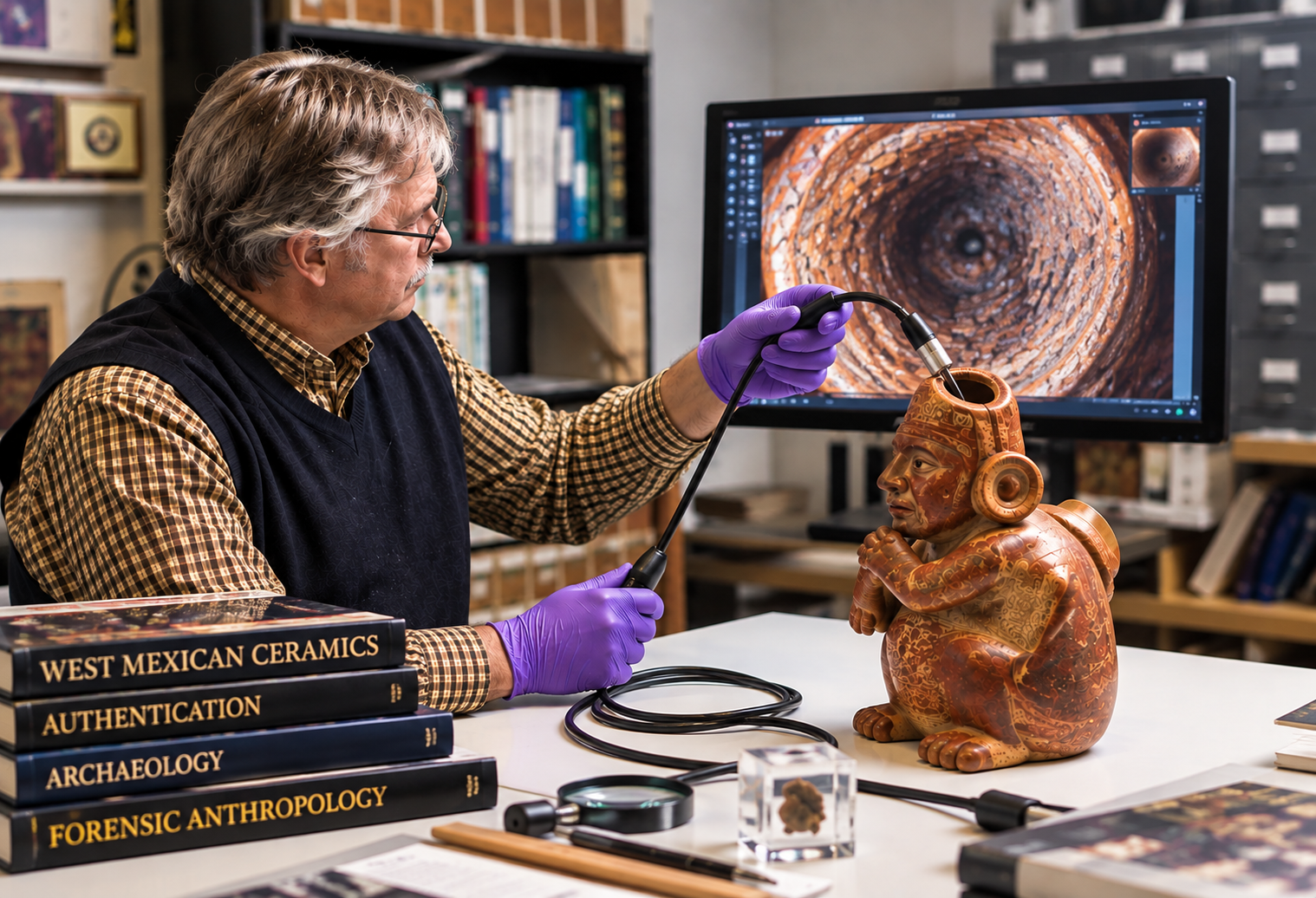
Pickering's most important contribution to the study of Pre-Columbian art may have been his application of forensic thinking to ancient West Mexican ceramics.
While examining an undisturbed shaft tomb near Guadalajara in the 1990s, Pickering observed insect remains associated with ceramics from the burial. That observation contributed to research into whether insect remains, mineral deposits and other physical evidence could help establish whether an object had actually spent centuries in an ancient burial environment.
Pickering became among the early Pre-Columbian scholars to systematically investigate what could be learned from the interior of hollow ceramic sculpture.
Using medical endoscopes, and later technologies including CT imaging, he examined areas normally invisible to collectors and scholars. He looked for evidence associated with burial environments, ancient manufacture, restoration, alteration and modern fabrication.
This represented an important change in perspective. Authentication of West Mexican ceramics had long depended heavily upon style, iconography, surface examination and connoisseurship. Pickering asked an additional question: What physical evidence does the object itself contain?
His work with chemist Ephraim Cuevas on ancient West Mexican ceramics brought scientific and forensic methods directly into the authentication discussion.
West Mexico: Ritual and Identity
In 2016, Pickering curated West Mexico: Ritual and Identity at Gilcrease Museum and coauthored the accompanying publication.
The exhibition addressed not only the artistry and cultural meaning of West Mexican ceramics but also some of the difficult issues surrounding them: archaeological context, restoration, alteration and forgery.
Two years later, Pickering and colleagues examined more than 100 West Mexican ceramics at Emory University’s Michael C. Carlos Museum. Among their techniques was the use of an endoscope to examine inaccessible interior surfaces for evidence that could contribute to understanding an object's history and authenticity.
Education Through Objects
For all of Bob's scientific work, education remained a consistent thread throughout his career.
It began with museum education at the Field Museum, continued at the Children’s Museum of Indianapolis, expanded through his curatorial and administrative positions, and eventually included training future museum professionals at the University of Tulsa.
I would not describe Bob primarily as a philosopher of art. He was an anthropologist and educator, and his approach was grounded in evidence.
But there was a philosophy behind what he did:
The object is the beginning of the inquiry, not the end of it.
A West Mexican figure could be aesthetically extraordinary, but Bob wanted to know more. How was it made? How was it used? Where had it been? Had it been altered or restored? Was it actually ancient? What could science contribute that the eye alone could not?
In many ways, that summarizes Bob Pickering's contribution as both a scholar and a teacher: