The Authority of the Label
A Challenge to Museums and Educators
After more than fifty years of looking at art in private and public collections, one problem has become increasingly clear to me: we have a tendency to confuse what we believe with what we know.
There is another problem. Sometimes we are told what to think before we have had a chance to look.
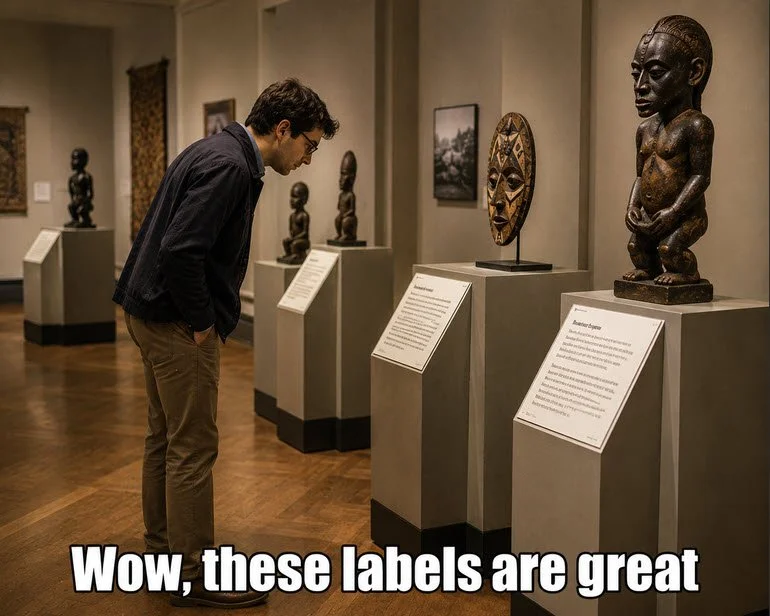
Years ago, while preparing a Roadshow shoot at the Menil Collection in Houston, I became interested in Dominique de Menil's approach to presenting art. What stayed with me was the unobtrusive placement of labels, which encouraged visitors to encounter the object before turning to an explanation. The Texas State Historical Association describes the Menil exhibition philosophy as emphasizing “direct engagement with works of art without didactic wall text.” A history of the museum likewise describes the galleries as providing a “very direct experience with the work of art,” with “little or no text” and a contemplative experience.
The principle is worth considering: look first, read second.
A museum label can identify an object's material, date, provenance, cultural origin and documented use. It can also provide interpretation. The difficulty begins when those two kinds of information become indistinguishable.
One Object, Different Perspectives
Consider an object made in an Indigenous community in Africa, Oceania or the Americas.
Its maker may have understood it one way. The person who commissioned or used it may have understood it differently. It might have been valued as prestigious, protective, ancestral, sacred or effective in fulfilling a particular purpose.
Later, a curator may approach the same object through art history or anthropology. A dealer may consider rarity, quality, provenance and market history. An appraiser considers authenticity, condition, attribution, comparable objects and value. A collector brings another body of experience. A contemporary member of the source community may contribute inherited knowledge unavailable to earlier scholars.
The museum visitor brings something else: a direct response to the object.
These perspectives need not compete. They answer different questions.
What Does the Label Actually Tell Us?
Museum labels often use the language of art history and connoisseurship: balance, abstraction, monumentality, elegance or expressive power. Such observations can be valuable, but we should identify what kind of statements they are.
Consider the difference:
"This sculpture has extraordinary balance."
"I find the balance of this sculpture extraordinary."
"The people who created this sculpture valued it because of its extraordinary balance."
The first is an aesthetic judgment presented as a characteristic of the object. The second identifies the judgment as the observer's. The third makes a historical claim about another culture and therefore requires evidence.
That distinction matters because museums possess institutional authority. Once an interpretation appears on a museum label or in a scholarly catalogue, readers can easily begin treating it as established fact.
The problem is not interpretation. The problem is interpretation presented without identifying its source or evidentiary basis.
What We Know and What We Think
Every museum label contains, implicitly or explicitly, two categories of information.
One is evidence: material, dimensions, documented provenance, scientific analysis, historical photographs, field observations and recorded statements by makers or users.
The other is interpretation.
Words such as beautiful, elegant, crude, sophisticated, monumental, spiritual, powerful and masterpiece generally describe judgments rather than independently demonstrable properties.
Interpretation is essential to scholarship. But museums would strengthen their authority by making clearer where evidence ends and interpretation begins.
The same standard should apply to Indigenous knowledge. Source communities can contribute language, history, ritual knowledge, symbolism, manufacture and use that collectors and scholars overlooked or misunderstood. That knowledge deserves serious documentation.
But "Indigenous" no more represents a single viewpoint than "Western" does. Knowledge can differ among individuals, families, specialists and generations. When anyone makes a historical claim about what a particular maker or community believed generations ago, it remains reasonable to ask what evidence supports it.
Expertise Still Matters
None of this diminishes expertise.
Decades spent examining objects reveal materials, techniques, restoration, regional characteristics, workshop practices and stylistic relationships that a casual observer will miss. A curator, conservator, anthropologist, source-community specialist, collector, dealer and appraiser may each possess knowledge relevant to the same object.
The mistake is assuming that one perspective automatically becomes the complete meaning of the object.
An object can move through many worlds. It may be made, commissioned, used, inherited, collected, studied, exhibited, bought, sold and eventually reinterpreted by later generations.
The object accumulates meanings.
The museum's interpretation is one important part of that history, but it is not necessarily the whole story.
A Challenge to Museums
A museum label should help visitors distinguish among three things: what is documented, what is interpreted and who is providing the interpretation.
And sometimes the museum might give visitors something even simpler: enough space to encounter the object before explaining it.
That is what has stayed with me from the Menil.
Look first. Then read.
The label may change what you see. Scholarship may reveal meanings that visual examination alone could never provide. That is one of the museum's great contributions.
But the authority of the institution should come from demonstrating how it knows what it says it knows, not merely from putting those conclusions on a label.
For museums, scholars, collectors, dealers, appraisers and source communities alike, the fundamental question remains the same:
How do we know?