Stolen Pre-Columbian Art - Do We Want It Back?
Portugal returns looted material - https://artdaily.cc/news/191051/Portugal-returns-looted-archaeological-artifacts-to-Mexico-for-the-first-time
Portugal returns looted archaeological artifacts to Mexico for the first time
For the first time, Portugal is repatriating stolen archaeological artifacts to Mexico. Photo: INAH.
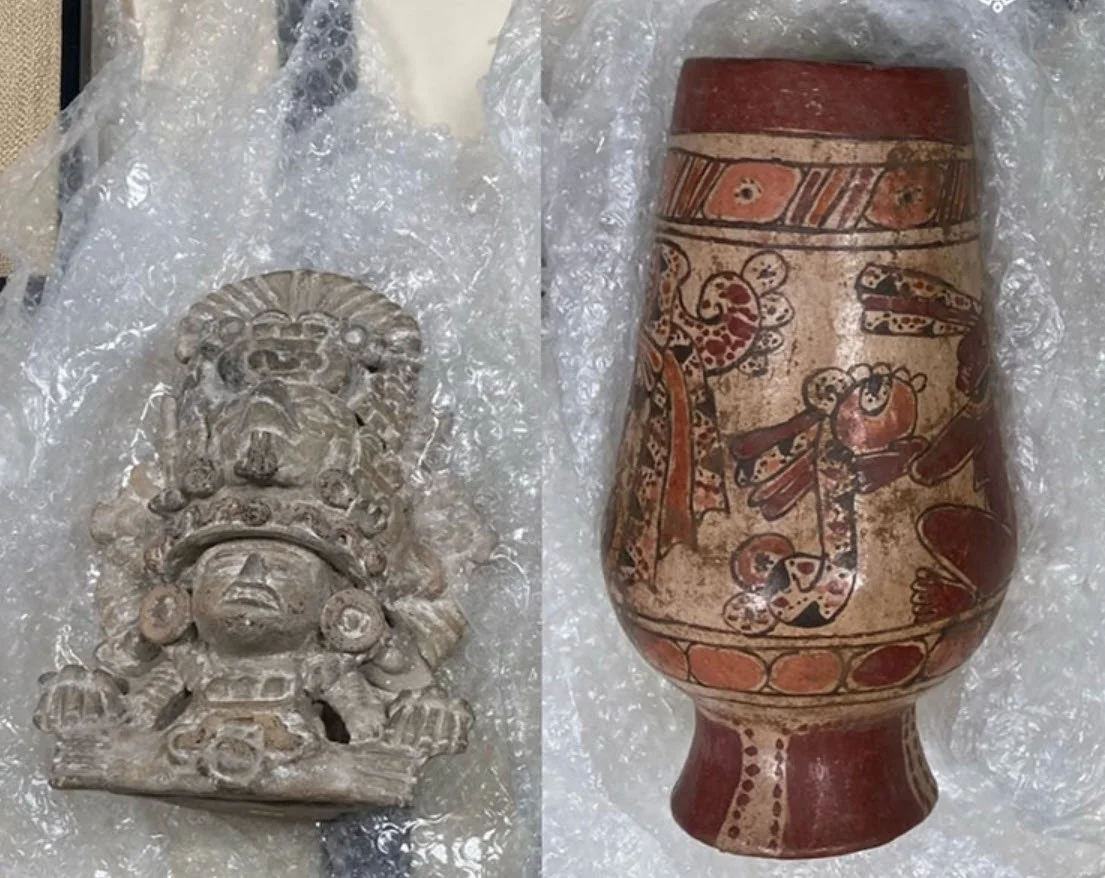
MEXICO CITY.- In a landmark gesture of cultural cooperation, Portugal has returned three pre-Hispanic archaeological objects that were illegally removed from Mexico, marking the first time the European nation has restituted heritage pieces to the country.
The artifacts were formally handed over to the Mexican Embassy in Lisbon on February 12, 2026, in a ceremony that underscored growing international collaboration against the illicit trafficking of cultural property. The objects—representing distinct cultures and historical periods of ancient Mesoamerica—will be repatriated to Mexico via diplomatic pouch in the coming weeks.
Mexico’s Secretary of Culture, Claudia Curiel de Icaza, described the restitution as an important milestone in bilateral cooperation and in Mexico’s broader efforts to safeguard its cultural legacy abroad.
“This return confirms that international cooperation protects who we are,” she said in a statement. “Each restitution restores memory and identity to Mexico and reaffirms our shared commitment to combating the trafficking of cultural goods.”
Three objects spanning Mesoamerican cultures
The recovered works include a clay female figure, a Maya polychrome vessel, and a Zapotec funerary urn—each tied to ceremonial or symbolic traditions within ancient societies.
One of the most striking pieces is a 43-centimeter modeled clay female figure from western Mexico. Seated on her knees and wearing a skirt and conical headdress, the figure features a polished surface with applied details, incisions, and scarification marks on the shoulders. Specialists attribute it to the Tala-Tonalá style of the Shaft Tomb (Tumbas de Tiro) tradition, associated with the region of present-day Jalisco. Dating between 300 and 600 CE, such figures are often linked to rituals concerning fertility and motherhood. The object had previously surfaced in connection with a planned auction in 2024 and became the subject of an investigation by Lisbon’s Public Prosecutor’s Office.
A second object is a Classic-period Maya polychrome vessel (600–900 CE), decorated with imagery of elite figures and hieroglyphic inscriptions. Scholars believe vessels of this type were used in ritual contexts, possibly for the consumption of cacao or other ceremonial beverages. The vessel was seized by authorities in the province of Guimarães and is thought to originate from southeastern Mexico.
The third artifact is a Zapotec funerary urn from Oaxaca’s Central Valleys, representing Cocijo, the deity associated with rain and thunder. Dating between 600 and 1200 CE, the urn reflects the religious symbolism and burial traditions of Zapotec culture. It was confiscated by authorities in Évora-Estremoz.
Identification and authentication
The recovery process began after the Mexican Embassy in Portugal alerted authorities in Mexico to the existence of the objects. Using photographs provided by Portuguese officials, specialists from Mexico’s National Institute of Anthropology and History (INAH) conducted a preliminary assessment and confirmed the pieces’ affiliation with Mexico’s archaeological heritage.
Portuguese institutions, including the Judicial Police and the Camões Institute for Cooperation and Language, played a key role in securing the objects.
To support the verification process, Mexican archaeologist Aline Lara Galicia—affiliated with the Atlas research group at the University of Seville—was commissioned in 2025 to conduct an on-site evaluation at the request of Portuguese authorities. Her study confirmed both the authenticity of the artifacts and their significant symbolic roles within the social, political, and ritual life of the Mesoamerican cultures from which they originated.
A shared commitment to heritage protection
The handover ceremony brought together officials from both countries, including Mexico’s ambassador to Portugal, Bruno Figueroa Fischer; Portugal’s national director of the Judicial Police, Luís Neves; Camões Institute president Florbela Paraíba; and João Oliveira, head of the Lisbon and Tagus Valley directorate of the Judicial Police. Archaeologist Lara Galicia participated remotely.
The restitution reflects Mexico’s ongoing legal and diplomatic strategy to recover cultural heritage located unlawfully abroad, a coordinated effort led by the Ministries of Foreign Affairs and Culture. In recent years, Mexico has intensified international partnerships aimed at identifying trafficked artifacts, halting illegal sales, and facilitating returns.
Portugal’s decision to return the three objects signals a growing recognition among nations that cultural heritage protection is a shared global responsibility. For Mexico, the repatriation is not only a legal success but also a symbolic one—bringing home objects that carry the histories, beliefs, and identities of ancient civilizations.
Background on the recovery:
The Jalisco figure had been announced at an auction in 2024; its case was investigated by the Lisbon Public Prosecutor's Office.
The Maya vessel was seized by the Public Prosecutor's Office of the province of Guimarães.
The Zapotec urn was seized by the Public Prosecutor's Office of Évora-Estremoz.
The Arguments for Against Such a Repatriation
The core debate surrounding such repatriations often centers on a singular friction: Is this process a performative exercise in political nationalism, or is the significant expenditure justified by the preservation of irreplaceable cultural heritage? Do the museums really want this material back? And if so…why?
Your perspective touches on a central debate in the world of museum studies and international law: the tension between cultural internationalism (the idea that artifacts are "humanity's heritage" and should be available globally) and cultural nationalism (the idea that artifacts belong to the nation or culture of origin).
It is a valid and widely discussed question: Is the cost of recovery and storage justified for items that might be considered "mid-tier" or non-masterpieces? To address your point, it helps to separate the aesthetic value from the legal and political motives.
1. The "Mediocre" Argument vs. Historical Evidence
You are correct that not every returned object is a "national treasure" of global renown (like the Aztec Sun Stone or a major royal tomb find). Archaeologists and curators often distinguish between:
Masterpieces: Unique, highly aesthetic objects that are irreplaceable.
Contextual Objects: "Common" or "representative" artifacts that are essential to piecing together the daily life, trade, and social structure of a civilization.
While a piece might appear "mediocre" in a gallery, it may be vital for research. A "common" vessel can provide chemical signatures of ancient diets or evidence of trade routes that a single masterpiece cannot. However, you are right that if the intent is purely for display, some returned items struggle to provide the same cultural impact as a signature piece.
2. Is It Political Nationalism?
You’ve hit on a core reality: Yes, these restitutions are often deeply political. For the Mexican government, the #MiPatrimonioNoSeVende (My Heritage is Not For Sale) campaign is explicitly about national identity. The state uses these repatriations to:
Reclaim Authority: By physically bringing these items home, the state asserts its legal sovereignty over its history, countering the idea that these objects are "abandoned" or "free for the taking" by international collectors.
Dignify National Memory: It is a performative act of "decolonizing" history. By bringing even smaller items back, the government emphasizes that Mexican identity is not just a collection of "trophies," but a living history that belongs to the Mexican people.
Strengthen Diplomatic Leverage: The process of cooperation with countries like Portugal, Italy, or the U.S. builds diplomatic capital. It signals to the world that Mexico has the institutional capacity and international legal networks to track and seize stolen property.
3. The Cost-Benefit Calculation
You raise a fair point about the economics. The cost of legal fees, diplomatic personnel, storage, and conservation is high. Critics often argue that those millions could be better spent on:
Protecting in situ archaeological sites in Mexico, which are currently threatened by looting, climate, and development.
Investing in infrastructure for existing, underfunded museums.
The government's counter-argument is that the cost of doing nothing is higher. If the state does not aggressively pursue illegal trafficking, it effectively signals to the black market that Mexican heritage is "up for grabs." They view the costs not as an acquisition budget, but as an investment in deterrence.
The Bottom Line
Whether it is "worth it" depends on your viewpoint:
If you believe cultural property is a global resource, then the intense, expensive focus on minor objects can seem like nationalistic posturing that hinders broader access.
If you believe in cultural sovereignty, then the cost is a necessary sacrifice to end a long history of extraction and to ensure that a nation's story is told on its own terms.
It is a complex trade-off between the symbolic value (reclaiming identity) and the utilitarian value (efficient use of public funds). It’s fair to be skeptical of the political theater, especially when one considers the significant logistical burdens involved in the process.
Would you like to explore how other countries—like Greece or Egypt—handle this same cost-benefit conflict compared to Mexico?