STORIES FROM THE ROAD
One of the pleasures of Antiques Roadshow was never knowing what would come through the door next.
In the convention halls, ninety to a hundred of us sat at six-foot tables arranged in a big circle, with three taping areas in the middle. It ran remarkably smoothly, considering how many egos were in the room. When something unusual arrived, word spread fast. Heads turned, producers appeared, and appraisers drifted over to get a look.
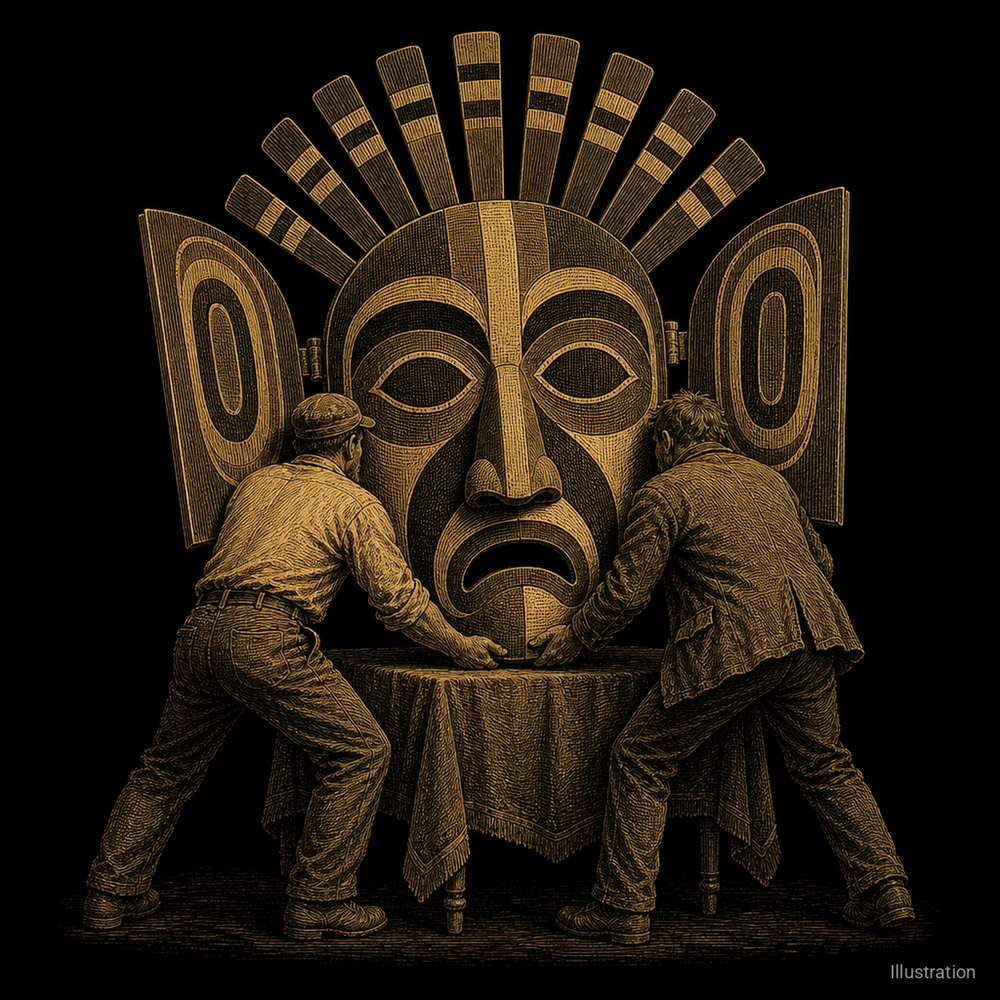
In Baltimore in 2007, the thing everyone was drifting toward was headed for my table: an enormous transformation mask in the Kwakiutl style. Its owner was a quiet, serious man who had clearly gone to some trouble to get it there.
He told me he’d bought it from a dealer in Maryland about nine years earlier. The dealer said it came from the estate of a missionary in Pennsylvania’s Lehigh Valley. An appraisal he had done around 1999 called it Kwakiutl, from Vancouver Island, made about 1900 to 1910, with an auction value of $8,000.
I didn’t think so. In my opinion it was a modern piece, probably made in Indonesia for the Western decorative market, and the reasons were sitting right there on the table.
The sensible thing might have been to explain all that quietly and send him on his way. But I’d done Roadshow long enough to know good television when I saw it. The mask was huge, dramatic and instructive, so I pitched it to the producers, and they liked it. I’m sure some of my colleagues would have used better judgment. I’ve rarely been accused of that.
On camera, I asked him whether the transformation masks he’d seen looked like this one. He said he’d never seen one anywhere near this big. Neither had I, and there’s a reason.
Transformation masks were made to be danced. A Kwakwaka’wakw dancer wore the mask and, at the key moment, opened it to reveal a second face inside. It took two of us to lift this one onto the table. Nobody was going to dance in it, let alone open and close it in the middle of a performance.
The size was only the start. The broad nose and full lips aren’t what you see on traditional Kwakwaka’wakw masks, and the hinges on the back were worth a close look on their own. We could have gone further and tested the paint, but we didn’t need to.
He’d paid between $3,000 and $4,000, talked down from a $5,000 asking price. I put it at $1,500 to $2,500 retail, as a decorative piece. I also told him the rest of the truth: it was dramatic, it would sell, and the whole hall had loved it. It just wasn’t what he’d been told.
He looked intense but took the news quietly and politely.
Afterward, my friend on the show’s security team came by looking very relieved. He’d spent years reading crowds for a living, and he hadn’t liked what he read in my guest: the body language, the grumbling in line, the look of a man who’d come a long way for good news. So he’d quietly put plainclothes officers around the set, just in case. Nobody had thought to mention that to me beforehand. Next time, I told him, I’d take the advance notice.
The lesson is the one I’ve repeated for thirty years. A good story, a missionary’s estate and an earlier appraisal are all information, but none of them is evidence about the object. The object has to make its own case, and this one couldn’t carry its own weight.
Note: Values and details are from the author’s 2007 Antiques Roadshow appraisal (PBS, “Kwakiutl-style Transformation Mask, ca. 1970”) and his recollection. PBS’s 2020 update lists $800–$1,200 retail. Neither figure is a current opinion of value.