Tribal Art Repatriations: The Growing Impact on Museums and Collectors
ArtTrak | October 2026
The expanding repatriation of Native American cultural property is reshaping museum collections and raising important questions for private collectors, dealers, and appraisers. The most significant development is the application of NAGPRA not only to ancestral remains and archaeological materials, but also to historic ceremonial objects, baskets, clothing, and other works traditionally collected as Native American art.
The following cases are organized by institution, with particular attention to the objects involved, the status of the proceedings, and their implications for the art market.
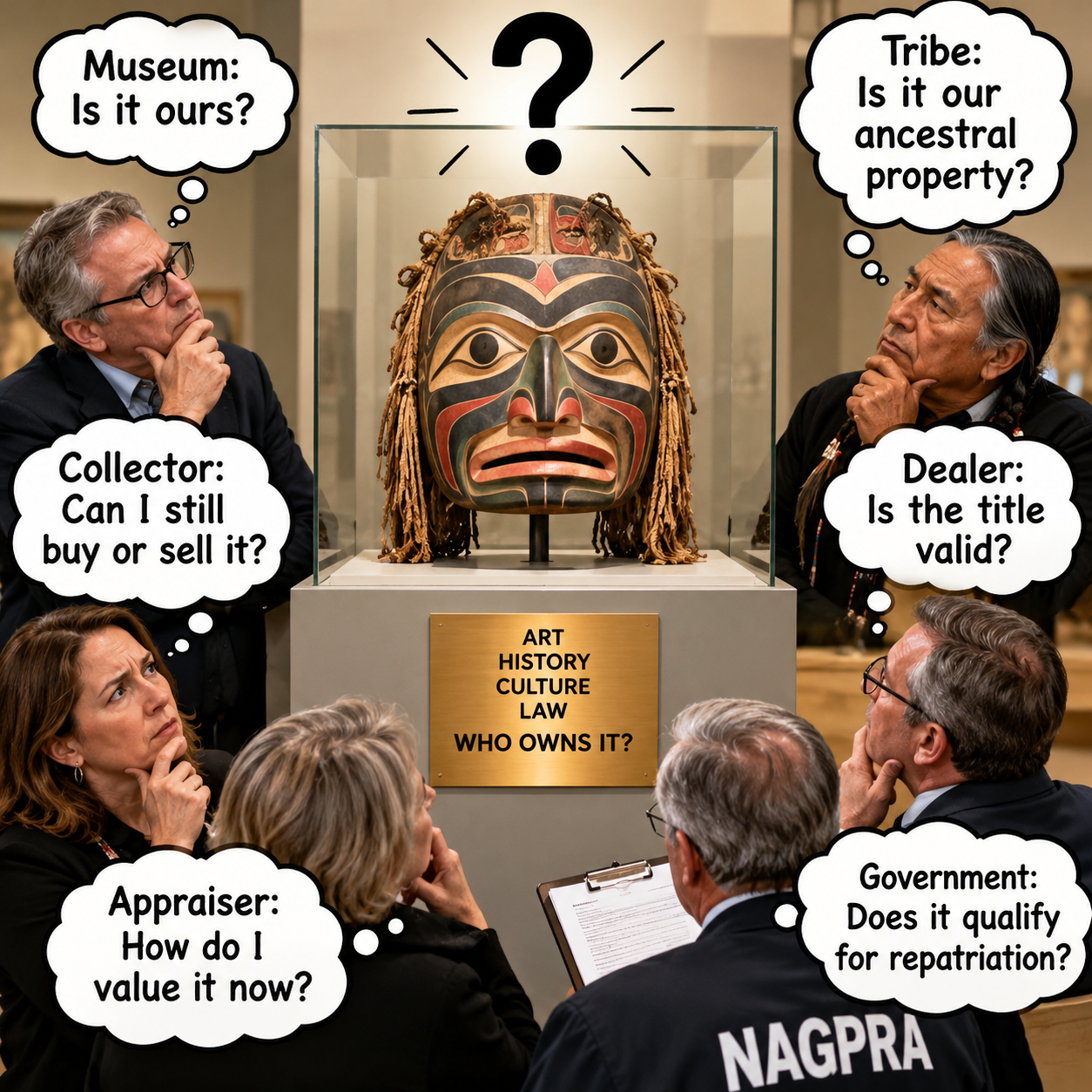
1. Virginia Museum of Fine Arts — Northwest Coast ceremonial art
Objects: Headdress frontlet, raven rattle, and halibut grease dish.
A September 2026 federal notice identified three culturally significant Northwest Coast objects for possible repatriation, with transfer permitted beginning October 23, 2026, subject to the applicable claims process.
These are especially important categories of material in the Northwest Coast art market. Historic rattles, ceremonial headdresses, and carved feast utensils can command substantial prices, particularly when supported by early collection histories.
Market implications: The case illustrates the potential vulnerability of objects traditionally treated as privately owned works of art when evidence establishes that they are sacred objects or communal cultural patrimony. Their artistic importance and commercial value do not, by themselves, determine their legal status.
2. Portland Art Museum — nineteenth-century Kawaiisu baskets
Objects: Two historic baskets associated with the Kawaiisu people, including an example dated approximately 1850.
The Tejon Indian Tribe submitted a repatriation claim in February 2026. The baskets had belonged to the Elizabeth Cole Butler collection, but documentation of their ownership before Butler was reportedly unavailable.
The claim concerns the baskets' cultural significance and whether they constitute communal cultural patrimony rather than ordinary personal property.
Market implications: This is a particularly consequential case for collectors of California basketry. It raises the possibility that objects with established private collecting histories may nevertheless be subject to repatriation when their original status as communal property can be demonstrated.
The notice permitted repatriation after August 31, 2026, but that date alone does not confirm that the objects have been physically returned.
3. American Museum of Natural History — extensive Native American holdings
Objects: Sacred objects, funerary material, cultural patrimony, and ancestral remains associated with numerous Indigenous communities.
The American Museum of Natural History is undertaking a broad reassessment of its Native American collections. Its 2026 reporting identifies dozens of federal notices and completed repatriations, with additional holdings remaining under review.
Unlike cases involving one or two prominent objects, this is a systematic examination of collecting histories, cultural affiliations, and legal ownership across a major institutional collection.
Market implications: The importance lies in the scale of the review. Objects collected during the nineteenth and early twentieth centuries may require renewed provenance research even when their acquisition histories have long been accepted by museums.
4. Ball State University — historic Northwest Coast totem carvings
Objects: Two totem carvings, including a model carving associated with Edward Maitland, made at Metlakatla in 1896.
A September 23, 2026, notice identifies both objects as cultural patrimony associated with the Metlakatla Indian Community. One entered the university through a private donation in 1991; another had previously been attributed to the Tlingit before consultation identified a Tsimshian connection.
Repatriation may proceed beginning October 23, 2026.
Market implications: Particularly important because one object has a named maker and nineteenth-century documentation. Identifying an artist does not necessarily establish that an object was freely alienable personal property.
5. University of California — systemwide collections
Objects: Ancestral remains, funerary objects, sacred objects, cultural patrimony, and material awaiting classification.
The University of California's April 2026 reporting identifies an enormous inventory still requiring action:
63,461 associated funerary objects awaiting federal notice.
24,222 associated funerary objects already noticed but awaiting repatriation or a request.
86,779 additional objects requiring consultation to determine their NAGPRA status or possible voluntary deaccession.
These are different administrative categories and should not all be described as approved repatriation claims.
Market implications: The scale of institutional reassessment may influence future provenance standards, particularly for archaeological collections and objects acquired through early anthropological collecting.
6. Fowler Museum at UCLA — Cahuilla cultural patrimony
Objects: Thirteen lots of cultural material, including archaeological objects.
An October 16, 2026, federal notice identifies objects of cultural patrimony associated with the Cahuilla Band of Indians. Repatriation may proceed on or after November 16, 2026.
Market implications: This proceeding is more relevant to archaeological and ethnographic collections than to the high-end sculptural art market, but it demonstrates the continuing breadth of NAGPRA.
7. Portland Art Museum — additional sacred-object proceeding
Separate from the Kawaiisu baskets, the Portland Art Museum published another notice in July 2026 concerning a sacred object, with repatriation permitted beginning August 31, 2026. The published notice is a separate administrative action and should not be confused with the two-basket claim.
What these cases mean for collectors
The most consequential cases are those involving recognizable, traditionally marketable works of Indigenous art rather than large archaeological inventories.
The Virginia Museum of Fine Arts and Portland Art Museum proceedings deserve particular scrutiny because they involve objects with established histories in private collections and commercial galleries.
The Virginia case is especially revealing. Its frontlet passed through Alaska on Madison, its raven rattle through Tambaran Gallery, and its grease dish through the Rasmussen collection, Earl Stendahl, and the Portland Art Museum. Yet the museum has determined that all three qualify as cultural patrimony associated with the Metlakatla Indian Community.
The central market implication: A distinguished provenance can document an object's collecting history without establishing that its original transfer was legally authorized. That distinction may affect future museum acquisitions, private sales, appraisals, insurance, and donations.
For ArtTrak, these cases warrant continued attention not because every Indigenous object is vulnerable to repatriation, but because they demonstrate how historical ownership and communal cultural rights can produce fundamentally different conclusions about legal title.
Status note: Published notices authorize potential repatriation after specified dates; they do not by themselves prove that the objects have been physically returned or that a contested court case is underway
Sources for the ArtTrak article
Virginia Museum of Fine Arts
Federal Register — Intended Repatriation Sept. 23, 2026
Fowler Museum, UCLA
Federal Register — Cultural Patrimony - Oct. 16, 2026
Portland Art Museum
National NAGPRA Notices Database - 2026
Ball State University
National NAGPRA Notices Database - 2026
American Museum of Natural History
Ongoing
University of California
Federal NAGPRA Inventory Records
The Portland, Ball State, AMNH, and University of California links above are database entry points, not direct citations to their individual cases. Those individual notices and institutional reports should be verified and linked before publication.
Two additional authoritative references
National Park Service — Repatriation Procedures explains how claims, consultation, notices, and returns proceed.
National Park Service — Notices and Statements explains the distinction between an intended repatriation and the formal relinquishment of possession or control.