Brooklyn Museum Takes a New Look at Hopi Kachina Dolls
Hopi Kachina Dolls: Blessings for a Balanced World
Brooklyn Museum, New York
October 2, 2026–June 27, 2027
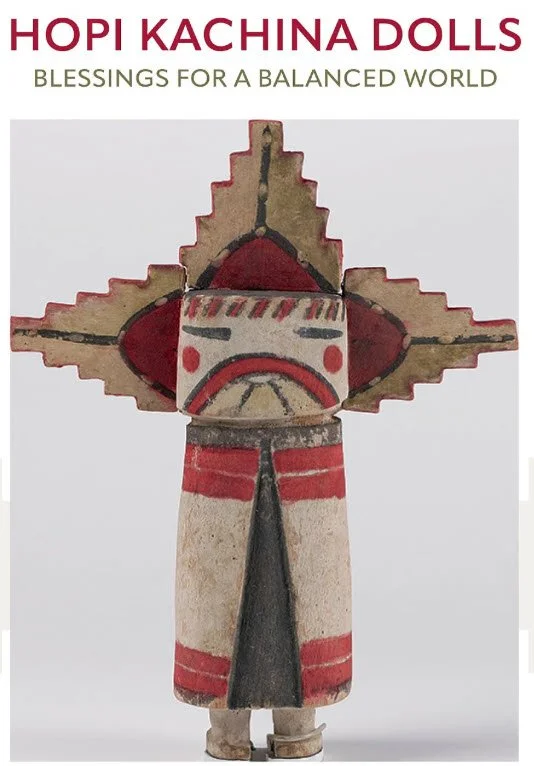
One of the more important Native American art exhibitions of 2026 opens at the Brooklyn Museum on October 2. Hopi Kachina Dolls: Blessings for a Balanced World brings together more than 120 works to reconsider one of the best-known—and frequently misunderstood—forms of Southwestern Native American art.
At the center of the exhibition are 53 Hopi kachina dolls, or tithu, drawn from the Brooklyn Museum's extensive Indigenous collection. They are joined by historic and contemporary baskets, pottery, jewelry, photographs and other works associated with Hopi women and the Katsina tradition. (Brooklyn Museum)
What makes the exhibition unusual is not simply the quality or number of objects. The curators have deliberately shifted the point of view.
Kachinas Seen Through the Women Who Receive Them
Kachina dolls have been collected, studied and marketed outside Hopi communities for well over a century. Much of that literature has concentrated on identifying individual Katsinam, establishing typologies, documenting carving styles and identifying individual carvers.
The Brooklyn exhibition approaches the subject differently. It examines tithu through the experiences of Hopi girls and women—the traditional recipients of the dolls.
Katsinam are ancestral spirits associated with rain, moisture, fertility and maintaining balance in the Hopi world. Tithu representing them are carved principally from cottonwood and traditionally presented to girls and women at significant points in their lives. The exhibition follows that relationship from infancy through adolescence, marriage and adulthood. (Brooklyn Museum)
The result should provide a useful counterpoint to the way kachina dolls have traditionally been viewed in the Western art market: as individual sculptures removed from the social and ceremonial relationships for which they were created.
An Extraordinary Historic Collection
The exhibition also provides an opportunity to revisit one of America's important early museum collections of Native American art.
Much of the Brooklyn Museum's strength in the field resulted from the collecting activities of ethnologist Stewart Culin, the Museum's first curator of ethnology. Between 1903 and 1911, Culin acquired more than 9,000 objects during museum-sponsored expeditions to the Southwest, Northwest Coast, California and Oklahoma.
Those expeditions created particularly strong holdings in Southwest pottery, textiles and elaborately costumed Hopi and Zuni kachina dolls. (Open Collection)
Several remarkable dolls entered Brooklyn during Culin's 1903 and 1904 expeditions, giving the collection considerable documentary as well as aesthetic importance.
One example is a late-19th-century Katsinmana Tihu (Katsina Maiden Kachina Doll) acquired during the Museum Expedition of 1904. Carved from cottonwood and painted with pigment, it retains the comparatively restrained sculptural form characteristic of early examples. (Open Collection)
Another late-19th-century example, identified as Shalako, was also collected during the 1904 expedition and incorporates wood, pigment, string and feather. (Open Collection)
These early collection dates are particularly important today. They place many Brooklyn examples within a documented historical context before the dramatic expansion of the Southwestern tourist and collector market later in the twentieth century.
A Collaboration with Hopi Voices
The exhibition is organized by Colleen Lucero (Hopi), Managing Director of the Hopivewat Learning Center; Nancy Rosoff, Andrew W. Mellon Senior Curator of Arts of the Americas at the Brooklyn Museum; and Dare Turner (Yurok Tribe), the Museum's Curator of Indigenous Art, with curatorial assistant Grace Billingslea. (City Life Org)
The inclusion of contemporary Hopi artists is significant. Rather than treating kachina dolls solely as remnants of a historic religious tradition, the exhibition places older objects alongside the continuing artistic production of Hopi women.
That approach also makes the exhibition relevant to a larger discussion taking place throughout the tribal-art field: How should museums reinterpret historic ethnographic collections assembled more than a century ago while preserving their importance as works of art and historical documents?
Brooklyn's answer appears to be to retain the objects while substantially expanding the voices through which they are interpreted.
The Catalogue
An important accompanying publication should give the exhibition a life well beyond its Brooklyn run.
Nancy B. Rosoff, Dare Turner and Colleen Lucero, eds.
Hopi Kachina Dolls: Blessings for a Balanced World
Brooklyn Museum, 2026
Paperback, 136 pages
Publication date: September 29, 2026
ISBN: 979-8-9931280-4-7
Publisher's list price: $40
The fully illustrated catalogue includes essays by Colleen Lucero, Nancy Rosoff and Dare Turner, contributions by scholars Diane Dittemore and Kelley Hays-Gilpin, and interviews with Hopi artists and cultural leaders. (City Life Org)
The book covers material from the nineteenth century through the present, extending the discussion beyond the historic dolls themselves to contemporary ceramics, basketry and jewelry. (Ayden LeRoux)
Bibliographic listings give a September 29 publication date, 136 pages and ISBN 9798993128047. The stated publisher list price is $40, although retail pricing can vary. (TextbookX)
Why This Exhibition Matters
For collectors and students of traditional Native American art, this is an exhibition worth watching.
Kachina dolls occupy an unusual position in the history of the Native American art market. Early examples can simultaneously be religiously and culturally significant objects, documents of Hopi history, ethnographic records and extraordinary works of sculpture. Later examples also became an important component of the Southwestern art and tourist markets.
Blessings for a Balanced World does not appear designed primarily as a history of collecting or of the commercial kachina market. Instead, it returns attention to the Hopi community and particularly to the girls and women for whom tithu traditionally carried meanings very different from those assigned to them by museums, dealers and collectors.
That makes the exhibition especially interesting.
For more than a century, museums have asked what a kachina doll is, who or what it represents, when it was made, and who carved it.
Brooklyn is adding another question:
What did the object mean to the person for whom it was originally made?
That question does not diminish the importance of connoisseurship, attribution, dating or provenance. It adds another layer to them—and potentially gives us a more complete understanding of these remarkable objects.
Hopi Kachina Dolls: Blessings for a Balanced World opens at the Brooklyn Museum on October 2, 2026.
Collector and Market Implications: When Provenance Matters More Than Appearance
One of the exhibition's greatest contributions is the opportunity to compare historic Hopi kachina dolls with the increasingly sophisticated carvings produced for collectors during the twentieth century and today.
The Brooklyn Museum's holdings include important examples acquired during its 1903–1904 collecting expeditions. These documented objects provide valuable benchmarks for studying early carving conventions, pigments, materials, construction, and ceremonial relationships.
But an important distinction must be made. Commercial production was already developing in the late nineteenth century. Early collection dates do not automatically establish that an object was made exclusively for traditional Hopi use.
For collectors, the central questions are therefore not simply age and artistic quality, but when, where, by whom, and for what purpose was the object made?
Later collector-market carvings can demonstrate extraordinary artistry, sometimes surpassing earlier examples in technical refinement. Their cultural significance and artistic merit should not be dismissed merely because they were made for sale.
Nevertheless, documented early examples and later commercial carvings represent different collecting categories, with potentially significant differences in rarity, provenance, cultural context, and market value.
The exhibition offers a useful reminder that age is not provenance, stylistic appearance is not proof of ceremonial use, and artistic sophistication is not necessarily evidence of antiquity.
For serious collectors and appraisers, the Brooklyn Museum's historic holdings provide an essential comparative foundation. The challenge is to distinguish documented history from attractive assumptions—and to value each object within its actual historical and artistic context.