The Problem of the African “Master”: A Case for Provable Attribution
When does stylistic similarity become historical fact?
The recognition of individual African artists was an important correction to the old assumption that African sculpture was simply the anonymous product of a “tribal style.” But recognizing artistic individuality is not the same as proving that a group of sculptures was carved by one historical individual.
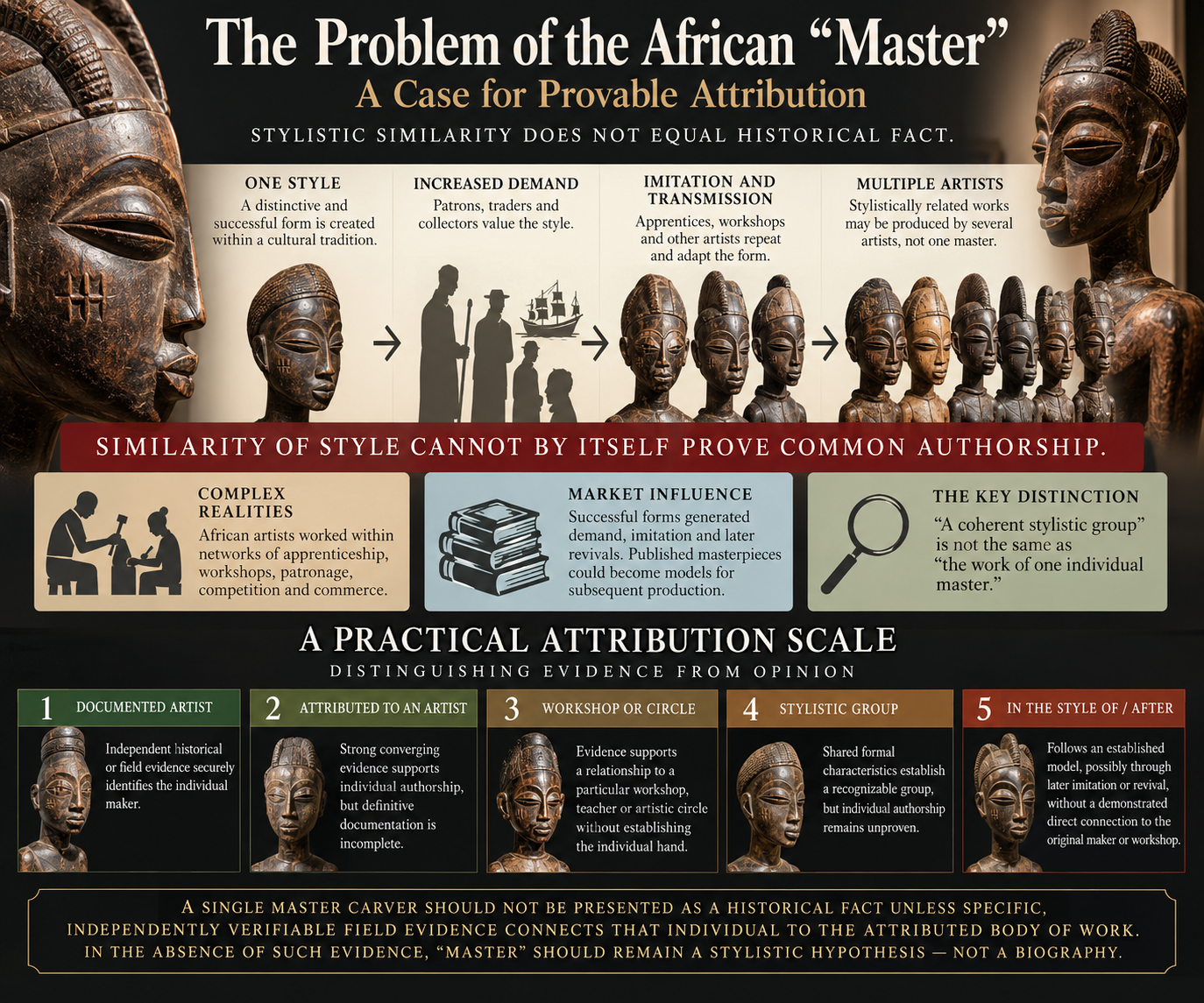
Scholars have identified numerous anonymous “master carvers,” including the Master of Buli, Master of Warua, and Master of the Cascade Coiffure. These attributions generally begin with formal comparisons of eyes, mouths, hands, coiffures, proportions, and carving techniques. Sculptures sharing distinctive characteristics are grouped into a presumed individual oeuvre.
The problem is that stylistic similarity alone cannot establish common authorship.
Six related sculptures might represent one exceptional carver. Equally, they might represent a master and his apprentices, several workshop artists, neighboring sculptors copying a successful prototype, or artists responding to similar patronage and market demands.
Sidney Littlefield Kasfir's scholarship provides an important warning. African artists operated within complex networks of workshops, apprenticeship, patronage, competition, and commerce. Styles were learned, transmitted, adapted, and imitated. The very similarities used to identify a single master may instead demonstrate the success of an artistic tradition.
The Market Complicates Attribution
African sculpture was commodified long before it entered Western collections. Artists responded to patrons, traders, and changing demand. Successful forms encouraged repetition and imitation.
The process is simple:
Successful style → Demand → Imitation → Multiple artists producing similar works.
Western collecting intensified this phenomenon. Once important sculptures were exhibited, published, and celebrated, their characteristics became recognizable and commercially desirable. Published masterpieces could themselves become models for subsequent production.
Consequently, stylistic similarity does not necessarily establish common authorship, workshop proximity, or even chronological proximity.
Attribution Is Not Identification
There is a fundamental difference between two statements:
“These sculptures constitute a coherent stylistic group.”
“These sculptures were carved by one individual master.”
The first may be demonstrated through formal analysis. The second is a historical assertion requiring independent evidence.
Such evidence might include contemporary field documentation, identified artists, documented commissions, photographs of workshops, interviews with artists or their communities, or reliable records connecting particular sculptures to their makers.
Without that evidence, the scholar is constructing an attribution from stylistic characteristics, not identifying a documented historical individual.
This distinction becomes especially important when scholarly hypotheses are repeated in museum catalogues, auction descriptions, and dealer publications. Repetition gradually gives an attribution the appearance of established fact, while the original evidence remains unchanged.
Publication is not proof, and scholarly consensus is not a substitute for historical documentation.
A Practical Attribution Scale
Museums, scholars, auction houses, and dealers would benefit from a consistent vocabulary distinguishing documented authorship from stylistic opinion. The following five-level scale offers a practical approach:
1 Documented Artist - Independent historical or field evidence securely identifies the individual maker.
2 Attributed to an Artist - Strong converging evidence supports individual authorship, but definitive documentation is incomplete
3 Workshop or Circle - Evidence supports a relationship to a particular workshop, teacher, or artistic circle without establishing the individual hand.
4 Stylistic Group - Shared formal characteristics establish a recognizable group, but individual authorship remains unproven.
5 In the Style of / After - The work follows an established artistic model, possibly through later imitation or revival, without a demonstrated direct connection to the original maker or workshop.
These levels describe the strength and nature of the attribution, not artistic quality, authenticity, or market value. A masterpiece may fall within Level 4, while an ordinary sculpture may have a fully documented maker.
The scale also requires a distinction between evidence and opinion. Provenance, technical analysis, dating, and stylistic comparisons can strengthen an attribution, but none should be mistaken for direct proof of individual authorship.
Most importantly, anonymous “Masters” reconstructed solely through stylistic comparisons belong at Level 4, regardless of how frequently their names appear in publications or auction catalogues. Stronger independent evidence may justify a higher classification.
The Burden of Proof
Connoisseurship remains essential to understanding African sculpture. It can identify artistic relationships, distinguish regional traditions, and recognize exceptional craftsmanship. But its conclusions must not be presented with greater certainty than the evidence permits.
Where independent documentation is absent, the appropriate description is “the stylistic group conventionally attributed to the Master of Warua,” rather than treating the Master as a documented historical personality.
This does not deny the existence of exceptional African artists. It acknowledges that workshops, apprentices, imitation, and commercial demand can produce stylistically related works without a single author.
The governing principle should be straightforward:
A single master carver should not be presented as a historical fact unless specific, independently verifiable field evidence connects that individual to the attributed body of work. In the absence of such evidence, “Master” should remain a stylistic hypothesis—not a biography.
The purpose is not to diminish African artistic genius, but to distinguish informed connoisseurship from demonstrable history.
John Buxton | ArtTrak — Traditional Indigenous Art
Inspired in part by Sidney Littlefield Kasfir's scholarship on African artistic production, workshops, patronage, and commodification. The Practical Attribution Scale is a proposed framework, not an established industry standard.