
Mark Rasmussen, November 24, 2026
I’ve spent some of the best hours of my life looking: at patterns in nature, at a carving turning in raking light, at a fossil split open on a riverbank, at a shell I’d seen a hundred times that suddenly showed me something new. I’ve collected art, artifacts, and natural history most of my life, and some of my favorite days are still spent outdoors hunting agates and fossils. I’ve made things too, sculpting my own work, creating paintings, and taking tens of thousands of photographs. And I’ve spent years in authentication and forensic analysis, where looking carefully is the job. Through all of it, the one thing that has never worn out is the pleasure of seeing.
So I’ll start with the claim the rest of this essay depends on: what moves you doesn’t have to be the truth about an object. The record is another matter, and I’ll come to that later. Early on, as a collector, I bought fakes made to appeal to people exactly like me. I enjoyed them for what they were, and finding out what they really were taught me as much as genuine pieces did. That’s part of why my work is built on method, not certainty. The facts about an object matter enormously, and getting them right is my job. But the moment an object speaks to you belongs to you, and learning more should add to that moment, not take it away.
This essay is about protecting that pleasure while you learn, and about how someone who has spent decades looking might help others find it without telling them what to feel.
Light, texture, and touch
I met Henry Moore, Barbara Hepworth, and Naum Gabo in books long before I stood in front of their work. Each kind of encounter had its own joy. The photograph gave me the form. The object gave me scale and weight, and the way it changed as I walked around it.
Then I learned that a sculpture is never the same twice. I stood in one spot and watched a piece change through the day as the shadows moved across it. I saw it dark and glossy after rain, dull again once it dried, and half buried in snow, with the white tracing every curve that could hold it. Once I was given a white-glove tour of the kind usually reserved for blind visitors, where you see with your hands. Surfaces I thought I knew by sight became new under my fingers: the drag of a tool mark, the coolness of polished stone, the place where a curve tightened in a way my eyes had missed.
Light, texture, and touch aren’t extras added on top of seeing. For a sculptor they’re most of it, and a photograph flattens all three. When you can, go and stand in front of the thing, move around it, and come back at another hour. If you’re ever allowed to touch, take the chance. David Finn, who photographed sculpture for decades, makes much the same case in How to Look at Sculpture, urging readers to take in a work from every angle and to look at its surfaces as if with their fingertips (Finn, 1989).
Seeing what isn’t there
What Moore, Hepworth, and Gabo taught me, more than anything, was to see absence. Moore and Hepworth opened the solid, so the hole through a pierced form is as deliberate as the stone around it. Gabo treated space itself as a material and built volumes out of lines and planes that enclose almost nothing. For me as a sculptor, that was a revelation. Negative space, the empty space in and around a form, could have shape of its own, and the hole could be the subject.
This turns out to be the core skill, and it reaches far beyond sculpture. Learning to see negative space is the same discipline as learning to see what’s missing from any account of an object: the gap in a provenance, the ritual the museum label leaves out, the centuries before a document surfaces, the intention of a maker no one can recover. You can’t see past a narrative by pretending it isn’t there. You do it by noticing the shape of what it leaves out.
Nature as teacher
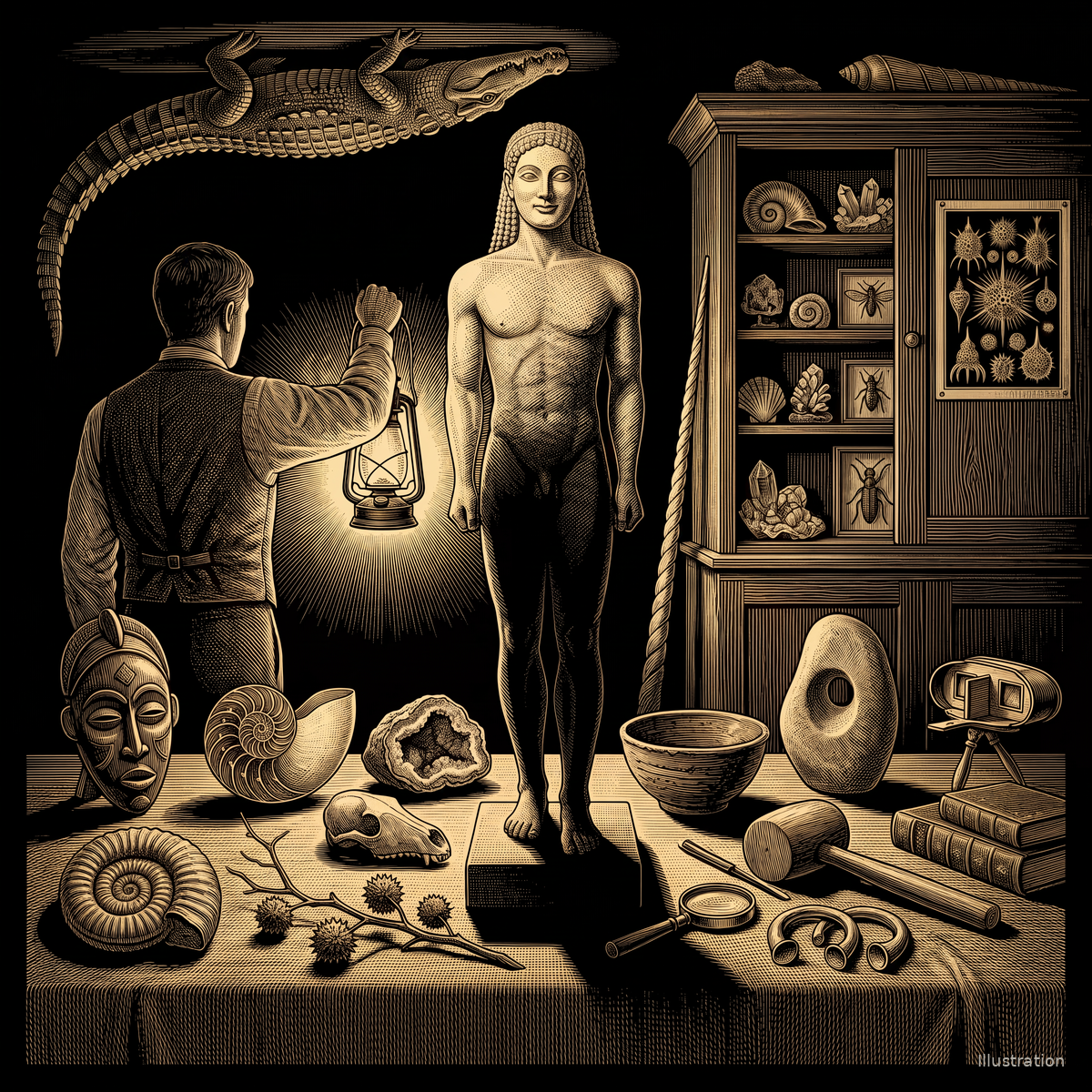
My collection doesn’t stop at art. I keep my own Kunstkammer and Wunderkammer: archaeological material and artifacts, a library, and a large natural history collection of fossils, minerals, skulls, bones, shells, galls, insects, and oddities, chosen for wonder, not spectacle. I also collect studio pottery, including work by potters whose eyes shaped mine: Warren MacKenzie, Randy Johnston, Jan McKeachie Johnston, Guillermo Cuellar, Robert Briscoe, and Dick Cooter. I collect all of it for its beauty, for the way the pieces speak to one another, and for a quality in certain objects that I’ve never been able to name.
Nature is the oldest teacher of form. A skull shows you structure and void working together. A shell’s spiral and a mineral’s crystal habit are pure geometry. An insect gall may be the strangest sculptor of all. A tiny wasp or midge redirects a plant’s own growth into a form the plant would never make on its own: a sphere, a spiky star, a structure that sometimes mimics a fruit or a bud. Cut one open and there’s a hidden architecture inside, chambers built to house and feed the larva, and sometimes other creatures that moved in uninvited. Oak galls also gave Europe its iron gall ink, so the same growth that hid a larva carried centuries of manuscripts and drawings.
Scientific observation can become some of the most wondrous imagery ever made. Ernst Haeckel’s drawings of radiolarians, the subject of David Lebrun’s film Proteus (Lebrun, 2004), are the proof, and Albertus Seba’s eighteenth-century cabinet plates are another (Seba, 2020). Rosamond Purcell has spent a career photographing specimens and old collections, finding beauty in damaged and hard-to-classify things, and Molly Bernstein's film about her work, An Art That Nature Makes: The Work of Rosamond Purcell, is a fine introduction (Bernstein, 2015).
The cabinet of curiosities came before the disciplines that later divided its contents (Impey & MacGregor, 1985). A narwhal tusk sat beside a carving, a shell beside a scientific instrument. The organizing principle was amazement. When I set a fossil beside a mask, I’m not arguing anything about either one. I’m looking at form, surface, and the way time works on material, and each teaches me something about the other.
Juxtaposition and reference
Putting things side by side is the oldest teaching tool in connoisseurship, and one of the great pleasures of collecting. A single object asks you to admire it. A pair asks you to see.
When Picasso, Braque, Derain, and Vlaminck began looking hard at African and Oceanic sculpture, they were reacting to forms that ran on different rules from the European tradition they’d been trained in (Rubin, 1984, 1989). Those forms favored reduction over description and presence over illusion. The artists’ understanding of the cultures behind the objects was often partial or romantic. The impact on their art was real anyway, and that encounter is part of the historical record. The modernists went looking outside the academy in other directions too, most notably toward the art of psychiatric patients, which fed Expressionism and Surrealism in much the same way (MacGregor, 1989).
Two films from the 1989 Picasso and Braque exhibition are good models of guided looking. In one, Rubin himself charts the partnership from 1907 until Braque left for the war in 1914 (Piper, 2007). The other is an hour-long documentary I watched on VHS more times than I can count. It puts Rubin beside David Hockney, Elizabeth Murray, and Frank Gehry, all looking at the same pictures (Philip Morris Companies & Minkoff/Clayman Productions, 1989).
Most collectors start in the same place. You’re drawn by difference, and you stay for quality. After you’ve looked at hundreds of related objects, being unusual stops being enough. Some pieces still feel inevitable, and others start to look decorative or clumsy. That’s where connoisseurship begins. The question shifts from why these objects are different to why this one is great and that one only competent. You learn the answer by comparison:
• a great piece beside a good one
• an original beside a copy
• a tourist piece beside the kind of work it imitates
• a mask beside the Picasso it may have influenced
• a Brancusi beside an anonymous carving
• a shell beside a sculpture
Tourist pieces taught me the first lesson. Many copy the surface vocabulary of older work without understanding what made it work, and set beside the real thing they show how much depended on decisions the copyist never understood. My own hands confirmed it. People assume simple forms are easy to make, and carvers know better. Ornament and elaborate surface can hide a weak decision. In a reduced form, every contour, interval, and volume carries the whole piece, and there’s nowhere to hide.
Brancusi’s Bird in Space is the clearest case I know. Many people see it and think, “That’s simple.” But change the swell of that curve a fraction, let the taper thicken or the flow falter, shift the point where the form gathers itself and rises, and the bird is gone. What’s left is a polished shape. Its presence lives in subtleties you’d struggle to measure: the gesture of the whole, the sense that the form is about to leave the ground. The best African masks and figures work the same way. Their sophistication lies in restraint, proportion, and rhythm, not in accumulated detail. Knowing how hard one committed cut is hasn’t drained my wonder at a great mask. It has multiplied it. That’s my best answer to the fear that knowledge kills joy. Sometimes you understand how much could have gone wrong, and the thing in front of you becomes more astonishing, not less.
Otherness and the word “primitive”
I should be plain about a word that sits under all of this. The modernists called these objects “primitive,” and the 1984 exhibition that taught a generation to look at them put the word in quotation marks for a reason (Rubin, 1984). As a description of people, the word deserves to be retired. But I don’t think we should be embarrassed by the experience it was trying to name, and I don’t think “otherness” is a dirty word either.
Otherness was the catalyst. The modernists weren’t looking for another Vermeer. Europe already had centuries of refined naturalism: perspective, anatomy, illusionistic light. What stopped them was work that ran on different priorities, abstraction over observation, symbolic force over description, reduction over accumulation. If these objects had looked like regional variants of European art, they wouldn’t have changed anything. Being drawn by difference isn’t a failing. It’s how looking begins. The failing is stopping there.
The old word also hides a paradox. Europeans thought the cultures that made these works primitive, while the works themselves were formally sophisticated, and that tension is a large part of why they mattered. Asking whether a great mask is “as sophisticated as” a Vermeer compares unlike achievements. Vermeer’s mastery is observational: he accumulates information. A master carver’s mastery is reductive: the carver eliminates it. Both demand judgment of the highest order. They solve different problems.
Three questions help keep this straight, and each deserves its own answer. What did the modernists believe they were seeing? What were the source cultures and objects actually like? And what did the encounter do to them? The modernists’ answers to the first were often romantic and sometimes simply wrong. That doesn’t change the third. These objects inspired them, but more than that, they stopped them, challenged what they’d been taught, and showed them that a figure could be built from planes and volumes instead of copied from life. Some of them never painted or carved the same way again. Their perception, accurate or not, is part of the historical record, and a weak answer to the second question doesn’t erase what the objects taught them.
The other side of this argument deserves its strongest form, because it isn’t foolish. When the Museum of Modern Art presented tribal and modern works as “affinities” in 1984, Thomas McEvilley answered in Artforum that the show used the objects to tell modernism’s story while saying almost nothing about the people who made them or what the objects meant to them (McEvilley, 1984). James Clifford pressed a related case the following spring (Clifford, 1985). Sally Price added two further points in Primitive Art in Civilized Places (Price, 1989). Her point about anonymous makers is one I take seriously. Naming makers wherever the record allows is part of looking well. Her doubt about a universal eye I’d answer differently: I don’t claim the eye is universal, only that it can be trained, and that its judgments can be tested. Those critiques helped change how museums document and present these objects, and the field is better for much of that change.
My disagreement is about order, not about whether. An argument about context lands best on someone who has already felt why the objects were compelling. The historical sequence ran from encounter to fascination, collecting, comparison, study, and judgment. Too often now it runs backward. The verdict comes first, then the theory and the moral framing, and only then the object, already labeled colonial, appropriated, or problematic. Some of those labels hold real truth, as far as we can know it today, and the same is true of the stories collectors tell. They are still categories, and a category isn’t the same thing as looking. Let the object work first. Then ask the hard questions. They matter more once the object matters to you.
Read afterward
I love reading about art. My library is one of the great pleasures of my life. But for a first viewing, I’ve learned to read afterward.
The reason is simple. Whatever you read first becomes the frame for everything you see. If a label tells you what an object means, you’ll find that meaning, and you may miss what was actually in front of you. Daniel Kahneman spent a career showing how readily first information anchors judgment, and how poorly we notice it happening, even when we know it can (Kahneman, 2011). So give the object your own eyes first. John Berger starts Ways of Seeing from the same place: a child looks and recognizes long before it has words (Berger, 1972). Then read the scholarship, and go back and look again. Reading after looking doesn’t shrink the experience. It’s how a second, richer experience starts.
Reading also restores what time has taken away. Early cinema, the pantomime tradition behind it, and the diableries of 1860s Paris all worked within hard limits. Pantomime had no words, early films ran a few minutes, and a diablerie was a single stereo photograph of sculpted clay skeletons and devils carrying on in hell, hand-colored on the back so it glowed when held to the light. So they spoke in metaphor, symbol, allegory, and the visual shorthand of their day, codes their audiences read instantly. The diableries were also satire aimed at Napoleon III’s Paris, which most viewers today would never guess. Learning those codes brings back jokes and meanings hiding in plain sight.
The loss is also a gift. You get to see these things with eyes no original viewer could have had, and what you take away may be truly yours rather than what a label tells you to think. Both kinds of seeing are worth having.
What knowing costs
Knowledge has a price, and collectors rarely talk about it. The first time I stood before a Hepworth, I wasn’t thinking about direct carving or postwar modernism. I just saw the hole, and everything I said earlier about absence arrived at once. That can’t happen twice. Now I see everything else as well: the conservation, the attribution, the gaps in the literature, the curator’s agenda, the market’s hand, the ghosts of former owners. In a painting I see the pentimenti and the relining, the passages of confidence and the passages of struggle. I see the making as much as the image. The eye gets sharper, and the surprises get fewer.
I wouldn’t trade the library or the decades of looking to get that first moment back. What I miss isn’t ignorance. It’s surprise. This is where the child’s eye matters, though it’s easy to misread. Children see mystery because they know nothing. Experienced collectors see mystery because they finally understand how much can’t be known. One is innocence and the other is discipline. The goal isn’t to return to innocence. It’s to recover openness: to know a great deal and still be surprised. That’s part of why I keep reaching outside my own field, to fossils, shells, and agates, and to work I haven’t studied, where I can still be a beginner.
The heart of the maker
No one can know what was in the heart of an artist. Even when a commission was openly ideological, an altarpiece for the Church, say, centuries can pass before letters, contracts, or conservation findings add to the story, and the next clue may change it again. We can’t know the heart. Sometimes, though, we know the conduct, and that’s a different problem.
The canon is full of artists whose conduct we’d condemn today. Gauguin, by his own account, took Teha’amana, a thirteen-year-old girl he called Tehura in Noa Noa, as his “wife” in Tahiti. Balthus spent much of his career painting young girls in poses that still divide viewers. In December 2017 more than 8,000 people signed a petition asking the Metropolitan Museum of Art to remove his Thérèse Dreaming, and the museum declined (McGivern, 2017). These are documented facts. I don’t think the honest response is to stop looking, and I don’t think it’s to pretend we never learned them. Claire Dederer’s Monsters sits with this dilemma honestly rather than resolving it (Dederer, 2023). Each viewer decides how that knowledge weighs on the work. That decision isn’t mine to make for you.
When an artist’s life troubles us, three questions remain, and they’re separate. Was the person awful? Is the work significant? How should we engage with it now? The first two are often easy. The third usually isn’t, and it gets no easier if we pretend the first answer settles it. Some art makes the question more interesting still. Ivan Albright’s Into the World There Came a Soul Called Ida and the decaying portrait he painted for the 1945 film of The Picture of Dorian Gray, both now at the Art Institute of Chicago, scrutinize flesh, vanity, and decay almost to the point of pathology. Wilde’s premise was that corruption shows up in the hidden portrait, not on the beautiful face, and Albright’s paintings live in that territory. With him, and with Bacon, Schiele, Munch, or Goya’s Black Paintings, much of the artist is already in the work, and knowing the artist can clarify it rather than contaminate it. Nabokov’s Lolita makes a related point. It isn’t an endorsement of Humbert. Its achievement is to show how charm and language can rationalize the indefensible until the reader catches on. Much great art deals with darkness rather than virtue. If every maker must pass a purity test before we look at the work, the canon gets very small. If we pretend biography never matters, we lose something too.
The same holds for objects whose power can’t be separated from their use. Some of the most compelling sculpture in the world was made to act in ritual, not to be admired, and some of those rituals included practices we now find abhorrent. Benin is the clearest case I know. The British punitive expedition of 1897 was a violent act of conquest and looting. The court whose treasures were taken also carried out human sacrifice, though the British accounts of it were partly written to justify the attack, and the scale is disputed. The metal itself carries history too. Chemical analysis has matched the metal of the Benin castings tested to the brass manillas of the early Portuguese trade, most of it from Germany’s Rhineland. Manillas were the currency of a trade that included enslaved people (Skowronek et al., 2023). All of those things are true at once. None of them erases the others, and none of them erases the authority of the objects.
A method for looking
Knowing about bias doesn’t protect you from it. Kahneman admitted that studying these errors did little to improve his own intuitions. His advice is modest: learn to recognize when you’re in a “cognitive minefield,” slow down, and let deliberate thinking take over. He also points out that we spot these mistakes far more easily in other people than in ourselves, and that organizations avoid them better than individuals because they can impose procedures (Kahneman, 2011). His later book Noise, written with Olivier Sibony and Cass Sunstein, turns that idea into a method. Make your own judgment before hearing anyone else’s, break an evaluation into parts, and hold off on the overall verdict until the careful look is done (Kahneman et al., 2021).
For looking at art, the parts come from Betty Edwards’s Drawing on the Right Side of the Brain (Edwards, 2012). The brain science in the title hasn’t held up well. The idea that a logical left brain and an artistic right brain take turns running the show came from early split-brain research and was simplified as it spread. Later work found that both hemispheres take part in nearly everything we do, and a large brain-imaging study found no sign that people are “left-brained” or “right-brained” at all (Nielsen et al., 2013). Edwards herself frames the two as modes of thinking, L-mode and R-mode, wherever they happen to sit in a given brain. None of that touches what makes the book valuable. Her exercises work. They’re still widely taught, and in my experience they offer real insight. What she really taught was a method: stop drawing what you think you see and start drawing what’s actually there. Read the neuroscience as metaphor and keep the method. She taught five perceptual skills, and I’d add two that sculpture demands:
1. Edges. Where forms meet: contour and silhouette. In a reduced form, these carry almost everything.
2. Spaces. The negative space around and through the object.
3. Relationships. Proportion, angle, and interval, which separate the inevitable piece from the clumsy one.
4. Light and shadow. How values reveal volume, and how they change with the hour, the weather, and the season.
5. The whole. How the parts come together into something with presence.
6. Viewpoint. Moving around the object, because sculpture has no single view.
7. Touch. Surface, weight, temperature, and tool marks, when you’re allowed.
In practice it looks like this:
• Look before you read. Cover the label and give it real time.
• Write down what you notice before you form an opinion. The writing is the bias control, because it records your judgment before anyone else’s can anchor it.
• Then read the label and the scholarship.
• Then look again, and notice what has changed and what hasn’t.
• Compare it with something else.
• Come back days later, in different light and a different mood.
• Don’t go looking for reasons to spoil the experience. The hard questions will find you soon enough.
Is the trained eye ever worth trusting? Malcolm Gladwell’s Blink opens with experts who sensed at a glance that the Getty kouros was wrong (Gladwell, 2005). Kahneman and the intuition researcher Gary Klein later worked out when gut judgment earns trust: in settings regular enough to learn, with long practice and honest feedback (Kahneman & Klein, 2009). Connoisseurship meets those conditions some of the time, which is why it sometimes fails. The kouros itself turns out to be a much harder case than Blink makes it look, and I’ll come back to it.
That leads to the difference between what I can test and what I believe. These claims can be tested, and I’d welcome the test:
• Labels change what people see.
• Comparison sharpens the eye.
• Knowledge can deepen a response instead of flattening it.
If the trained eye is worth anything, experts should agree more often than chance, and their judgments should hold up against technical evidence. Sometimes they don’t, and I’ve been among the people fooled.
Other things here are convictions, and I’ll call them that. I believe wonder should come before judgment. I believe art can speak beyond the circumstances that made it. I believe an interpretation the artist never intended can still be valid. I believe reduced forms are harder to make well than elaborate ones. My hands tell me so, but that’s a carver’s conviction, not a tested result. You don’t have to share these beliefs, but I’d rather state them plainly than slip them in as facts.
Real, altered, and fake
In 1985 the J. Paul Getty Museum bought a virtually complete, over-life-size Greek kouros, a standing youth in the Archaic style of the sixth century BC. When it went on display in the fall of 1986, it caused a sensation, and the doubters were as loud as the admirers. Thomas Hoving, the former director of the Metropolitan Museum of Art, was among the loudest. His False Impressions is a gleeful tour of fakes and the people who catch them, and the kouros gets a chapter of its own (Hoving, 1996). The archaeological scientist Paul Craddock covers the same case far more soberly in Scientific Investigation of Copies, Fakes and Forgeries. He calls Hoving’s account the more interesting read, but his own is the better lesson in how hard the question really is (Craddock, 2009, pp. 261–263).
The paperwork was false. A letter supposedly written in 1952 by a leading German scholar was on notepaper printed with a postal code that wasn’t introduced until 1972. That’s damning for the paper trail, and it’s tempting to treat it as damning for the statue too. It isn’t. Forged documents prove that someone lied about where an object came from, not who carved it or when. A genuine antiquity that was looted needs a clean-looking history just as badly as a fake does, and forged provenance is a common way to manufacture one. The record cuts the other way as well. A curator at the Geneva museum had seen a photograph of a kouros in the supposed collector’s possession, so he may really have owned one. The open question is whether it was this one (Craddock, 2009, p. 262).
A smaller kouros torso that turned up in Switzerland was an obvious forgery, and rumor said both had been cut from the same block by the same forger. That rumor was tested and failed: the marbles and the surfaces were entirely different. Years of work on the statue’s surface never settled anything either. The crust first described as ancient weathering turned out to be mostly calcium oxalate, a deposit that experiments showed is reasonably easy to build up artificially, yet the Getty’s own team couldn’t produce one that matched the kouros. Then Craddock adds the sentence I’d underline. Even if the crust were shown to be artificial, “this would not automatically condemn the piece as it could have been cleaned” (Craddock, 2009, p. 263). For years the museum’s own label read “Greek, about 530 B.C., or modern forgery” (Trafficking Culture, n.d.).
That last point is the one I keep coming back to. I leave room for several campaigns of alteration in the life of an object, because I’ve seen it happen. I’ve seen real objects altered and re-altered, cleaned, conserved, and restored, each campaign leaving the surface a little less like itself. I’ve seen provenance muddied the same way and then repeated in print until it looked settled. A genuine object handled like that can end up looking wrong. Craddock gives examples. The Fuller Brooch, a Late Saxon silver brooch now in the British Museum, was once dismissed as a forgery because it had been over-cleaned. The medieval Courtrai Chest was rejected as a nineteenth-century copy after its worn carving was recut. An ancient Egyptian gold headdress looked so modern after heavy polishing that it was suspected, until thermoluminescence dating of core material surviving inside showed that it was old (Craddock, 2009, pp. 502–504).
Age doesn’t settle the question either. Most of the work of the great Greek sculptors is known to us only through Roman copies (Craddock, 2009, p. 242). They’re ancient and real, and they still aren’t Greek. Craddock notes that they don’t seem to have been made to deceive, though Hoving argued that most of the so-called archaizing pieces were deliberate deceptions (Craddock, 2009, pp. 1, 242). The copies also vary, because their carvers made their own aesthetic choices, and a copy carries its maker’s eye as well as its model’s design.
So I don’t think of real and fake as a switch. There’s a range: carved new; ancient but recut or completed by a restorer; ancient but stripped and repatinated; ancient but not what the label says. Craddock’s description of Italy in the eighteenth and nineteenth centuries as the main source of “reality, restored reality, pastiche, fake and outright forgery” covers most of it (Craddock, 2009, p. 242).
Photography sits on the same range. One of the most famous Civil War photographs, The Home of a Rebel Sharpshooter, published by Alexander Gardner, was staged. Gardner and his assistant Timothy O’Sullivan had already photographed the dead soldier where they found him on a nearby slope. They then moved the body more than forty yards to a more dramatic spot among the rocks of Devil’s Den, set a rifle beside it, and O’Sullivan made the picture the world remembers (Gardner & O’Sullivan, 1863). The deception went unnoticed for nearly a century. A Civil War Times article pointed out in 1961 that the same body appears in another of the Gettysburg photographs, and the historian William Frassanito worked out the whole sequence in 1975 (Frassanito, 1975). Postmortem portraits were posed with care, too. None of that cancels the weight of those images. A staged war photograph can still carry the horror of a war, and a posed memento mori is still a reminder of death. Truth and significance aren’t the same thing.
What makes this so hard to correct is what I’ve called the Authority Cascade (Rasmussen, 2026). Once respected voices give a verdict, it gets repeated, and each repetition makes it look stronger. Repetition changes perception. It doesn’t change the evidence. A real object wrongly called a fake can stay condemned long after the evidence should have reopened the question, and a fake that slipped through can be cited for generations.
The worst damage happens in the reference collection. Craddock points out that a stylistic judgment is a comparison against “a canon of genuine pieces” (Craddock, 2009, p. 2). If fakes have slipped into that canon, every comparison inherits the error, and the next fake is easier to accept because the last one already moved the line. He gives a small, clear case. A hoard of about 300 Roman brooches found at Pyrmont in Germany in 1863 was copied for sale to visitors almost at once, and the 1869 publication of the hoard almost certainly included some of the copies (Craddock, 2009, p. 4). Anyone comparing against that publication starts from a tainted set.
All of this makes me more careful, not less curious. People sometimes mistake that kind of skepticism for cynicism, but it’s the opposite. A cynic says nobody can know anything. An investigator says let’s find out what can actually be known. What looks fake may be real and badly treated, and what looks real may be a fake that’s been in the books for a century. I hold my conclusions about any single object more loosely than my methods for reaching them. Oddly, that makes looking more interesting, because the object is never quite finished telling you what it is.
Lending someone your eyes
My best teachers and friends never told me what to think. They told me to look. Among them were Dr. Barbara Blackmun, John Buxton, Tom Chase, Ellen Howe, Jim Longman, Dr. Roy Sieber, and Bruce Stottrup. They’d put two things side by side, ask what I noticed, and then ask me to look again. Their lessons didn’t come with baggage, or with reasons I shouldn’t enjoy something new. They protected that first childlike response and helped me build on it.
That’s what I’m trying to do here and in what I’ll publish after this. When I tell you how a piece made me feel, it isn’t an instruction. It’s one viewer’s account, offered so yours can be richer. A good guide points rather than answering for you.
Further looking and reading
These sources pull against each other, and that’s the point. Each is right about a different part of looking, and none of them gets the last word. Full citations follow in the references.
• Wonder before categories: Bernstein (2015), Impey and MacGregor (1985), Lebrun (2004), and Seba (2020).
• The mechanics of seeing: Edwards (2012) and Finn (1989).
• Bias and method: Kahneman (2011), Kahneman et al. (2021), Kahneman and Klein (2009), and Gladwell (2005).
• Fakes, alteration, and the record: Craddock (2009), Frassanito (1975), Hoving (1996), Lowenthal (2015), and Rasmussen (2026).
• Lineage and influence: Gombrich (1950/1995), Rubin (1984, 1989), Piper (2007), Philip Morris Companies and Minkoff/Clayman Productions (1989), and MacGregor (1989).
• The critique: Clifford (1985), McEvilley (1984), and Price (1989).
• Quality and ideology: Florczak (2025) and Berger (1972).
• The artist and the art: Dederer (2023).
Where I stand
My moral stand is a simple one. Be open to seeing and learning, and accept that you’ll never know the full truth of anything. Everything is seen through a lens. Time corrects some errors and introduces others, and its corrections are only true for their own moment. Knowledge is imperfect, temporary, and always open to revision.
I don’t like censorship. I also understand that openness can cause real harm and distress, to others and to the viewer, and I don’t ignore that. Many things can hold at the same time, even things that pull in opposite directions, and how we read them is always colored by the present and informed by the past.
There’s one place where my own advice has limits, and I want to name it. Everything I’ve said about personal response, and about readings the artist never intended, belongs to the viewer. It doesn’t apply to an object’s job as evidence. When a museum keeps an object as a historical document, it owes the public the most accurate account of the past that current knowledge allows: what the thing is, where it came from, what has been done to it, and what remains unknown. Freedom of response belongs to the person looking. Accuracy belongs to the record. I also accept that the record will never stand still. David Lowenthal showed how the past is continually reshaped by the people who study, preserve, and display it, so what we know of it is always provisional and always at some risk (Lowenthal, 2015). That isn’t a reason to give up on accuracy. It’s a reason to label what’s known, what’s inferred, and what’s guessed, and to keep the record open to correction.
What I hope for is bigger than any one object. I hope you’ll find what I found: the world is full of things worth looking at, and seeing is a skill you can keep sharpening for the rest of your life. If you aren’t sure where to start, start with nature. A nautilus shell, a radiolarian, a split geode, the gall a tiny wasp coaxes out of an oak: each is hard to beat for sheer beauty, and most ask for nothing but attention. Then carry what they teach you about form, light, and surface to every carving, painting, and photograph you meet. Look first, from every side and in every light, with your hands when you can. Set things side by side. Read everything, then go back and look again. Let what you learn make the wonder larger, not smaller. Your reading of a work can be your own, even when the artist meant something else. And when you find the part no one has explained yet, the part that keeps pulling you back, trust it. That’s where seeing begins, and it never has to end.
© 2026 Mark Rasmussen. All rights reserved.
References
Berger, J. (1972). Ways of seeing. British Broadcasting Corporation; Penguin.
Bernstein, M. (Director). (2015). An art that nature makes: The work of Rosamond Purcell [Film]. Particle Productions.
IMDb: https://www.imdb.com/title/tt5797134/
Clifford, J. (1985). Histories of the tribal and the modern. Art in America, 73(4), 164–177, 215.
Craddock, P. (2009). Scientific investigation of copies, fakes and forgeries. Butterworth-Heinemann.
Dederer, C. (2023). Monsters: A fan’s dilemma. Alfred A. Knopf.
Edwards, B. (2012). Drawing on the right side of the brain (Definitive 4th ed.). Tarcher/Penguin.
Finn, D. (1989). How to look at sculpture. Harry N. Abrams.
Florczak, R. (2025). Good art/bad art: A guide to judging quality. Skyhorse.
Frassanito, W. A. (1975). Gettysburg: A journey in time. Charles Scribner’s Sons.
Gardner, A., & O’Sullivan, T. H. (1863, July 6). The home of a rebel sharpshooter, Gettysburg [Photograph 165-SB-41; National Archives Identifier 533315; exposure by O’Sullivan, published by Gardner]. U.S. National Archives, DocsTeach.
https://www.docsteach.org/documents/document/rebel-sharpshooter
Gladwell, M. (2005). Blink: The power of thinking without thinking. Little, Brown and Company.
Gombrich, E. H. (1995). The story of art (16th ed.). Phaidon. (Original work published 1950)
Hoving, T. (1996). False impressions: The hunt for big-time art fakes. Simon & Schuster.
Impey, O., & MacGregor, A. (Eds.). (1985). The origins of museums: The cabinet of curiosities in sixteenth- and seventeenth-century Europe. Clarendon Press.
Kahneman, D. (2011). Thinking, fast and slow. Farrar, Straus and Giroux.
Kahneman, D., & Klein, G. (2009). Conditions for intuitive expertise: A failure to disagree. American Psychologist, 64(6), 515–526.
DOI: https://doi.org/10.1037/a0016755
Kahneman, D., Sibony, O., & Sunstein, C. R. (2021). Noise: A flaw in human judgment. Little, Brown Spark.
Lebrun, D. (Director). (2004). Proteus: A nineteenth century vision [Film]. Night Fire Films.
IMDb: https://www.imdb.com/title/tt0391407/
Lowenthal, D. (2015). The past is a foreign country – revisited. Cambridge University Press.
MacGregor, J. M. (1989). The discovery of the art of the insane. Princeton University Press.
McEvilley, T. (1984). Doctor, lawyer, Indian chief: “Primitivism” in 20th century art at the Museum of Modern Art in 1984. Artforum, 23(3), 54–61.
McGivern, H. (2017, December 5). The Met decides not to pull ‘sexually suggestive’ Balthus painting after petition signed by thousands. The Art Newspaper.
Nielsen, J. A., Zielinski, B. A., Ferguson, M. A., Lainhart, J. E., & Anderson, J. S. (2013). An evaluation of the left-brain vs. right-brain hypothesis with resting state functional connectivity magnetic resonance imaging. PLoS ONE, 8(8), e71275.
DOI: https://doi.org/10.1371/journal.pone.0071275
Philip Morris Companies & Minkoff/Clayman Productions (Producers). (1989). New ways of seeing: Picasso, Braque, and the cubist revolution [Film; VHS].
https://www.moma.org/docs/press_archives/6717/releases/MOMA_1989_0084_88.pdf
Piper, T. (Director). (2007). William S. Rubin on Picasso and Braque: Pioneering cubism [Film lecture]. Museum of Modern Art; Checkerboard Film Foundation. (Original lecture recorded 1989)
https://checkerboardfilms.org/films/show/n/picasso-and-braque/
Price, S. (1989). Primitive art in civilized places. University of Chicago Press.
Rasmussen, M. (2026). Authority cascade: When authority begins to outpace evidence (Version 1.0).
Rubin, W. (Ed.). (1984). “Primitivism” in 20th century art: Affinity of the tribal and the modern (Vols. 1–2). Museum of Modern Art.
Rubin, W. (1989). Picasso and Braque: Pioneering cubism. Museum of Modern Art.
Seba, A. (2020). Cabinet of natural curiosities (I. Müsch, J. Rust, & R. Willmann, Eds.). Taschen. (Original work published 1734–1765)
Skowronek, T. B., DeCorse, C. R., Denk, R., Birr, S. D., Kingsley, S., Cook, G. D., Benito Domínguez, A. M., Clifford, B., Barker, A., Otero, J. S., Moreira, V. C., Bode, M., Jansen, M., & Scholes, D. (2023). German brass for Benin Bronzes: Geochemical analysis insights into the early Atlantic trade. PLoS ONE, 18(4), e0283415.
DOI: https://doi.org/10.1371/journal.pone.0283415
Trafficking Culture. (n.d.). Getty kouros.