Whitehawk Santa Fe 2026
The Show Was Big. Its Public Footprint Was Not.
The 2026 Whitehawk Antique Indian & Ethnographic Art Show was a substantial event: more than 130 exhibitors, thousands of objects and more than 40,000 square feet of exhibition space at the Santa Fe Community Convention Center. Now in its 48th year, Whitehawk remains one of the largest specialist gatherings for historic Native American and international ethnographic art in the United States.
What we cannot establish from the public record is how well the 2026 show performed commercially.
I have not found published 2026 figures for total attendance, dealer sales, first-time visitors, strongest price ranges or exhibitor satisfaction. Without those numbers, calling Whitehawk 2026 either a commercial success or failure would be speculation.
What we can evaluate is its public footprint.
The Promotion Did Not Match the Scale of the Show
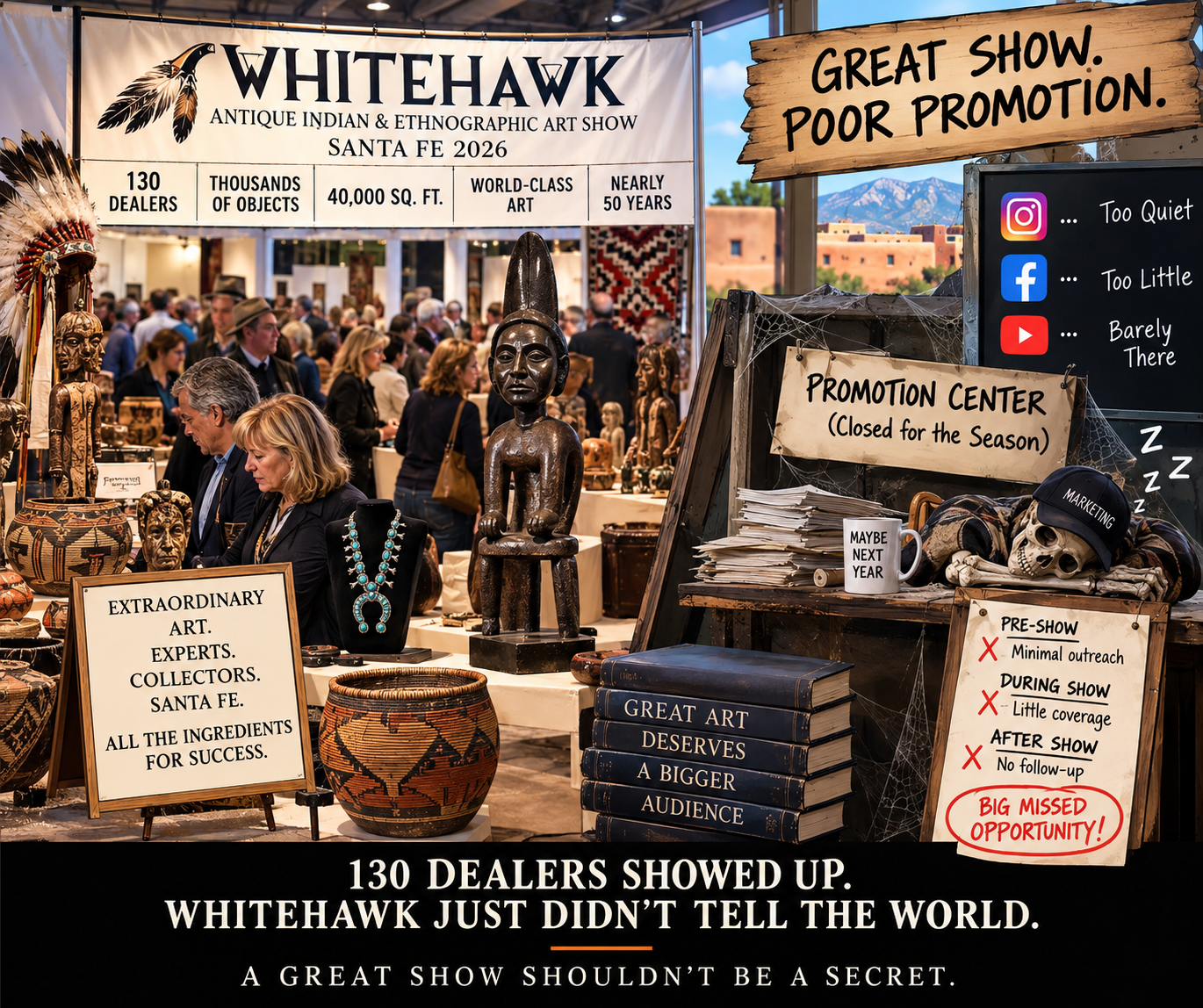
Whitehawk did promote the 2026 event. It issued press releases, received outside coverage and was promoted by ATADA and Santa Fe tourism organizations. Southwest Contemporary published a substantial preview highlighting the show's more than 130 exhibitors, 40,000-plus square feet and two special exhibitions.
But Whitehawk's own press archive currently identifies only three 2026 media appearances or articles: Southwest Contemporary, Hali and the Richard Eeds Show. Its 2025 archive lists six.
That comparison does not capture every Instagram post, dealer mailing, YouTube video or social-media mention. It does establish that Whitehawk's own documented press record for 2026 was limited relative to an event of this size.
The larger digital footprint is also difficult to find. Searches for Whitehawk 2026 produce event listings, press releases, dealer announcements and some social-media material, but relatively little sustained video coverage, dealer interviewing, object-based programming or post-show reporting.
For more than 130 exhibitors gathered for four days, that is a missed opportunity.
The Dealers Supplied the Content
Whitehawk did not have a shortage of material to promote.
Its exhibitors supplied thousands of objects and an unusual concentration of specialist knowledge. The show included The First Moderns, an exhibition of Navajo Germantown weavings, and Heritage: A Legacy of Tradition, devoted to Australian Aboriginal art.
Every dealer represented a potential story. Every booth contained objects that could have been photographed, discussed and explained.
A coordinated pre-show campaign could have been straightforward:
130 Dealers. 130 Objects. 130 Stories.
One object from each dealer. One short explanation of what it is, why it matters and what collectors should understand about it.
During the show, Whitehawk could have produced short dealer interviews, exhibition walkthroughs and daily object discussions. The resulting material could have been distributed through Whitehawk's channels and amplified through the participating dealers' own networks.
That would have promoted the fair while also educating potential collectors.
2025 Shows What Was Possible
The comparison with 2025 is particularly useful because Whitehawk and ATADA previously provided information that allowed the market to assess the event.
ATADA reported approximately 3,500 attendees in 2025, a 20 percent increase over the previous year. It reported record opening-night attendance and quoted producer Kim Martindale saying that more young people attended and that dealers reported very good sales.
ATADA also published dealer observations about specific areas of the ethnographic market. Dealers discussed sales of Tibetan, Polynesian, Melanesian, Asian and African material, including renewed demand for Ashanti gold weights.
Those reports were not audited market statistics. They were organizer and dealer accounts. But they gave collectors and exhibitors information about what happened.
I have not found comparable public reporting for 2026.
That is significant because the absence of information prevents us from answering basic questions about the show.
Was attendance above or below 3,500? Did the increase in younger visitors continue? How many dealers made sales? Which price ranges were active? Which categories performed well?
Those are questions Whitehawk could answer without disclosing individual dealer transactions.
Publish the Numbers
Whitehawk should conduct an anonymous post-show dealer survey and publish the results.
Report attendance separately. Report how many dealers responded to the survey. Ask whether they made sales, whether business was stronger or weaker than the previous year, which price ranges were active and whether they intend to return.
That would give the market evidence instead of impressions.
Crowded aisles are not sales data. More than 130 exhibitors demonstrate the scale of Whitehawk; they do not establish the strength of collector demand.
The distinction is important in a specialist market where reliable public data are limited.
Why This Matters to the Dealers
The exhibitors provide the inventory and expertise that make Whitehawk possible. They commit objects, personnel, travel, preparation and several days of their time to participate.
They therefore have a legitimate interest in Whitehawk developing the largest audience it reasonably can.
Today that audience extends far beyond the people who walk through the Santa Fe Convention Center.
A collector in Dallas, New York, Los Angeles, London or Paris should be able to encounter Whitehawk online, watch specialists explain objects, see what distinguishes the show and decide that Santa Fe is worth attending the following year.
That is not simply publicity. It is collector development.
Whitehawk Already Has the Difficult Part
Whitehawk has more than 130 exhibitors. It has thousands of objects. It has specialist knowledge, important exhibitions, Santa Fe and 48 years of history.
Those are the difficult assets to assemble.
The opportunity is to use them more effectively.
Build anticipation before the show. Document the people, objects and knowledge during it. Publish meaningful information afterward. Keep the strongest material circulating throughout the year.
None of this requires us to speculate about whether Whitehawk 2026 succeeded or failed commercially.
The evidence supports a narrower conclusion:
Whitehawk 2026 was a large and important specialist show whose documented media footprint and publicly available post-show reporting did not match the scale of the event.
For the dealers who committed their resources to participate, Whitehawk should aim higher.
The show already has the content. It needs to do more to build the audience.
This version is safer under your review standard because every important distinction is explicit. Whitehawk's scale is independently documented by both the organizer and outside coverage. (Santa Fe) Its own exhibitor page confirms the extensive 2026 roster. (Whitehawk - One Show…Endless Treasures) And the 2025 attendance and sales statements are expressly attributed to ATADA rather than presented as independently audited market data. (ATADA.org)
I would not soften the criticism beyond this. The original article's concern about promotion is defensible; the important change is that we now criticize the documented promotional and reporting performance, rather than claiming facts about Whitehawk's commercial performance that we don't possess. This is exactly the evidence discipline required by your publication prompt.